
A clutch problem rarely arrives with a neat label telling you exactly which part has failed. You may notice the engine revving without the car accelerating properly, a biting point that feels unusually high, difficulty selecting a gear or a pedal that suddenly feels heavy. These symptoms matter, but they do not automatically mean the entire clutch assembly needs replacing.
The clutch works alongside the gearbox, hydraulic system, release mechanism and, on many vehicles, a dual-mass flywheel. A leak from a slave cylinder can create symptoms that feel like clutch failure. A worn release bearing can make noise without the friction plate slipping. Gear-selection trouble may come from the linkage or gearbox rather than the clutch itself. Accurate diagnosis is therefore the first step towards an appropriate repair.
If you are looking for clutch repair Milton Keynes support, MK12 Autocare can inspect the vehicle at its Stacey Bushes workshop. The aim is to identify the actual fault, explain the available options and provide an itemised quote before authorised work begins. That approach is more useful than replacing expensive components based on a symptom alone.
This guide explains the warning signs, common causes, diagnostic process, repair options and factors that influence clutch repair Milton Keynes cost. It also covers when you should stop driving and what information to provide when arranging an inspection.
When Does a Clutch Need Repair or Replacement?
A clutch does not have one universal replacement interval. Its life depends on vehicle design, traffic conditions, load, driving technique and how much time the car spends starting, stopping or manoeuvring. A motorway vehicle may place different demands on the clutch from a car used mainly in slow urban traffic.
Some symptoms develop gradually, which makes them easy to overlook. You may adapt to a rising biting point or heavier pedal without realising how much it has changed. Comparing the current behaviour with the way the vehicle normally feels can help you recognise a developing problem.
Clutch Slipping During Acceleration
Clutch slip happens when the engine produces power but the clutch cannot transfer it effectively to the gearbox. The engine speed may rise sharply while road speed increases slowly, particularly in a higher gear, on an incline or during stronger acceleration.
Slip commonly indicates worn or contaminated friction material, but testing is still important. Continuing to drive can generate additional heat and damage the pressure plate or flywheel, turning a manageable repair into a more expensive job.
High Clutch Biting Point
The biting point is where the clutch begins to engage as you release the pedal. A noticeably high biting point can be associated with wear, especially when it appears alongside slip, poor acceleration or a burning smell.
However, biting-point position varies between vehicles and can also be influenced by cable adjustment or hydraulic operation. It is more useful to assess how the biting point has changed than to judge it against another car.
Difficulty Selecting Gears
If the clutch does not disengage fully, selecting first gear or reverse may become difficult while the engine is running. Gear changes can feel stiff, and the vehicle may try to creep forward even when the clutch pedal is fully depressed.
Similar symptoms can come from low hydraulic fluid, air in the system, a failing cylinder, damaged linkage or an internal gearbox fault. Forcing the gear lever can cause further damage, so arrange an inspection rather than treating extra force as a solution.
Juddering When Moving Away
Clutch judder feels like vibration or shuddering as the clutch begins to engage. It is often most noticeable when moving away from a standstill, reversing, climbing a hill or manoeuvring at low speed.
Possible causes include uneven friction surfaces, contamination, damaged engine or gearbox mounts and flywheel wear. Because several components can produce a similar sensation, the condition of the complete installation needs to be considered.
Burning Smell After Driving
A sharp burning smell after hill starts, heavy traffic or repeated manoeuvring may indicate excessive clutch heat. The smell can occur when the friction surfaces slip rather than locking together efficiently.
One brief episode does not prove that every clutch component has failed, but repeated smell, smoke or loss of drive needs prompt attention. Stop using the vehicle if the smell becomes strong or the clutch no longer transfers power reliably.
Heavy, Sticking or Spongy Clutch Pedal
A heavy pedal may be related to a stiff cable, pressure-plate mechanism, release bearing or linkage. A pedal that sticks down can indicate hydraulic failure or a problem within the release system.
A soft or spongy pedal often points towards air, leakage or insufficient fluid in a hydraulic system. These faults may be repairable without replacing the friction plate, which is why diagnosis should come before ordering a complete clutch kit.
Common Causes of Clutch Problems
The clutch assembly contains several working parts, and each can fail differently. Some faults affect power transfer, while others affect pedal movement, disengagement or noise. Treating every complaint as a worn friction plate can lead to unnecessary work and leave the original fault unresolved.
The technician should consider the symptoms, vehicle history and results of mechanical checks together. If gearbox removal is needed, related components can be examined directly before the final repair scope is confirmed.
Worn Clutch Friction Plate
The friction plate is designed to grip the flywheel and pressure plate. Its friction material gradually wears through normal use, much like brake-pad material, although the operating conditions and replacement process are different.
When the material becomes too worn, the plate may slip under load. Heat can then accelerate deterioration, so early assessment is sensible when rising engine speed no longer produces matching acceleration.
Damaged Pressure Plate
The pressure plate clamps the clutch disc against the flywheel. If its spring mechanism weakens, distorts or becomes damaged, clamping force can become inconsistent and the clutch may slip or engage unevenly.
Pressure-plate problems can also affect pedal feel and release operation. Because it works directly with the friction disc, it is normally assessed as part of the clutch assembly rather than as an isolated symptom.
Worn Release Bearing
The release bearing allows the clutch mechanism to disengage when you press the pedal. Wear may produce a whirring, rumbling or grinding noise that changes when the pedal is pressed or released.
Noise behaviour can provide a clue, but it is not a final diagnosis. Gearbox bearings and dual-mass flywheels can make related sounds, so a technician should compare the noise with pedal position and vehicle operation.
Clutch Cable or Adjustment Problems
Some vehicles use a cable to operate the clutch. The cable can stretch, become stiff, fray or lose its correct adjustment, creating a heavy pedal, poor disengagement or an unusual biting point.
Where the cable is the actual cause, replacement or adjustment may restore normal operation without a full clutch replacement. The surrounding pedal mechanism and release arm should also be checked for resistance or damage.
Master or Slave Cylinder Failure
Hydraulic clutch systems commonly use a master cylinder at the pedal and a slave cylinder near or inside the gearbox. Worn seals or leakage can prevent the system from generating enough movement to disengage the clutch.
Symptoms may include a soft pedal, low fluid, fluid leakage, inconsistent engagement or a pedal that stays near the floor. An internal concentric slave cylinder may require gearbox removal, so its location affects labour and repair planning.
Oil Contamination Inside the Clutch Housing
Engine oil or gearbox oil can reach the clutch through a failing seal. Once the friction material is contaminated, the clutch may slip or judder even if the disc has not reached its normal wear limit.
Replacing only the contaminated clutch without correcting the leak risks repeating the problem. The source of contamination must be identified, and the relevant seal or related component should be included in the repair plan where necessary.
How MK12 Autocare Diagnoses a Clutch Fault
Good diagnosis begins with a clear description of the problem. When did the symptom begin? Does it happen when the vehicle is cold, hot, loaded, reversing or climbing? Has the pedal feel changed? Details like these help the technician reproduce the fault safely.
The inspection may include a road test, pedal assessment, hydraulic checks and examination of accessible components. Some internal conditions cannot be confirmed until the gearbox has been removed, and a responsible quote should make that limitation clear.
Road Test and Clutch Engagement Assessment
During a controlled road test, the technician can assess biting-point behaviour, clutch engagement, gear selection, vibration and abnormal noise. The test is adapted to the vehicle’s condition and should not involve deliberately stressing a severely failing clutch.
The technician may also compare symptoms during acceleration, deceleration and low-speed manoeuvring. This helps separate clutch behaviour from engine performance, drivetrain movement and gearbox operation.
Checking Clutch Slip Under Controlled Load
Clutch slip is usually evaluated by observing how engine speed and vehicle speed respond under suitable driving conditions. A rise in engine speed without proportional acceleration is a strong indication that power transfer is being lost.
The test should be controlled and stopped if the clutch overheats or the vehicle becomes unsafe. Repeated aggressive testing can worsen damage and is unnecessary when the symptoms are already clear.
Inspecting the Hydraulic System
The hydraulic system can be checked for fluid level, visible leaks, damaged lines and inconsistent pedal pressure. Air in the circuit or a leaking seal may prevent the clutch from disengaging correctly.
Fluid loss also needs a cause. Simply topping up the reservoir does not repair a leaking master cylinder, slave cylinder or line, and continued leakage may lead to sudden loss of clutch control.
Checking Master and Slave Cylinders
The master cylinder is assessed around the pedal and hydraulic connections, while the slave cylinder is checked according to its location. External slave cylinders may be easier to inspect than concentric units fitted inside the bellhousing.
If an internal slave cylinder is leaking, gearbox removal may be required. When labour overlaps with clutch replacement, the technician may recommend addressing related worn parts during the same operation.
Gearbox and Gear-Selection Checks
Difficulty selecting gears does not always begin with the clutch. The linkage, cables, gearbox oil, mounts and internal transmission components can influence the way a gear engages.
Checks help determine whether the clutch is failing to disengage or the gearbox has a separate problem. This distinction is essential because replacing the clutch will not correct damaged synchromesh or a faulty selector mechanism.
Identifying Flywheel or Release-Bearing Noise
The technician listens for changes as the clutch pedal is pressed, held and released. Noise that changes with pedal position can help narrow the investigation towards the release bearing, gearbox input area or flywheel.
However, sound can travel through the drivetrain and body. Final confirmation may require dismantling, especially when the noise is intermittent or several worn components are present at the same time.
Clutch Repair vs Complete Clutch Replacement
The phrase “clutch repair” covers more than one type of work. A vehicle may need a hydraulic cylinder, cable, linkage component or complete clutch kit. The correct option depends on which part has failed and whether related components remain serviceable.
An inspection should separate external operating faults from wear inside the clutch housing. This prevents a relatively small hydraulic problem from being treated as a full clutch failure, while also avoiding incomplete repairs when the friction assembly is genuinely worn.
When a Hydraulic Repair May Solve the Problem
If the clutch disc grips properly but the pedal is soft, inconsistent or slow to return, the problem may be within the hydraulic system. A leaking master cylinder, slave cylinder or pipe can reduce the movement needed to disengage the clutch.
Replacing the failed hydraulic component and bleeding the system may restore correct operation. The clutch itself should still be assessed, particularly if leakage has been present for a long time or the slave cylinder sits inside the bellhousing.
When a Cable Replacement Is Sufficient
On a cable-operated system, stiffness, fraying or excessive stretch can change pedal effort and clutch movement. If the friction assembly remains healthy, a new cable or correct adjustment may resolve the complaint.
The pedal mechanism, mounting points and release arm should be inspected at the same time. A new cable will not remain a good solution if another component is seized or forcing it to work under excessive load.
When a Complete Clutch Kit Is Required
A complete kit is commonly recommended when the friction plate is worn, the pressure plate is weak or the release bearing is deteriorated. Replacing the matched components helps restore consistent engagement and avoids reusing parts with similar mileage and wear.
The precise contents depend on the vehicle and chosen kit. The technician should explain what is included and whether the slave cylinder, flywheel, seals or other parts are separate items.
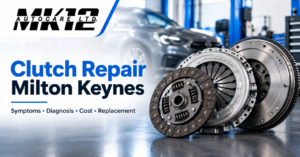
What Normally Comes in a Clutch Kit
Many conventional kits contain a friction disc, pressure plate and release bearing. Some vehicles use a concentric slave cylinder instead of a separate release bearing, and that component may be supplied or priced separately.
Assumptions can create confusion when comparing quotes. An itemised estimate should identify the parts, labour and any optional or condition-dependent components, making clutch repair Milton Keynes prices easier to compare fairly.
Why Related Components Are Inspected Together
Removing a gearbox involves significant labour, so it makes sense to inspect components that become accessible during the job. This may include the flywheel, release system, input area, seals and engine or gearbox mounts.
Inspection does not mean every related part must be replaced. It means worn or leaking components can be identified before reassembly, reducing the risk of paying similar labour again soon afterwards.
Dual-Mass Flywheel and Related Components
Many modern vehicles use a dual-mass flywheel, often shortened to DMF. It helps absorb vibration between the engine and gearbox, smoothing power delivery and reducing harsh torsional movement through the drivetrain.
The flywheel is a separate component from the clutch kit on many vehicles. It should be assessed on condition rather than automatically included or automatically ignored. Vehicle specification and manufacturer procedures determine the acceptable limits.
What a Dual-Mass Flywheel Does
A dual-mass flywheel contains two main sections connected through an internal damping mechanism. This arrangement absorbs variations in engine rotation before they reach the gearbox.
The design can improve refinement, particularly on high-torque diesel or turbocharged engines. Its internal moving parts also mean it can wear, develop excessive movement or lose damping performance over time.
Signs of a Worn Flywheel
Possible signs include rattling at idle, vibration during engagement, noise when the engine starts or stops, and movement beyond the permitted range. These symptoms can overlap with clutch, mount or gearbox faults.
No single sound confirms DMF failure. The technician considers noise, movement, heat marks, grease loss and manufacturer limits, with direct examination providing the clearest evidence once the gearbox is removed.
Why the Flywheel Is Not Automatically Replaced
Replacing every flywheel regardless of condition would add unnecessary cost. If the component meets the required checks and shows no unacceptable wear, it may remain suitable for continued use.
At the same time, fitting a new clutch to a flywheel that is already outside its limits can create judder, noise or early failure. The decision should be based on condition, specification and evidence.
How Flywheel Condition Affects the Quote
An initial quote may include the known clutch work and clearly state that flywheel replacement is subject to inspection. This is more honest than pretending an internal condition can always be confirmed before dismantling.
If the flywheel needs replacement, parts cost and labour procedures may change. The garage should contact you, explain the findings and request authorisation before adding substantial work.
Why Dismantling May Be Required for Final Confirmation
The bellhousing hides the clutch and working surface of the flywheel. External symptoms can guide diagnosis, but they cannot reveal every heat mark, crack, leak or measurement.
Once the gearbox is removed, the technician can inspect the components directly. This is why a responsible estimate may include a condition-dependent allowance rather than one guaranteed total for every possible internal fault.
Clutch Repair and Replacement Cost Factors
There is no accurate universal price for clutch replacement. The same symptom can involve very different parts and labour on two vehicles. A small hatchback with straightforward access is not equivalent to a larger vehicle with a complex drivetrain.
When comparing clutch repair Milton Keynes cost, look at what the quote includes rather than focusing only on the lowest headline figure. Parts specification, flywheel allowance, hydraulic components, labour, VAT and warranty terms all affect the real value.
Vehicle Make, Model and Engine
Vehicle specification determines the clutch size, kit type, access procedure and labour time. Different engines within the same model range may use different gearboxes, flywheels or slave-cylinder arrangements.
Providing the registration number helps the garage identify compatible parts, but further details may still be required. Imported, modified or engine-swapped vehicles may need additional confirmation.
Front-Wheel, Rear-Wheel and Four-Wheel Drive
Drivetrain layout influences how the gearbox is removed and what supporting components must be disconnected. Front-wheel-drive cars often package the engine and transmission tightly across the engine bay.
Rear-wheel-drive and four-wheel-drive vehicles can involve prop shafts, transfer components or additional access work. More complexity usually means more labour, but the exact procedure remains vehicle-specific.
Gearbox Removal Time
The clutch sits between the engine and gearbox, so the gearbox normally has to be separated from the engine. Access may require removal or support of surrounding components, subframes or mountings.
Labour time is therefore a major part of the price. This also explains why replacing a clearly worn related component while access is available can sometimes be more economical than repeating the removal later.
Clutch Kit Quality and Specification
The replacement kit must match the vehicle’s design and torque requirements. Price differences can reflect brand, specification, included components and warranty rather than simple markup.
The cheapest clutch repair Milton Keynes offer is not automatically the best choice if it excludes important parts or uses an unsuitable kit. Ask for clarity about the components and their warranty.
Dual-Mass Flywheel Condition
A serviceable flywheel can remain in place where appropriate, while a worn one may add a significant parts cost. The possibility should be discussed before work begins on vehicles equipped with a DMF.
Some applications may have alternative conversion options, but these are not automatically suitable. Changes can affect vibration and drivetrain behaviour, so any alternative must be assessed against vehicle and manufacturer requirements.
Additional Hydraulic or Gearbox Faults
A leaking internal slave cylinder, damaged seal, worn mount or gearbox fault can expand the repair scope. These problems may not be evident from the original symptom alone.
An itemised quote should separate confirmed work from additional findings. If further problems appear after dismantling, you should receive an explanation and revised cost before the extra repair is completed.
Can You Drive with a Failing Clutch?
Whether the vehicle can be driven depends on the symptom and how quickly it is changing. A mildly altered biting point may allow time to arrange an inspection, while severe slip or loss of disengagement can make the vehicle unsafe or leave it stranded.
Remember that a valid MOT does not guarantee the clutch will remain serviceable. The driver is responsible for the vehicle’s roadworthiness and control between tests. When uncertain, ask for professional advice rather than hoping the symptom will disappear.
When Limited Driving May Still Be Possible
If the vehicle drives normally and the symptom is minor, you may be able to travel a short distance for inspection. Avoid heavy loads, steep routes, unnecessary stop-start traffic and aggressive acceleration.
This is not a promise that the vehicle is safe. Conditions can deteriorate quickly, and advice must consider the actual symptom, traffic route and distance involved.
Signs That Mean You Should Stop Driving
Stop if the clutch cannot transfer power reliably, the pedal remains on the floor, gears cannot be selected safely or the vehicle behaves unpredictably when moving away.
Strong vibration, smoke, severe grinding or rapidly worsening symptoms also need urgent attention. Continuing can damage the flywheel, gearbox or other drivetrain components.
Complete Loss of Drive
If the engine revs but the car no longer moves, the clutch may be unable to transmit power or another drivetrain component may have failed. Do not repeatedly raise the engine speed in an attempt to force movement.
Move the vehicle only if it can be done safely without driving it. Arrange recovery to a garage for inspection and keep clear of live traffic lanes.
Strong Burning Smell or Smoke
A strong burning smell suggests excessive friction heat, while visible smoke is a clear reason to stop. Park safely, switch off and allow the vehicle to cool.
Do not continue simply because the smell temporarily fades. The clutch may slip again as soon as load is applied, and heat can affect other components.
Difficulty Selecting a Safe Gear
If you cannot select first gear, reverse or the correct gear for traffic conditions, you may not be able to control the vehicle predictably. Forcing the lever can cause additional damage.
Hydraulic failure can also become worse without warning. If the pedal has collapsed or the car creeps with the pedal down, recovery is usually safer than continued driving.
When Vehicle Recovery Is Safer
Recovery is appropriate when the vehicle has lost drive, cannot change gear, produces severe noise or smoke, or cannot be moved without creating a road-safety risk.
It is also sensible when the route involves heavy traffic, high-speed roads or a long distance. A recovery fee can be far less costly than secondary drivetrain damage or a roadside breakdown.
Book Clutch Repair in Milton Keynes
MK12 Autocare provides mechanical inspection and repair support from its workshop in Stacey Bushes. If you suspect a clutch problem, describe what the vehicle does rather than trying to identify the failed part yourself.
Clear information helps the garage plan the appointment and investigate efficiently. A final repair decision should follow inspection, parts confirmation and your authorisation.
Clutch Services Available at MK12 Autocare
The workshop can assess clutch slip, pedal problems, gear-selection complaints, hydraulic faults, clutch noise and related drivetrain symptoms. The required repair is explained after the available checks.
Where a full clutch replacement is needed, related items such as the release mechanism, slave cylinder and flywheel can be reviewed as part of the quotation.
Information Required for an Initial Quote
Provide the vehicle registration, make, model, engine, mileage and gearbox type. Explain when the problem occurs and whether it changes when the engine is hot or cold.
Mention warning lights, fluid loss, recent repairs, unusual smells and any breakdown history. More precise information allows the team to identify likely parts and allocate suitable diagnostic time.
Registration, Mileage and Symptom Details
The registration assists with parts matching, while mileage and history add context. A clutch can fail at different mileages, so the figure is useful but not a diagnosis by itself.
Describe the symptom in your own words. For example, “the revs rise in fourth gear but the car does not accelerate” is more useful than simply saying “the clutch is gone”.
Serving Stacey Bushes, Wolverton, Greenleys and Bradville
MK12 Autocare’s Stacey Bushes location is convenient for drivers across MK12 Milton Keynes, including nearby Wolverton, Greenleys and Bradville. Local references should help customers find the workshop, not be repeated as keyword filler.
Drivers looking for a garage in Milton Keynes can combine clutch assessment with related vehicle diagnostics or planned maintenance where appropriate.
Requesting an Inspection and Itemised Quote
Ask the team to explain the suspected fault, proposed parts, labour and condition-dependent items. If dismantling reveals additional work, request an updated quote before authorising it.
You can review the wider services offered by MK12 Autocare or read the car diagnostic cost guide when planning related fault-finding work.
Arrange a Proper Clutch Diagnosis
Clutch slip, judder, noise and pedal problems deserve attention, but none of them should be used as a shortcut to an automatic full replacement. Hydraulic cylinders, cables, release components, gearbox issues and flywheel wear can create overlapping symptoms. Proper inspection helps identify the actual fault and prevents unnecessary parts replacement.
The final price depends on the vehicle, access, clutch specification and condition of related components. For clutch repair in Milton Keynes, contact MK12 Autocare with your registration, mileage and symptom details. The team can arrange an inspection at Stacey Bushes, explain the repair options and provide an itemised quote for authorised work.
Frequently Asked Questions
Q1: How Do I Know If My Clutch Is Slipping?
The clearest sign is engine speed rising without an equal increase in road speed. It may be most noticeable in higher gears, on hills or when accelerating firmly.
You may also notice a high biting point or burning smell. Arrange an inspection because continued slip generates heat and can damage the pressure plate or flywheel.
Q2: Can a Clutch Be Repaired Without Replacing the Full Kit?
Yes, when the fault is external to the friction assembly. A cable, master cylinder, slave cylinder, pipe or adjustment problem may be repairable separately.
If the friction plate, pressure plate or release bearing is worn, a matched clutch kit is often the practical repair. Diagnosis determines which option applies.
Q3: How Long Does Clutch Replacement Normally Take?
Labour time varies with vehicle design and gearbox access. Some vehicles are relatively straightforward, while others require additional component or subframe removal.
Parts availability and extra findings can also affect completion. The garage can give a more useful estimate after confirming the vehicle and repair scope.
Q4: Does Clutch Replacement Include the Flywheel?
Not automatically. The flywheel is often separate from the clutch kit and should be checked against condition and manufacturer limits.
If it remains serviceable, replacement may not be necessary. If it is worn or damaged, the garage should explain the evidence and revised price before proceeding.
Q5: Why Is My Clutch Pedal Heavy or Sticking?
Possible causes include a stiff cable, worn release mechanism, pressure-plate problem, damaged pedal linkage or hydraulic fault. The exact cause depends on the system fitted.
A pedal that stays down or suddenly changes requires prompt inspection. Avoid forcing it, as that can worsen damage or leave you unable to control the clutch.
Q6: Can I Drive with a Burning Clutch Smell?
A brief smell after excessive manoeuvring may fade, but repeated burning suggests the clutch is slipping or overheating. Reduce load and arrange an inspection.
Stop driving if the smell is strong, smoke appears or the vehicle loses drive. Recovery is safer when the clutch cannot transfer power reliably.
Q7: What Information Is Needed for a Clutch Repair Quote?
Provide the registration, make, model, engine, mileage and gearbox type. Describe the symptoms, when they occur and whether any warning lights or leaks are present.
An initial quote may remain subject to inspection, particularly for the flywheel, internal slave cylinder or oil contamination. Ask for those conditions to be stated clearly.
Q8: Does MK12 Autocare Provide Clutch Repair Near Wolverton?
Yes. MK12 Autocare is based in Stacey Bushes, Milton Keynes, with convenient access for drivers from Wolverton, Greenleys, Bradville and surrounding MK12 areas.
Contact the workshop with the vehicle registration and symptom details to discuss availability. The team can arrange an inspection and confirm the appropriate next step.