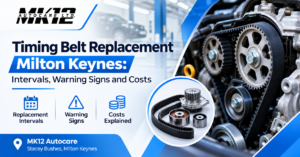

A Timing Belt Should Be Replaced Before It Fails
Your car’s engine depends on several components working together at precisely the right moment. One of the most important is the timing belt, also known as a cambelt. Although it is hidden behind protective covers and rarely receives attention during everyday driving, it plays a critical role in keeping your engine running correctly.
If you are looking for timing belt replacement Milton Keynes, understanding when your belt needs changing is essential. Unlike some other vehicle components, a timing belt does not always provide obvious warning signs before it fails. Waiting until you hear an unusual noise or experience engine problems can be an expensive mistake.
A timing belt is a scheduled maintenance component. It gradually wears because of repeated movement, engine heat, tension and the conditions under which the vehicle operates. Every vehicle has a recommended replacement interval based on its manufacturer, engine design and belt specification. Some vehicles require replacement after a particular mileage, while others also have a time-based limit.
Ignoring the recommended interval can put your engine at serious risk. On many modern petrol and diesel engines, a broken timing belt can allow pistons and valves to collide, resulting in bent valves, damaged pistons or extensive cylinder-head repairs.
At MK12 Autocare, based in Stacey Bushes, Milton Keynes, we understand the importance of preventative vehicle maintenance. If you are unsure whether your car needs a cambelt change, the sensible first step is to confirm the correct replacement schedule using your vehicle details and service history.
Whether you drive a family car, a daily commuter or a vehicle used for business, getting the timing belt checked against the manufacturer’s recommendations can help you avoid unexpected mechanical problems.
Contact MK12 Autocare to discuss your vehicle’s maintenance requirements and arrange an assessment or quotation for timing belt replacement in Milton Keynes.
What Does a Timing Belt Do?
A timing belt is a reinforced rubber belt fitted inside your engine. Its main responsibility is to keep the crankshaft and camshaft rotating in the correct relationship with one another.
Although the belt itself may look like a relatively simple component, its job is extremely precise. The engine needs its valves to open and close at specific moments during every combustion cycle. Even a small timing error can affect how efficiently the engine operates.
Most timing belts have specially shaped teeth on their inner surface. These teeth engage with matching sprockets, helping maintain accurate movement and preventing unwanted slipping under normal operating conditions.
Depending on the engine design, the timing belt may also drive other components, including the water pump.
Synchronising the Camshaft and Crankshaft
To understand the importance of a timing belt, it helps to know what the crankshaft and camshaft actually do.
The crankshaft converts the movement of the pistons into rotational energy. This rotation eventually helps power the vehicle’s wheels through the transmission.
The camshaft controls the opening and closing of the engine’s intake and exhaust valves. These valves allow the correct air-fuel mixture into the cylinders and release exhaust gases after combustion.
Both components must operate in perfect coordination.
The timing belt connects the crankshaft and camshaft using precisely positioned teeth. As the crankshaft rotates, the belt transfers movement to the camshaft at the correct ratio.
Think of it like a carefully coordinated team. If one part moves too early or too late, the entire process becomes disrupted.
This is why a stretched, damaged or incorrectly installed timing belt can create serious engine-running problems. Correct timing is essential for reliable combustion and efficient engine operation.
Controlling Valve and Piston Timing
Inside a combustion engine, pistons move up and down within the cylinders. At the same time, the intake and exhaust valves open and close to control airflow.
These movements must be carefully synchronised.
During the intake stroke, the intake valves open to allow air, or an air-fuel mixture depending on the engine design, into the cylinder. The piston then compresses the contents before combustion takes place.
After combustion, the exhaust valves open to allow the gases to leave the cylinder.
The timing belt helps ensure that the valves operate at the correct stage of this process.
If the belt slips or breaks, valve movement can become disconnected from piston movement. Depending on the engine design, this can cause the two to collide.
That is why timing belt maintenance is not simply about preventing a breakdown. It is about protecting the internal components that make your engine work.
Timing Belt vs Auxiliary Drive Belt
A timing belt and an auxiliary drive belt are not the same component, even though both are belts fitted within the engine area.
The timing belt controls the relationship between the crankshaft and camshaft. Its operation is essential to the engine’s valve timing.
An auxiliary drive belt, sometimes called a serpentine belt, operates external accessories. Depending on the vehicle, these may include the alternator, air-conditioning compressor and power steering pump.
A damaged auxiliary belt can cause charging problems, loss of air conditioning or other accessory-related faults.
A broken timing belt, however, can cause the engine to stop and may result in severe internal damage.
The two belts also have different inspection and replacement requirements.
If you hear a squealing noise from the engine bay, do not automatically assume the timing belt is responsible. The auxiliary drive system may be the source of the problem.
A professional inspection can help identify the correct component and prevent unnecessary repairs.
Timing Belt vs Timing Chain
Not every vehicle uses a timing belt. Some engines are designed with a timing chain instead.
Both systems perform the same basic job: synchronising the crankshaft and camshaft.
However, their construction and maintenance requirements are different.
A timing belt is generally made from reinforced rubber-based materials and has a specified replacement schedule. It is usually protected by covers to keep out dirt and other contaminants.
A timing chain is made from metal links and operates with lubrication from the engine oil system. It may last longer than a conventional timing belt, but it is not necessarily maintenance-free.
Timing chains can stretch, wear their guides or develop tensioner problems over time.
Some engines also use wet timing belts, which operate inside the engine and are exposed to engine oil. These systems have their own specific maintenance requirements.
If you are unsure whether your vehicle uses a timing belt or chain, check the manufacturer’s technical information using your exact engine details.
Do not assume that all vehicles from the same manufacturer use the same system.
Why Correct Engine Timing Matters
Correct engine timing affects more than just whether your car starts.
It influences combustion efficiency, engine smoothness, power delivery and emissions. When the timing system operates correctly, the valves open and close at the appropriate points in the combustion cycle.
If the timing becomes inaccurate, you may notice rough idling, reduced performance, misfiring or difficulty starting.
In severe cases, a belt failure can stop the engine completely.
A timing belt is therefore one of those components where preventative maintenance makes much more sense than waiting for a fault to develop.
When Should a Timing Belt Be Replaced?
There is no single replacement interval that applies to every vehicle.
Some manufacturers specify a mileage limit, others provide both mileage and age limits, and certain engines have different schedules depending on the model year or production specification.
A timing belt may need replacing even if the vehicle appears to run perfectly.
The most reliable approach is to follow the manufacturer’s maintenance schedule for the exact engine installed in your vehicle.
Manufacturer Mileage Intervals
Most timing belt replacement schedules are based partly on mileage.
For example, one engine may require a belt replacement at a particular mileage, while another engine from the same manufacturer may have a different requirement.
The correct figure depends on the engine design, belt material, operating conditions and manufacturer recommendations.
General online advice sometimes refers to intervals between approximately 50,000 and 100,000 miles. However, this should not be treated as a universal replacement rule.
Some vehicles have shorter or longer manufacturer-approved intervals.
If your car is approaching its specified mileage limit, it is sensible to arrange the replacement before reaching that point.
Waiting until the belt exceeds its recommended service life can increase the risk of unexpected failure.
Time-Based Replacement Intervals
Mileage is only one part of timing belt maintenance.
Rubber-based belt materials gradually age, even when the vehicle is not driven frequently.
Heat cycles, environmental conditions and the natural ageing of materials can affect belt durability.
For this reason, some manufacturers specify a maximum age as well as a mileage limit.
A vehicle that has covered relatively few miles over several years may still require a timing belt replacement.
Always follow whichever manufacturer limit applies first.
If your service records show that the belt was replaced several years ago, check whether it is approaching its next recommended replacement date.
Why Low-Mileage Vehicles Still Need Attention
A common misconception is that a car driven only occasionally does not need timing belt replacement.
Unfortunately, that is not necessarily true.
Imagine two identical vehicles. One travels long distances every week, while the other spends most of its time parked outside the owner’s home.
Although the second vehicle may have covered fewer miles, its timing belt still experiences ageing.
The belt is exposed to changes in temperature and environmental conditions, and its materials can deteriorate over time.
This means low annual mileage does not automatically extend the belt’s service life.
If you own a low-mileage vehicle and cannot remember when the timing belt was last changed, check the manufacturer’s time-based requirements before assuming it is still safe.
Vehicle Age and Service History
Your vehicle’s service history is one of the most useful documents when planning timing belt maintenance.
A previous invoice may show the replacement date, mileage and parts fitted.
This information helps establish when the next replacement will be due.
If you purchased a used vehicle, ask the previous owner or supplying dealer for evidence of the last cambelt replacement.
Do not rely entirely on a verbal statement that the belt has already been changed.
Look for a dated invoice or other reliable maintenance record.
If no evidence is available, the safest approach is to have the vehicle’s requirements checked and discuss whether preventative replacement is appropriate.
Engine-Code and Production-Date Differences
Two cars with the same badge and registration year may have different engines.
Manufacturers sometimes introduce revised engine versions, change components during production or offer several engine options within one model range.
These differences can affect the timing belt specification and replacement interval.
An engine code is therefore particularly useful when checking the correct maintenance information.
It helps identify the exact engine rather than relying on the general vehicle model.
When arranging a quotation, providing the registration number and, where necessary, the VIN or engine code can help the garage identify the correct belt kit and associated components.
Why Registration Year Is Only a General Guide
Your registration year is helpful, but it does not always tell the complete story.
A vehicle registered in one year may have been manufactured earlier. It may also have received an engine revision during its production period.
This matters because replacement schedules and component specifications can vary.
For example, two versions of the same popular family car might use different timing systems.
Before recommending a replacement interval, the exact engine application should be confirmed using reliable manufacturer information.
At MK12 Autocare, you can discuss your vehicle details and maintenance history when requesting advice about timing belt replacement in Milton Keynes.
Timing Belt Warning Signs
Timing belts do not always provide clear warnings before failure.
However, certain symptoms may indicate that the timing system or related components need professional attention.
If you notice unusual engine behaviour, avoid assuming the timing belt is the only possible cause. Other mechanical faults can produce similar symptoms.
The important thing is to arrange an appropriate inspection rather than ignoring the problem.
Ticking or Rattling From the Engine
An unusual ticking, rattling or slapping sound from the engine area can sometimes indicate a problem with the timing system.
Possible causes include a worn belt, incorrect tension, a damaged tensioner or a failing pulley bearing.
However, similar noises can also come from other engine components.
A timing belt itself does not necessarily make a noticeable noise as it wears.
If you hear a new or persistent noise, arrange an inspection promptly. Avoid continuing to drive if the sound is accompanied by serious engine-running problems or warning lights.
Visible Cracking, Fraying or Contamination
A damaged timing belt may show signs of physical deterioration.
These can include:
- Cracks across the belt surface.
- Fraying along the edges.
- Missing or damaged teeth.
- Signs of uneven wear.
- Glazing or surface deterioration.
- Oil or coolant contamination.
However, inspecting a timing belt is not always straightforward.
The belt is usually hidden behind protective covers, so a complete visual assessment may require specialist access.
Even when visible, a belt can look acceptable while still being close to its replacement limit.
A visual inspection should therefore never replace the manufacturer’s scheduled maintenance requirements.
Oil Around the Timing Belt Cover
Oil contamination is another concern.
If engine oil reaches the timing belt, it may affect the belt material and reduce its service life.
Possible sources include leaking camshaft seals, crankshaft seals or other engine sealing points.
Oil around the timing cover does not automatically mean the timing belt has failed. However, it should not be ignored.
The underlying leak needs to be identified and repaired where necessary.
Replacing a belt without addressing an oil leak could leave the new component exposed to the same problem.
Coolant Leakage Near the Water Pump
On engines where the water pump is driven by the timing belt, coolant leakage near the pump can be particularly important.
A failing water pump may develop seal or bearing problems.
Coolant escaping from the pump can contaminate nearby components, while a worn bearing can affect the timing belt system.
If you notice coolant beneath your vehicle, a falling coolant level or signs of overheating, arrange a professional inspection.
Do not open the coolant reservoir while the engine is hot.
The cooling system should be checked to identify the leak and establish whether the timing belt area is affected.
Engine Misfiring or Running Problems
An engine that misfires, idles roughly or struggles to start may have a timing-related problem.
If the timing belt has slipped by one or more teeth, the camshaft and crankshaft may no longer operate in the correct relationship.
This can affect combustion and engine performance.
However, ignition faults, fuel delivery problems, sensor issues and other mechanical faults can cause similar symptoms.
A proper vehicle diagnostic assessment may be necessary to identify the underlying cause.
If the engine suddenly develops serious running problems, avoid repeatedly trying to restart it until the cause has been assessed.
Why a Belt Can Fail Without Visible Warning
This is one of the most important things to understand about timing belt maintenance.
A timing belt may appear normal shortly before it fails.
The internal reinforcing fibres can deteriorate without obvious external damage. A belt may also suffer tooth damage or other structural weaknesses that are difficult to identify through a basic visual inspection.
Age, heat, incorrect tension and contamination can all contribute to premature failure.
That is why following the manufacturer’s replacement schedule is more reliable than waiting for visible signs.
If you cannot confirm when the belt was last replaced, do not assume that it is safe simply because the engine sounds normal.
What Happens If a Timing Belt Breaks?
A broken timing belt can turn a routine maintenance issue into a major engine repair.
The exact damage depends on the engine design, operating speed and circumstances surrounding the failure.
Some engines may experience limited damage, while others can suffer extensive internal mechanical failure.
Understanding what happens can help explain why timing belt replacement should be treated as preventative maintenance.
Loss of Camshaft and Crankshaft Synchronisation
When the timing belt breaks, the connection between the crankshaft and camshaft is lost.
The crankshaft may continue rotating briefly because of the vehicle’s momentum, but the camshaft is no longer controlled in the correct relationship with it.
This interrupts normal valve operation.
The engine will usually stop running, and restarting it may be impossible.
Depending on the design, the pistons may continue moving while some valves remain in positions that create a risk of collision.
Interference vs Non-Interference Engines
Not every engine responds to timing belt failure in the same way.
An interference engine is designed so that the pistons and valves occupy overlapping areas of the cylinder at different stages of the combustion cycle.
They do not normally collide because the timing system keeps their movements synchronised.
If the belt breaks, the pistons and valves may come into contact.
A non-interference engine has a different internal design, providing sufficient clearance to reduce or prevent this type of collision when timing is lost.
However, this does not mean that a non-interference engine is immune to all consequences of belt failure.
The engine will still stop operating correctly and may require repairs.
Never assume that your vehicle has a non-interference engine without checking its exact specification.
Bent Valves and Piston Damage
On an interference engine, a broken belt can allow the pistons to strike open valves.
The impact may bend the valves or damage their stems and guides.
In more serious cases, the pistons, cylinder head and other internal components can also be affected.
The extent of damage depends on the engine and the circumstances of failure.
A vehicle that experiences this type of breakdown may require extensive mechanical investigation before a repair estimate can be provided.
Cylinder-Head Repair Requirements
If valves are damaged, the cylinder head may need to be removed for inspection and repair.
Depending on the findings, the work may include:
- Replacing bent or damaged valves.
- Inspecting valve guides and seats.
- Checking the cylinder head for damage.
- Examining pistons and combustion chambers.
- Replacing damaged timing components.
- Checking the engine’s lubrication and cooling systems.
Not every timing belt failure results in all these repairs.
However, the potential labour and parts costs can be substantial.
This is why a scheduled belt replacement is generally preferable to dealing with an unexpected engine failure.
Why Prevention Is Normally Less Expensive
Preventative maintenance allows the timing belt to be replaced before it reaches its specified service limit.
The job can be planned, the correct parts can be sourced and related components can be inspected at the same time.
A broken belt may require recovery, diagnostic work, engine disassembly and additional replacement parts.
In some cases, the cost of repairing the engine may be greater than the vehicle’s value.
Following the manufacturer’s maintenance schedule is therefore a sensible way to protect both your vehicle and your budget.
What a Timing Belt Replacement Includes
A professional timing belt replacement involves more than simply removing an old belt and fitting a new one.
The timing system contains several components that work together. These must be inspected and fitted correctly to ensure reliable operation.
The exact work required depends on the engine design and the manufacturer’s repair procedure.
Timing Belt Kit
A timing belt kit normally includes the replacement belt and the associated components specified for the application.
The belt itself must have the correct dimensions, tooth profile and material specification.
Using the wrong component can cause installation problems or premature failure.
The correct kit should be selected using the vehicle’s exact engine details rather than simply its model name.
Where appropriate, an original equipment or reputable equivalent-quality kit should be considered.
Tensioner and Idler Pulleys
The tensioner maintains the correct belt tension.
If the tension is too low, the belt may slip or jump teeth. If it is too high, unnecessary loads may be placed on the belt, bearings and related components.
Idler pulleys guide the belt along its correct path.
Both components are important to the timing system’s operation.
Their bearings and condition should be assessed during replacement.
Where the manufacturer’s procedure or kit specification recommends replacement, new tensioners and idler pulleys should be fitted rather than reusing worn components.
Water-Pump Inspection
The water pump circulates coolant through the engine and radiator to help control operating temperature.
On many engines, the timing belt drives the water pump.
If this applies to your vehicle, the pump’s condition should be considered during the replacement procedure.
A worn pump bearing, leaking seal or damaged impeller can create problems after the new belt has been fitted.
A suitable inspection helps establish whether the pump should be replaced at the same time.
Coolant Replacement Where Required
If the water pump is replaced, some or all of the engine coolant may need to be drained.
The correct coolant specification should be used when refilling the system.
Different vehicles require different coolant formulations, and mixing incompatible products can cause problems.
The cooling system should also be checked for leaks and properly bled according to the manufacturer’s procedure.
Timing Cover and Oil-Seal Inspection
The timing cover protects the belt from dirt, debris and other external contamination.
During replacement, the cover and surrounding areas should be inspected for cracks, damage and signs of leaks.
Oil seals may also need attention if leakage is identified.
Replacing a timing belt while leaving an active oil leak unresolved can put the new belt at risk.
The aim is to ensure that the complete timing system is in suitable condition, not simply to replace one visible component.
Why Locking Tools and Manufacturer Timing Data Matter
Timing belt replacement is precision mechanical work.
The crankshaft and camshaft must be positioned correctly before the old belt is removed and the replacement is installed.
Many engines require dedicated locking tools to hold the components in their specified positions.
The technician must also follow the correct installation procedure, belt tension specifications and torque settings.
After installation, the timing should be checked according to the manufacturer’s procedure.
Incorrect alignment can cause poor engine performance, starting problems or serious mechanical damage.
For this reason, timing belt replacement should be carried out by a suitably equipped and experienced automotive technician.
Should the Water Pump Be Replaced at the Same Time?
Whether the water pump should be replaced during a timing belt change depends on the engine design, pump condition and manufacturer’s recommendations.
It is not automatically necessary on every vehicle.
However, when the water pump is driven by the timing belt, replacing it at the same time can be a sensible preventative decision.
When the Water Pump Is Driven by the Timing Belt
On certain engines, the timing belt drives the water pump.
This means the pump is located within the timing belt system and operates as part of the same mechanical arrangement.
If the pump develops a leak or bearing problem later, accessing it may involve removing some of the same components again.
In this situation, considering replacement during the timing belt job can help avoid repeating labour-intensive work.
The correct approach depends on the engine and the pump’s maintenance requirements.
Labour Overlap
One of the main reasons to consider replacing the water pump at the same time is labour overlap.
On engines where the pump is driven by the timing belt, reaching it may require significant dismantling.
If the pump fails shortly after the belt has been replaced, some of that work may need to be repeated.
Replacing a suitable pump during the same repair may therefore be more economical over the longer term.
However, the decision should be based on the vehicle’s design and a clear quotation.
Bearing and Seal Condition
A water pump contains moving components and sealing surfaces.
Over time, its bearings and seals can wear.
Signs of a failing pump may include coolant leakage, unusual bearing noise or visible damage.
If these problems are identified during timing belt work, replacing the pump may be advisable.
Even if no obvious fault is present, the manufacturer’s maintenance recommendations should be considered.
Coolant Specification
Whenever the water pump is replaced, the cooling system may need fresh coolant.
The correct coolant specification matters because vehicle manufacturers use different formulations.
The system should be refilled using the appropriate product and bled correctly.
Incorrect coolant or poor bleeding can contribute to corrosion, inadequate cooling or overheating.
When Water-Pump Replacement May Not Be Required
There are situations where replacing the water pump during a timing belt change may not be necessary.
For example, the pump may be driven by a separate belt, may be easily accessible or may have a different replacement schedule.
Some engines also use timing arrangements where water-pump replacement does not provide the same labour-saving benefit.
The pump’s condition and manufacturer guidance should determine the decision.
A professional quotation should clearly explain whether the water pump is included, optional or unnecessary.
Timing Belt Replacement Cost Factors
One of the first questions drivers ask is how much timing belt replacement costs.
The answer depends on the vehicle.
There is no reliable single price for every car because timing belt systems vary considerably in design, accessibility and parts requirements.
A straightforward replacement on one engine may involve considerably less work than a complicated job on another.
When requesting a timing belt replacement Milton Keynes quotation, it is important to understand what the estimate includes.
Vehicle and Engine Type
The make, model and engine specification are major factors in the overall price.
Some engines provide relatively straightforward access to the timing belt.
Others require more components to be removed before the technician can reach the timing system.
Petrol and diesel engines may also have different component layouts and repair requirements.
Even two versions of the same vehicle can have different labour times.
Providing accurate vehicle details helps the garage identify the correct parts and estimate the work more accurately.
Engine-Bay Access
The amount of dismantling required can have a significant effect on labour costs.
Some vehicles have more space around the timing belt area, while others have tightly packaged engine compartments.
Depending on the design, the work may involve removing engine mounts, covers, auxiliary components or other surrounding parts.
The technician must follow the correct procedure without damaging adjacent components.
This is why labour costs can vary even between vehicles from the same manufacturer.
Timing Belt Kit Specification
The replacement kit also affects the quotation.
A complete kit may include the belt, tensioner and idler pulleys.
Some applications require additional components or specific hardware.
Parts quality and manufacturer specifications should be considered when comparing prices.
The cheapest available belt kit is not necessarily the best option.
The important thing is to use components that are correct for the engine and suitable for the intended replacement interval.
Water Pump and Coolant
If the water pump is driven by the timing belt, its replacement may be recommended.
The quotation may also include coolant and associated parts.
If the pump is not included in the initial estimate, ask whether it has been inspected and whether replacing it would be beneficial.
A transparent quotation should identify the parts and labour involved rather than presenting an unexplained total.
Oil Contamination or Damaged Covers
If oil or coolant has contaminated the belt area, additional repairs may be necessary.
For example, leaking seals may need replacing before a new belt is installed.
Damaged timing covers, missing fasteners or worn pulleys may also add to the work required.
It is important to address the underlying cause rather than simply installing a new belt.
Otherwise, the replacement component could be exposed to the same problem.
Additional Engine Damage
A scheduled timing belt replacement is different from repairing an engine after belt failure.
If the belt has already broken, further diagnostic work may be needed to establish the extent of internal damage.
Depending on the engine, the repair could involve cylinder-head work, valve replacement or other mechanical repairs.
These costs cannot be accurately estimated until the engine has been assessed.
For an accurate timing belt replacement quote in Milton Keynes, provide your registration number, engine details and available service history. This gives the garage a better starting point for identifying the correct parts and labour requirements.
Timing Belt Replacement at MK12 Autocare
Choosing a garage for important engine maintenance is about more than finding the lowest advertised price.
You need to know that the correct components will be identified, the manufacturer’s procedures will be followed and any additional work will be explained clearly.
MK12 Autocare is an independent vehicle service and repair centre located at 27 Heathfield, Stacey Bushes, Milton Keynes, MK12 6HP.
The business provides vehicle servicing, mechanical maintenance, vehicle diagnostics and MOT testing for a range of vehicles.
If your car is approaching its cambelt replacement interval, you can contact the team to discuss the vehicle’s requirements and confirm the availability of the appropriate timing belt work.
Confirming the Correct Interval
The first step is identifying when your timing belt is due.
Rather than applying a generic mileage figure, the replacement requirement should be checked against the manufacturer’s information for your exact engine.
This may include both a mileage limit and a maximum age.
Your service history should also be reviewed to establish whether the belt has already been replaced.
If there is no reliable record, discuss the safest maintenance option with the garage.
Details Required Before Quoting
A timing belt replacement quotation needs more information than just the vehicle’s make.
Useful details include:
- Vehicle registration number.
- Make and model.
- Engine size and fuel type.
- Engine code, where available.
- Current mileage.
- Previous timing belt replacement date, if known.
- Existing engine or cooling-system symptoms.
These details help identify the correct timing belt kit and any additional parts that may be required.
Providing accurate information at the beginning can also reduce delays when arranging the work.
Registration, VIN and Engine Information
Your registration number is usually a convenient starting point for vehicle identification.
However, some vehicles have several engine variations within the same model range.
If additional confirmation is needed, the VIN or engine code can help identify the exact application.
This is particularly important when checking replacement intervals and ordering components.
The aim is to ensure that the replacement parts match your vehicle’s actual engine specification.
Serving Stacey Bushes and Nearby Milton Keynes Areas
MK12 Autocare is based in Stacey Bushes, making it a local option for drivers looking for vehicle servicing and mechanical repair in Milton Keynes.
Its location at 27 Heathfield, Milton Keynes, MK12 6HP, is convenient for motorists travelling from nearby neighbourhoods.
Drivers from areas such as Wolverton, New Bradwell, Bradville, Heelands, Greenleys and other parts of Milton Keynes can contact the garage to discuss their maintenance requirements.
If you are searching online for a garage Milton Keynes, local vehicle servicing or car repair in the MK12 postcode area, it is worth discussing your vehicle’s requirements directly with the team.
Booking Scheduled Timing-Belt Work
Timing belt replacement should be planned around the manufacturer’s maintenance schedule.
If your vehicle is approaching its recommended mileage or age limit, do not leave the decision until the last minute.
Contact MK12 Autocare with your vehicle information and ask about the correct replacement procedure, parts requirements and available appointment options.
Before confirming the work, request a clear quotation that explains:
- Which timing belt kit is required.
- Whether tensioners and idler pulleys are included.
- Whether water-pump replacement is recommended.
- Whether coolant or additional seals are required.
- The expected labour and overall cost.
A clear discussion before the repair helps you understand what your vehicle needs.
Contact MK12 Autocare to discuss timing belt replacement in Milton Keynes and plan your vehicle’s maintenance before the recommended interval is exceeded.
Confirm the Interval Before It Is Too Late
Your timing belt may be hidden from view, but its role in your vehicle’s engine is essential.
It keeps the crankshaft and camshaft synchronised, allowing the pistons and valves to operate at the correct moments. When the belt reaches the end of its recommended service life, delaying replacement can put the entire engine at risk.
The important thing to remember is that timing belt replacement intervals vary. Mileage, vehicle age, engine specification and service history all matter. A belt can also deteriorate without showing obvious signs of damage.
If you are unsure when your vehicle last had a cambelt change, check the maintenance records and confirm the correct interval for your engine.
For drivers looking for timing belt replacement Milton Keynes, MK12 Autocare in Stacey Bushes provides a local point of contact for vehicle maintenance and repair enquiries.
Share your registration number, mileage and available service history with the team to discuss the correct requirements and request a tailored quotation.
Do not wait for a timing belt to break before taking action. Confirm the interval, plan the maintenance and give your engine the attention it needs.
Frequently Asked Questions
1. How Often Should a Timing Belt Be Replaced?
A timing belt should be replaced according to the interval specified by the vehicle manufacturer.
The recommended schedule varies depending on the make, model and engine. Some manufacturers specify a mileage limit, while others also set a maximum number of years.
General advice often refers to intervals between approximately 50,000 and 100,000 miles, but this is not a universal rule.
Your vehicle may require replacement earlier or later depending on its engine specification.
The best approach is to check the manufacturer’s maintenance schedule and review your service history. If you cannot confirm when the belt was last replaced, contact a suitable garage for advice.
2. Is a Cambelt the Same as a Timing Belt?
Yes. Cambelt is another common name for a timing belt.
Both terms describe the belt responsible for synchronising the crankshaft and camshaft in an engine.
The terminology varies between manufacturers, garages and drivers, particularly in the UK.
If you search for cambelt replacement Milton Keynes or timing belt replacement, you are generally looking for the same type of maintenance work.
However, always check whether your vehicle uses a timing belt, timing chain or another type of timing system before arranging a replacement.
3. Should the Water Pump Be Changed With the Timing Belt?
The water pump should be considered during timing belt replacement, particularly if it is driven by the timing belt.
On these engines, the water pump may be difficult to access separately. Replacing it during the same repair can avoid repeating some of the labour if it fails later.
The pump should be assessed for bearing wear, leakage and general condition.
However, water-pump replacement is not automatically required on every vehicle.
The correct decision depends on the engine design, pump condition and manufacturer’s recommendations. Ask for the water pump to be included or explained separately in your quotation.
4. Can a Timing Belt Fail Without Warning?
Yes. A timing belt can fail without giving the driver a clear warning.
Although some damaged belts may produce unusual noises or engine-running problems, others can appear normal shortly before failure.
Internal deterioration, damaged belt teeth, incorrect tension and contamination may not always be visible during a basic inspection.
This is why following the manufacturer’s replacement schedule is so important.
If your vehicle has reached its specified mileage or age limit, do not wait for symptoms to appear before arranging replacement.
5. What Happens If the Timing Belt Breaks?
If a timing belt breaks, the connection between the crankshaft and camshaft is lost.
The engine will normally stop running because its valve timing can no longer operate correctly.
On an interference engine, the pistons may collide with open valves, causing bent valves, damaged pistons or cylinder-head problems.
The amount of damage depends on the engine design and the circumstances of the failure.
Some repairs may involve extensive engine dismantling and replacement components.
If you suspect your timing belt has broken, switch off the engine and avoid repeatedly attempting to restart the vehicle. Arrange professional assistance.
6. Can a Timing Belt Be Checked During a Normal Service?
A technician may be able to inspect accessible parts of the timing system during a vehicle service, depending on the engine design.
However, timing belts are commonly hidden behind protective covers, so checking their full condition may require additional access and labour.
More importantly, a visual inspection cannot reliably establish the remaining service life of every timing belt.
A belt may look acceptable while still being close to its scheduled replacement limit.
During a full car service Milton Keynes, it is worth discussing your timing belt history and replacement schedule. A routine service should not be treated as a substitute for the manufacturer’s cambelt maintenance requirements.
7. How Is the Correct Timing-Belt Interval Confirmed?
The correct interval is confirmed by identifying your exact vehicle and engine specification.
Useful information includes the registration number, VIN, engine code, model year and current mileage.
The manufacturer’s maintenance schedule should then be checked for the relevant engine application.
It is also important to review previous invoices or service records to establish whether the belt has already been replaced.
Registration year alone may not be sufficient because some vehicle models have several engine versions.
A garage can help identify the correct maintenance requirement using the available vehicle information.
8. How Can I Book Timing-Belt Replacement in Milton Keynes?
Start by contacting MK12 Autocare with your vehicle registration number, make, model, engine details and current mileage.
If you have an invoice showing the previous timing belt replacement, share that information as well.
The team can discuss your vehicle’s maintenance requirements and confirm the availability of the relevant work.
You should request a quotation covering the timing belt kit, associated pulleys, water pump where applicable, coolant and labour.
MK12 Autocare is located at:
27 Heathfield, Stacey Bushes, Milton Keynes, MK12 6HP, United Kingdom.
You can contact the garage by telephone on +44 1908 22 77 94 or email contact@mk12autocare.com to discuss your requirements.
9. Is It Safe to Drive With an Old Timing Belt?
An old timing belt is not automatically about to fail, but driving beyond the manufacturer’s recommended replacement limit increases the risk of an unexpected failure.
The problem is that the remaining service life cannot always be determined from the belt’s appearance.
If your vehicle has exceeded its recommended interval, arrange professional advice as soon as possible.
If there are signs of mechanical trouble, unusual noises or engine-running problems, stop driving where it is unsafe to continue and arrange an inspection.
10. Is Timing Belt Replacement Included in a Full Car Service?
Not usually. A standard full car service and a timing belt replacement are separate maintenance procedures.
A full service generally involves routine checks and scheduled items such as engine oil, filters, brakes, tyres and other vehicle components, depending on the service specification.
Timing belt replacement is a separate, more involved job that follows a specific manufacturer maintenance schedule.
If your vehicle is approaching its cambelt interval, ask the garage about arranging the work alongside your regular vehicle servicing.
This can help you plan maintenance more conveniently, although the timing belt replacement will need its own quotation.