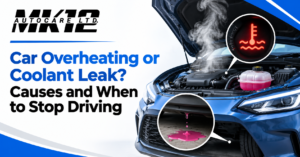

Is your car overheating, losing coolant, or showing a temperature warning light? These symptoms can appear suddenly, often when you are travelling to work, sitting in traffic, or driving on the motorway.
A car overheating or coolant leak problem should never be ignored. Your engine produces considerable heat while running. Without an effective engine cooling system, that heat can damage expensive components, including the cylinder head, head gasket, and internal engine parts.
Sometimes, the problem starts with something relatively simple, such as a damaged coolant hose or a leaking radiator. In other cases, overheating may indicate a faulty thermostat, water pump, or an internal engine problem.
But how can you tell the difference?
Perhaps you have noticed a sweet smell coming from the engine bay. Maybe your coolant level keeps dropping, even though there is no visible puddle underneath your car.
You might also be wondering whether you can safely drive to a nearby garage in Milton Keynes or whether your vehicle needs professional recovery.
The most important thing to understand is that a small cooling-system fault can quickly become a serious mechanical problem if you continue driving.
This guide from MK12 Autocare explains the common causes of engine overheating, how to recognise a coolant leak, what to do when your temperature warning light appears, and how garages diagnose cooling-system faults.
You will also learn when it is safer to stop driving and arrange professional vehicle diagnostics.
What Counts as an Overheating Warning?
Your car does not always produce visible steam when it starts overheating. In many cases, the first warning appears on the dashboard or through a change in how the engine behaves.
Understanding these early symptoms can help you identify a developing cooling system problem before it causes significant damage.
Temperature Gauge Rising Above Normal
The engine temperature gauge shows how hot your engine is while the vehicle is running. On many cars, the needle normally remains close to the middle of the gauge once the engine reaches its usual operating temperature.
If the needle rises noticeably above its normal position or moves towards the red section, your engine coolant temperature may be too high. This can happen because of insufficient coolant, poor circulation, or a cooling-system component failure.
A temperature gauge may rise when you are stationary in traffic and return to normal when the car starts moving. This pattern sometimes indicates a problem with the radiator cooling fan.
However, a rising gauge is not enough to identify the exact fault. If the engine is approaching the overheating range, find a safe place to stop rather than waiting for additional symptoms.
Red Temperature Warning Light
A red engine temperature warning light is one of the clearest signs that your car needs immediate attention.
Depending on the vehicle, the dashboard may display a thermometer symbol, an engine temperature message, or a warning telling you to stop the engine.
The warning can appear when the coolant temperature becomes dangerously high. Some vehicles also have separate warnings for a low coolant level.
If the red warning appears while driving, pull over safely and switch off the engine. Do not continue driving simply because the vehicle still feels normal.
Modern engines can develop serious mechanical damage before the driver notices a loss of performance.
Steam From the Engine Bay
Seeing steam coming from underneath the bonnet is a strong indication that something may be wrong with your engine cooling system.
Steam can appear when hot coolant escapes through a damaged hose, a leaking radiator, an expansion-tank fault, or another pressurised component.
The escaping liquid may contact hot engine surfaces and turn into visible vapour.
However, not every cloud of vapour indicates the same problem. A garage must inspect the vehicle to determine whether the source is escaping coolant or another issue.
If you notice steam while driving, stop in a safe location and turn off the engine.
Never attempt to remove the radiator cap or coolant expansion tank cap while the system is hot.
Heater Suddenly Blowing Cold Air
Your vehicle’s cabin heater normally uses heat transferred from the engine through a small heat exchanger called the heater matrix.
When hot coolant circulates correctly, the heater can produce warm air inside the cabin.
If your heater suddenly starts blowing cold air while the engine temperature gauge is rising, the cooling system may have lost coolant or developed an air pocket.
Low coolant can prevent hot liquid from reaching the heater matrix, even while the engine itself becomes dangerously hot.
A faulty heater control or blocked heater matrix can also cause poor cabin heating. Therefore, cold air alone does not confirm an overheating fault.
However, cold air combined with temperature warnings requires immediate attention.
Sweet Coolant Smell
Many types of engine coolant have a distinctive sweet smell because of their chemical composition.
If you notice this smell around the front of your vehicle, it may indicate that coolant is escaping from the radiator, coolant hoses, or other components.
A sweet smell inside the passenger cabin can sometimes suggest a leaking heater matrix.
You may also notice misted windows, damp carpets, or an unusual film on the inside of the windscreen.
These symptoms deserve professional investigation because coolant can escape without leaving an obvious puddle underneath the vehicle.
Avoid touching or tasting suspected coolant. Some antifreeze ingredients are toxic to humans and animals.
Repeated Coolant Top-Ups
A healthy, sealed engine cooling system should not require frequent coolant top-ups.
Although the coolant level can change slightly between hot and cold conditions, a repeated drop below the recommended level usually indicates a problem.
You might add coolant every week or notice that the expansion tank becomes empty after several journeys.
This does not necessarily mean the leak is visible. Coolant may escape only when the system becomes hot and pressurised.
A failing head gasket can also allow coolant to enter the combustion chamber or mix with engine oil.
If your car keeps losing coolant, arrange a proper diagnosis rather than repeatedly adding more fluid.
Common Causes of Coolant Leaks
A coolant leak can develop almost anywhere in your vehicle’s cooling system.
The system includes several connected components that circulate coolant, transfer heat, and maintain the correct operating pressure.
As these parts age, rubber seals deteriorate, plastic components become brittle, and metal surfaces may corrode.
Damaged Radiator
The radiator is responsible for releasing heat from the engine coolant into the surrounding air.
It contains narrow passages through which coolant flows. These passages allow heat to transfer through the radiator fins before the liquid returns to the engine.
Over time, corrosion, road debris, vibration, or physical damage can cause a radiator coolant leak.
You may notice damp patches around the radiator, coloured deposits, or coolant collecting underneath the front of the vehicle.
A damaged radiator can reduce the cooling system’s ability to maintain a stable engine temperature.
Small leaks may initially appear harmless, but continued coolant loss can eventually cause engine overheating.
Split or Loose Coolant Hose
Coolant hoses connect the radiator, engine, heater matrix, and other cooling-system components.
These hoses must tolerate changing temperatures, pressure, and engine movement.
As rubber ages, it can become brittle, swollen, or cracked. Hose clamps can also loosen, allowing coolant to escape around the connections.
A split radiator hose may release coolant rapidly, while a small crack can cause a gradual leak.
You might notice dried coolant residue around a hose connection or a wet patch after the engine has been running.
Replacing a damaged hose is often less complicated than repairing major engine damage, but the correct hose and secure fitting are important.
Expansion-Tank Cracks
The coolant expansion tank, also called the coolant reservoir or header tank, allows coolant to expand as its temperature increases.
Many modern vehicles use plastic expansion tanks with visible minimum and maximum level markings.
Repeated heating and cooling can weaken the plastic over time, particularly around seams and hose connections.
A small crack may allow coolant to escape only when the system reaches operating temperature.
This makes the leak difficult to identify when the vehicle is parked and the engine is cold.
A professional inspection or cooling-system pressure test can help identify leaks around the tank and its connections.
Radiator-Cap Failure
The radiator cap or expansion-tank pressure cap plays an important role in controlling cooling-system pressure.
The cap contains a pressure-control mechanism designed for the vehicle’s specific cooling system.
If the cap cannot maintain the required pressure, coolant may boil at a lower temperature or escape through the overflow system.
This can contribute to coolant loss and engine overheating.
A faulty cap may appear normal from the outside, which is why visual inspection alone is not always sufficient.
A garage can assess the cap and determine whether it needs replacement. Never substitute a cap with an incorrect pressure rating.
Water-Pump Leakage
The water pump circulates coolant through the engine, radiator, and other cooling-system components.
Its seals and bearings can deteriorate with age, mileage, or contamination.
A leaking water pump may produce coolant deposits around the pump housing or a small drainage opening.
Some vehicles may also develop unusual bearing noises when the pump begins to fail.
Because water pumps are often located behind other engine components, the leak may not be immediately visible.
A faulty pump can cause both coolant loss and inadequate coolant circulation, making early diagnosis important.
Heater-Matrix Leakage
The heater matrix is a small radiator located inside the vehicle’s heating and ventilation system.
Hot engine coolant flows through it, allowing warm air to enter the passenger compartment.
If the matrix develops a leak, coolant may escape inside the dashboard area instead of dripping onto the road.
Common warning signs include a sweet smell inside the car, unexplained windscreen misting, and damp carpets.
A leaking heater matrix can also cause the coolant level to fall gradually.
Because access often requires removing interior components, the labour involved in replacing a heater matrix can be significant.
Common Causes of Car Overheating
Not every overheating problem involves an external coolant leak.
Your car can overheat even when the coolant reservoir appears full.
The reason is that the engine cooling system depends on several components working together. Coolant must circulate correctly, release heat efficiently, and remain within the manufacturer’s intended operating range.
Low Coolant Level
A low coolant level is one of the most common reasons for an engine to overheat.
Coolant absorbs heat from the engine and carries it towards the radiator.
When the system contains insufficient liquid, it cannot transfer heat as effectively.
Air may also enter the cooling passages, preventing coolant from reaching certain parts of the engine.
The result can be localised hot spots, unstable temperature readings, and eventually overheating.
If your coolant level is repeatedly low, simply adding more liquid will not resolve the underlying problem.
The cause of the coolant loss must be identified and repaired.
Stuck Thermostat
The engine thermostat regulates coolant flow according to engine temperature.
When the engine is cold, the thermostat helps it reach its normal operating temperature.
As the coolant warms, the thermostat opens to allow circulation through the radiator.
If the thermostat becomes stuck closed, coolant may not flow through the radiator properly.
This can cause the engine temperature to rise rapidly, even when the coolant level is correct.
A thermostat stuck open can cause different symptoms, including slow engine warm-up and poor cabin heating.
A qualified auto mechanic can investigate thermostat operation and replace a defective unit when necessary.
Cooling-Fan Failure
The radiator cooling fan moves air through the radiator, particularly when the car is stationary or travelling slowly.
At higher road speeds, natural airflow helps remove heat from the radiator.
However, when you are sitting in traffic, the cooling fan becomes especially important.
If the fan motor, relay, fuse, temperature sensor, or control system fails, coolant temperature may increase while the vehicle is idling.
A common symptom is car overheating in traffic but operating normally at higher speeds.
The fan can also start unexpectedly, even when the engine is switched off. Keep your hands and clothing away from fan blades during any inspection.
Blocked Radiator
A blocked radiator cannot release engine heat efficiently.
External blockages may involve dirt, leaves, insects, or debris collecting around the radiator fins.
Internal restrictions can develop because of corrosion, sludge, or contamination within the coolant passages.
Both problems reduce the radiator’s ability to remove heat from the cooling system.
An externally blocked radiator may struggle during hot weather or demanding driving conditions.
An internal blockage can create uneven temperature distribution and reduce coolant circulation.
A garage can inspect the radiator and determine whether cleaning, further testing, or replacement is appropriate.
Failed Water Pump
A failed water pump may stop coolant circulating effectively through the engine.
Depending on the vehicle, the pump may be driven by a timing belt, auxiliary belt, or an electric motor.
A mechanical failure can involve damaged internal components, worn bearings, or a broken drive mechanism.
When coolant circulation decreases, heat can build up rapidly inside the engine.
Some vehicles develop overheating symptoms without any obvious external coolant leak.
If the pump is associated with a timing-belt system, the repair may involve additional components and labour.
A proper inspection is essential before deciding which parts need replacement.
Head-Gasket Problems
The head gasket seals the connection between the engine block and cylinder head.
It helps keep combustion gases, engine oil, and coolant within their intended passages.
If the gasket fails, combustion pressure may enter the cooling system or coolant may enter an engine cylinder.
Possible symptoms include repeated overheating, unexplained coolant loss, persistent white exhaust smoke after warm-up, and bubbling in the coolant reservoir.
You may also notice poor engine performance or contamination in the engine oil.
However, these symptoms do not automatically confirm a blown head gasket.
A professional diagnosis is required because other cooling-system faults can produce similar warning signs.
What to Do If Your Car Overheats While Driving
Discovering that your car is overheating while driving can be stressful, especially on a busy road.
The correct response is to protect yourself, your passengers, and the engine.
Continuing to drive may turn a relatively minor mechanical fault into a much more expensive repair.
Find a Safe Place to Stop
If your temperature gauge rises into the warning area or the dashboard displays an overheating alert, look for a safe place to stop as soon as possible.
Avoid sudden braking or dangerous manoeuvres.
If you are on a motorway, follow the relevant motorway breakdown guidance and use a safe stopping location where possible.
Turn on your hazard warning lights when appropriate.
Once stopped, protect yourself and your passengers from moving traffic.
Your personal safety must always come before inspecting the engine.
Switch Off the Engine
Once you have stopped safely, switch off the engine.
This reduces further heat generation and limits the risk of additional damage.
Do not continue running the engine to see whether the temperature warning disappears.
Some manufacturers provide specific overheating procedures, so follow the vehicle handbook where it differs from general advice.
A severely overheated engine can suffer damage to the cylinder head, head gasket, and other internal components.
Stopping early gives you a better chance of preventing further damage.
Do Not Open a Hot Coolant Cap
Never remove the radiator cap or coolant expansion-tank cap when the engine is hot.
Most modern cooling systems operate under pressure.
Opening the cap suddenly can release boiling coolant and steam, potentially causing serious burns.
Even if the engine has been switched off, the cooling system may remain dangerously hot.
You should also avoid touching hot hoses, the radiator, or other engine components.
Wait until the engine and cooling system are completely cold before attempting any coolant-level inspection.
Allow the Cooling System to Cool
Give the engine enough time to cool naturally.
A severely overheated vehicle may need considerably longer than 30 minutes before the cooling system becomes safe to inspect.
Do not assume that the system is cool simply because the temperature gauge has fallen.
Avoid pouring cold water onto a hot engine or directly into a hot radiator.
Sudden temperature changes can damage components.
Once everything is cold, you may check the visible coolant level in the expansion tank without opening the cap.
If the reservoir is empty or there is obvious leakage, arrange professional assistance.
Check the Handbook and Warning Display
Your vehicle’s handbook contains information specific to its cooling system and dashboard warnings.
Some vehicles distinguish between low engine coolant, high coolant temperature, and other engine-management faults.
Modern cars may also display messages explaining whether the driver should stop immediately or seek professional assistance.
Read these messages carefully once the vehicle is safely stationary.
A warning that disappears after the engine cools does not necessarily mean the fault has been resolved.
The problem may return as soon as the cooling system reaches operating temperature again.
Decide Between Inspection and Recovery
After stopping, you need to decide whether the vehicle can be inspected safely or requires recovery.
This decision should be based on the symptoms, not simply the distance to the nearest garage.
When Recovery Is the Safer Option
Arrange vehicle recovery if you have experienced severe overheating, visible steam, rapid coolant loss, an empty reservoir, abnormal engine noises, or repeated temperature warnings.
Do not restart the engine when there is evidence that continued operation could cause further damage.
When Professional Inspection Is Appropriate
If you noticed a minor coolant-level concern without overheating, a garage or breakdown professional can advise on the next step.
Even in this situation, do not assume the vehicle is safe to drive until the cause has been assessed.
Can You Drive with a Coolant Leak?
Driving with a coolant leak can be risky because the cooling system may lose its ability to control engine temperature.
A leak that appears minor when the vehicle is parked may become more serious once the system reaches operating pressure.
The safest decision depends on the severity of the leak, the engine’s condition, and whether there are any overheating symptoms.
Why Leak Size Is Difficult to Judge
A small puddle underneath your vehicle does not always mean the leak itself is small.
Coolant may collect on an engine cover or undertray before dripping onto the road.
Some leaks occur only when the engine is running and the cooling system is pressurised.
Others may leave dried residue without producing a visible puddle.
This makes it difficult to judge the severity of a leak through a quick visual inspection.
If your car is losing coolant, professional testing can help determine where the liquid is escaping.
Slow Leak vs Rapid Coolant Loss
A slow coolant leak may cause the coolant level to decrease gradually over several days or weeks.
A rapid leak can empty the cooling system within a much shorter period.
Both require attention because an unexpected increase in coolant loss can cause overheating.
A damaged hose or cracked expansion tank may worsen suddenly.
Even a slow leak can allow air into the cooling system and cause unpredictable temperature changes.
For this reason, repeated coolant top-ups should not become part of your normal driving routine.
Driving with a Warning Light
If your vehicle displays a red engine temperature warning light, stop driving as soon as it is safe.
Do not continue towards your destination simply because the garage is nearby.
The engine may already be operating outside its safe temperature range.
Some cars also display a separate low coolant warning before overheating occurs.
Consult the handbook for the exact meaning of the warning.
If you cannot confirm that the cooling system is safe, arrange professional assistance rather than risking further damage.
Steam, Misfiring or Abnormal Engine Noise
Visible steam, engine misfiring, or unusual mechanical noises can indicate a more serious problem.
A misfiring engine may have several possible causes, but when misfiring occurs alongside coolant loss, an internal engine fault must be considered.
Knocking noises or a sudden loss of power may also indicate significant mechanical stress.
Do not continue driving with these symptoms.
Switch off the engine in a safe location and contact a breakdown provider.
Professional engine diagnostics can help identify whether the problem involves the cooling system or additional engine damage.
When Vehicle Recovery Is Necessary
Vehicle recovery is generally the safer choice when overheating has occurred or coolant is escaping rapidly.
It is also advisable when the engine produces steam, the temperature warning remains active, or the coolant reservoir is empty.
Recovery allows the car to reach a workshop without running an engine that may already be overheating.
For drivers around Milton Keynes, this is particularly important when a breakdown occurs on a busy road or away from a safe stopping area.
The cost of recovery may be considerably lower than the cost of replacing a severely damaged engine.
How a Garage Diagnoses Coolant Loss
Finding the cause of coolant loss involves more than checking whether the expansion tank is empty.
A professional vehicle diagnostic process examines the cooling system, visible components, temperature-control functions, and relevant engine symptoms.
The exact tests depend on the make, model, engine design, and condition of the vehicle.
Cooling-System Pressure Testing
A cooling-system pressure test is commonly used to identify leaks that are difficult to see during a normal visual inspection.
A technician uses suitable equipment to apply controlled pressure to the cooling system while the engine is cold.
This can reveal escaping coolant around hoses, radiator connections, expansion tanks, and other components.
The test must follow the manufacturer’s pressure limits.
If pressure decreases, the technician investigates whether coolant is escaping through an external leak or whether further testing is necessary.
However, a pressure test alone may not identify every internal engine problem.
Visual Hose and Radiator Inspection
A mechanic begins by examining accessible coolant hoses, connections, the radiator, and the expansion tank.
The inspection may reveal cracks, staining, loose clamps, corrosion, or wet areas around cooling-system components.
Dried coolant deposits can provide useful evidence of a leak that occurs only when the engine is hot.
Technicians may also inspect the underside of the engine and surrounding components.
Some leaks are difficult to reach and require the removal of protective covers.
A thorough inspection helps distinguish between a damaged component and a leak caused by an incorrect fitting or connection.
Thermostat and Fan-Operation Checks
If the coolant level is normal but the engine overheats, attention may turn to the thermostat and radiator cooling fan.
A technician may assess coolant temperature readings, thermostat operation, fan activation, and relevant electrical controls.
A diagnostic scan can sometimes identify faults involving temperature sensors or fan circuits.
However, the absence of an electronic fault code does not prove that the mechanical cooling system is working correctly.
Why Electronic Diagnostics Are Not Enough
A scan tool can provide valuable temperature data and stored fault information.
Physical checks are still necessary because a leaking hose, blocked radiator, or mechanically defective thermostat may not generate a specific diagnostic trouble code.
Water-Pump Inspection
The water pump is inspected when symptoms suggest inadequate coolant circulation or leakage around the pump housing.
The technician may check for coolant deposits, mechanical noises, bearing problems, and other signs of damage.
On some vehicles, pump operation can also be assessed using manufacturer-specific diagnostic procedures.
Access to the water pump varies significantly between engines.
A pump driven by a timing belt may require more extensive inspection than an easily accessible external pump.
The mechanic should establish the cause of the problem before recommending replacement.
UV Dye Where Appropriate
Some coolant leaks are extremely small and difficult to locate.
In suitable cases, a technician may use a compatible UV diagnostic dye designed for the cooling system.
The dye circulates with the coolant and can become visible under ultraviolet inspection equipment where fluid escapes.
This method may help identify small leaks around joints, seals, or difficult-to-access components.
However, UV dye is not suitable or necessary for every diagnosis.
The technician must confirm that the product is compatible with the vehicle and follow the correct testing procedure.
Combustion-Gas or Head-Gasket Testing
When symptoms suggest an internal engine problem, a garage may investigate the possibility of head-gasket failure.
One method involves checking the cooling system for combustion gases using suitable test equipment.
A positive result can indicate that combustion gases are entering the coolant, although further assessment may be necessary.
Other diagnostic methods may include compression testing, cylinder leak-down testing, or inspection for coolant contamination.
Why a Head-Gasket Diagnosis Needs Confirmation
Unexplained coolant loss does not automatically mean that the head gasket has failed.
External leaks, expansion-tank problems, and other mechanical faults can produce overlapping symptoms.
A structured diagnostic process helps prevent unnecessary engine repairs.
Cooling-System Repair Options and Cost Factors
The cost of a cooling-system repair depends on which component has failed, how accessible it is, and whether overheating has caused additional damage.
A simple hose replacement may require relatively little labour, while internal engine repairs can involve extensive dismantling.
For an accurate quotation, the garage needs to identify the cause before recommending replacement parts.
Hose or Expansion-Tank Replacement
Replacing a damaged coolant hose or expansion tank is often a relatively straightforward repair.
However, the total cost depends on the vehicle and the location of the damaged component.
Some hoses are easy to access, while others are positioned behind engine covers or additional components.
A repair may involve replacing clamps, seals, or related fittings.
After replacement, the cooling system normally needs to be filled with the correct coolant and bled according to the manufacturer’s procedure.
The garage should also check for further leaks.
Radiator Replacement
A damaged radiator may require replacement if it is leaking, corroded, or internally restricted.
The repair process varies between vehicle models.
Some radiators can be removed without major dismantling, while others require removal of the bumper, cooling fans, or additional front-end components.
The type and quality of the replacement radiator also affect the cost.
After installation, the cooling system must be refilled correctly and checked for leaks.
Proper coolant circulation and temperature control should be confirmed before the vehicle returns to normal use.
Thermostat Repair
A faulty engine thermostat usually requires replacement rather than repair.
On some cars, the thermostat is housed in a separate, easily accessible unit.
Other vehicles use an integrated thermostat housing containing sensors or electronically controlled components.
The design affects both parts pricing and labour time.
A technician must confirm that the thermostat is responsible for the overheating symptoms before replacing it.
After installation, the cooling system should be filled, bled, and tested according to the manufacturer’s instructions.
Cooling-Fan Repair
A cooling-fan failure may involve the electric fan motor, wiring, relay, fuse, sensor, or control module.
Replacing the entire fan assembly is not always necessary.
An auto electrician or diagnostic technician may need to test electrical supply, control signals, and fan operation.
This helps identify whether the fault is mechanical or electrical.
The repair cost depends on the failed component and accessibility.
A proper diagnosis can avoid replacing a working fan when the actual problem is a defective control circuit.
Water-Pump Replacement
Replacing a water pump can be a relatively simple or complex job depending on its location.
Some pumps are driven by an external auxiliary belt, while others are connected to the engine’s timing system.
A timing-belt-driven water pump may require substantial labour because several components must be removed.
In some circumstances, replacing related timing components during the same repair may be appropriate.
The technician should follow the manufacturer’s service instructions and discuss any additional work with you.
The final cost depends on parts, labour, coolant requirements, and any related repairs.
Internal Engine Repair
Internal engine repairs are generally more expensive than replacing an external cooling-system component.
If overheating has damaged the head gasket, cylinder head, or engine block, the garage may need to perform extensive mechanical work.
Possible repairs include replacing the head gasket, inspecting cylinder-head flatness, and addressing any related damage.
The condition of the engine determines whether repair is practical.
In severe cases, engine replacement may need to be considered.
Early diagnosis of engine overheating and coolant loss is therefore important because it can prevent a manageable problem from becoming a major mechanical expense.
Coolant-Leak Diagnosis in Milton Keynes
If your car is losing coolant or showing signs of overheating, identifying the cause early can help protect the engine.
Drivers looking for coolant-leak diagnosis in Milton Keynes should choose a workshop that can assess the vehicle’s symptoms and explain the appropriate diagnostic process.
MK12 Autocare is an independent auto centre based in Stacey Bushes, Milton Keynes, providing automotive servicing and diagnostic services.
Cooling-System Inspection at MK12 Autocare
If you suspect a coolant leak, contact MK12 Autocare to discuss your vehicle’s symptoms and the appropriate inspection.
A cooling-system investigation may involve checking coolant levels, identifying visible leaks, assessing temperature-control components, and determining whether specialist pressure testing is required.
The exact procedure depends on the vehicle and the fault.
For warning lights or unusual engine behaviour, you can enquire about the workshop’s vehicle diagnostics service in Milton Keynes.
This helps establish the next step instead of replacing components without identifying the cause.
Information to Provide When Booking
When requesting car diagnostics in Milton Keynes, provide the registration number, make, model, engine type, and approximate mileage.
You should also explain when the overheating or coolant loss first appeared.
For example, does the engine overheat while idling, during motorway driving, or after several short journeys?
Does the coolant level fall overnight, or only after the engine has been running?
These details can help a technician understand the symptoms and plan an appropriate inspection.
If the vehicle has already overheated severely, explain this before arranging transport to the workshop.
Warning Lights, Recent Repairs and Coolant-Loss Rate
Recent maintenance can provide useful information when diagnosing a cooling-system fault.
Tell the garage if the vehicle recently had a radiator, thermostat, water pump, timing belt, or coolant hose replaced.
Also mention whether the coolant was recently drained or refilled.
Air trapped in the system after maintenance can sometimes cause temperature-control problems.
If possible, note how quickly the coolant level drops and whether any dashboard warning messages appear.
Photographs of visible leaks or warning displays may help explain an intermittent problem.
Stacey Bushes Workshop Location
MK12 Autocare operates from 27 Heathfield, Stacey Bushes, Milton Keynes.
The workshop serves drivers looking for local vehicle servicing, car diagnostics, and general automotive maintenance.
If you are located around MK12 Milton Keynes, including nearby residential and business areas, the workshop provides a local point of contact for discussing vehicle faults.
However, a car that has severely overheated should not be driven to the garage without an appropriate safety assessment.
If necessary, arrange recovery and contact the workshop before transporting your vehicle.
You can explore the services offered by MK12 Autocare for more information about the workshop’s available maintenance and repair services.
Linking Diagnosis with Routine Vehicle Servicing
Regular vehicle servicing can help identify deteriorating hoses, low coolant levels, and other maintenance concerns before they cause a breakdown.
During routine car servicing, technicians may check fluid levels, inspect accessible components, and review the vehicle’s general condition.
However, routine maintenance does not automatically include every specialist cooling-system test.
If you have noticed recurring coolant loss, mention it when booking rather than assuming a standard service will identify the problem.
Drivers who need scheduled maintenance can explore the full car service at MK12 Autocare.
A combination of appropriate maintenance and targeted diagnosis can help keep your vehicle reliable.
Stop Early and Protect the Engine
A car overheating or coolant leak problem is something every driver should take seriously.
Although some cooling-system faults are relatively straightforward to repair, continuing to drive while an engine overheats can lead to expensive damage.
The warning signs are not always dramatic.
A rising temperature gauge, falling coolant level, sweet smell, or heater that suddenly blows cold air may be the first indication that something is wrong.
Common causes include damaged radiators, split coolant hoses, faulty thermostats, failed water pumps, and head-gasket problems.
The important thing is to identify the actual fault before it becomes more serious.
If your vehicle overheats, stop somewhere safe, switch off the engine, and allow it to cool completely.
Never open a hot coolant cap, and arrange recovery when the symptoms indicate that further driving could be unsafe.
For drivers in Milton Keynes, MK12 Autocare provides local vehicle diagnostics and maintenance services.
If your car is losing coolant or displaying temperature warnings, contact the workshop to discuss the appropriate inspection.
Early diagnosis can make the difference between replacing a small cooling-system component and facing major engine repairs.
Frequently Asked Questions
1. Can I Drive When the Temperature Warning Light Is On?
No. If your vehicle displays a red engine temperature warning light, you should stop driving as soon as it is safe.
The warning may indicate that your engine is operating at an unsafe temperature.
Continuing to drive can damage the head gasket, cylinder head, and other internal engine components.
Switch off the engine and allow it to cool completely.
Do not assume the car is safe to drive simply because the warning disappears after cooling.
If the vehicle has overheated or the cause remains unknown, professional inspection or recovery is the safer option.
2. Why Is My Car Losing Coolant Without a Visible Leak?
If your car is losing coolant without a visible leak, the fluid may be escaping from a component that is difficult to inspect.
Small leaks may occur only when the cooling system becomes hot and pressurised.
Coolant can also collect on an undertray or evaporate after contacting hot engine surfaces.
Possible causes include a damaged water pump, expansion tank, heater matrix, or hose connection.
In some cases, an internal engine fault such as head-gasket failure may be responsible.
A garage can use suitable inspection methods and cooling-system pressure testing to investigate the cause.
3. Can Low Coolant Cause the Heater to Blow Cold Air?
Yes. A low coolant level can cause your car’s heater to blow cold air.
The cabin heating system depends on hot engine coolant flowing through the heater matrix.
When coolant levels fall, hot liquid may not circulate correctly through the heating system.
Air trapped in the cooling passages can also interfere with heat transfer.
However, a faulty heater control, blocked matrix, or thermostat problem may produce similar symptoms.
If the heater suddenly blows cold air while the engine temperature rises, stop safely and investigate the possibility of engine overheating.
4. Is It Safe to Open the Coolant Cap When the Engine Is Hot?
No. Never open the radiator cap or coolant expansion-tank cap while the engine is hot.
The cooling system is pressurised, and removing the cap can release boiling coolant or steam.
This can cause serious burns.
Even after the engine has been switched off, the coolant may remain dangerously hot for a considerable period.
Wait until the system is completely cold before opening the cap.
When checking the engine coolant level, follow the manufacturer’s instructions and use the correct coolant specification.
5. Can a Faulty Thermostat Cause Overheating?
Yes. A faulty engine thermostat can cause overheating if it becomes stuck in the closed position.
The thermostat controls coolant circulation between the engine and radiator.
If it does not open correctly, heat may build up inside the engine.
A defective thermostat can cause a rising temperature gauge, unstable engine temperature, or poor heating performance.
However, overheating can also result from a blocked radiator, failed water pump, or low coolant level.
A professional car diagnostic inspection can help identify the actual cause before components are replaced.
6. What Colour Should Engine Coolant Be?
Engine coolant is available in several colours, including pink, red, orange, blue, green, and purple.
However, coolant colour does not reliably identify its chemical formulation or compatibility.
Different manufacturers use different antifreeze technologies and specifications.
You should always check your vehicle handbook or manufacturer guidance before selecting a coolant.
Mixing incompatible coolant types can reduce corrosion protection and create cooling-system problems.
If the coolant appears oily, unusually cloudy, contaminated, or contains visible debris, arrange a professional inspection.
The correct coolant specification is more important than its colour.
7. How Does a Garage Find a Small Coolant Leak?
A garage may use several methods to locate a small coolant leak.
The process typically begins with a visual inspection of the radiator, hoses, expansion tank, water pump, and accessible connections.
A cooling-system pressure test can help reveal leaks that occur under pressure.
In suitable cases, the technician may use UV dye to identify where coolant escapes.
If no external leak is found, further testing may be needed to investigate possible internal engine problems.
Professional vehicle diagnostics helps identify the source of coolant loss before recommending repairs.
8. When Should an Overheating Car Be Recovered?
Arrange vehicle recovery if your car has severely overheated, produced steam, lost coolant rapidly, or displayed persistent temperature warnings.
Recovery is also advisable if the coolant reservoir is empty or the engine develops abnormal noises or misfiring.
Continuing to operate an overheating engine can cause serious mechanical damage.
If your vehicle breaks down around Milton Keynes, stop in a safe location and contact a suitable recovery provider.
Once the vehicle reaches a workshop, a technician can investigate the cause of the overheating.
If you are considering MK12 Autocare, contact the workshop to discuss your symptoms and the appropriate diagnostic appointment.