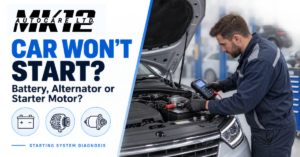

A warning light appears on your dashboard. You search for a car diagnostic price and find several different figures. What are you actually paying for?
A professional diagnostic appointment is a fault-finding process. A technician may read fault codes, examine live data, test a circuit, inspect a component and compare the results with the problem you described. The first scan can point them in a direction, but it does not always identify the failed part. That distinction matters when you are comparing prices.
You also need to separate the diagnostic charge from the cost of putting the fault right. Testing might establish that a wiring repair is needed, for example, but the repair requires its own labour and possibly parts. Some faults are found during an initial appointment. Intermittent or complex faults can require more investigation and a separate estimate.
MK12 Autocare currently displays £49.99 as the main price for its vehicle diagnostics product. The listing describes a 45-minute check with written reports. An older price of £39.99 also appears in a related-services table on the same page, so confirm the current checkout price and what your appointment covers before booking.
This guide explains what happens during a vehicle diagnostic test, why prices differ and how to use the results to make a sensible repair decision.
What Is a Car Diagnostic Test?
A car diagnostic test investigates a reported fault using information from the vehicle and checks carried out by a technician. Modern cars have electronic control units that monitor systems such as the engine, brakes, airbags and transmission. When a system detects a problem, it may store a diagnostic trouble code, illuminate a warning light or change how the car operates.
The aim is to understand why the fault occurred. A code reader is one tool in that process. The technician still needs to consider your symptoms, inspect relevant parts and decide whether further testing is needed.
Connecting to the Vehicle’s Electronic Systems
A technician usually connects diagnostic equipment through the vehicle’s OBD-II port. The equipment communicates with an electronic control unit, or ECU, and requests information such as fault codes, sensor readings and system status.
The available information depends on the car and the equipment being used. A simple reader may access basic engine information, while professional tools can often communicate with additional modules. Even then, electronic access cannot replace a physical inspection.
Reading Stored and Pending Fault Codes
A stored diagnostic trouble code records a condition that the vehicle’s system has detected. A pending code can indicate that a fault has appeared but has not yet met the conditions needed to confirm it or switch on a warning light.
Codes provide a useful starting point. Their wording must be interpreted alongside the vehicle’s symptoms and test data. A code mentioning a sensor circuit, for example, could relate to the sensor, its wiring, a poor connection or another condition affecting its signal.
Checking Live Sensor Data
Live data lets a technician see what the vehicle reports while the engine runs or a system operates. Depending on the fault, useful readings might include battery voltage, engine temperature, fuel pressure, wheel speeds or exhaust sensor values.
The readings become meaningful when they are compared with expected behaviour. A number on its own may look normal. A number that changes at the wrong time, disagrees with another sensor or fails to respond during a test may reveal where to investigate next.
Combining Electronic and Physical Inspection
An auto diagnostic check can lead to a hands-on test. If an ABS code points towards a wheel-speed signal, the technician may inspect the sensor, connector, wiring and nearby components. If an engine fault suggests an air leak, they may examine hoses or carry out a suitable leak test.
This combination helps distinguish a confirmed cause from a possibility. It also explains why two garages offering a “diagnostic test” may perform different amounts of work for different prices.
How Much Does a Car Diagnostic Test Cost?
There is no single car diagnostic price for every fault or every vehicle. The charge depends on what is included in the appointment, the time required and whether specialist access or testing is needed.
For a local reference point, MK12 Autocare’s main diagnostics listing currently shows £49.99 for a 45-minute appointment with written reports. Because the same page contains a conflicting older figure in another section, check the amount displayed when you book. Ask separately how additional testing is priced if the fault cannot be confirmed within the initial appointment.
Basic Code Reading vs Full Fault Investigation
Basic fault code reading may tell you which codes are stored and allow them to be cleared. It can be useful, but it rarely answers every question about the cause. A printout containing a code description is not necessarily a diagnosis.
A fuller investigation interprets codes, examines relevant live data and tests the system involved. Before comparing quotes, ask whether the diagnostic fee covers a scan only or includes technician time to investigate your specific symptom.
Labour Time and Technician Expertise
Diagnostic work requires time to gather evidence and interpret it. A technician may need to reproduce the complaint, consult vehicle information, take measurements and check whether an apparent fault is a cause or a consequence of another problem.
The number of minutes spent connected to a scanner is therefore only part of the labour time. An experienced technician’s reasoning and testing can save you from paying for parts that would never have fixed the fault.
Vehicle Make, Model and System Access
Different vehicles use different control modules, communication methods and test procedures. One engine warning may be straightforward to investigate; a network fault affecting several modules may take considerably longer.
Tell the garage your registration number and describe the fault before booking. This gives them a chance to check vehicle coverage, equipment needs and whether the initial appointment is likely to answer your question.
Specialist Equipment and Software
Professional automotive diagnostic test equipment may provide access to manufacturer-specific codes, guided functions and detailed live data. Other faults call for tools such as a multimeter, battery tester, pressure gauge or oscilloscope.
Equipment helps the technician gather evidence, but it does not make every result automatic. The right test depends on the symptom. A charging fault, for instance, may require electrical measurements even when the vehicle stores no useful code.
Written Reports and Follow-Up Testing
A written diagnostic report helps you keep track of what was found, what was tested and what should happen next. It is particularly useful when you need to consider a repair estimate or discuss an intermittent problem at a later appointment.
Check how the garage handles work beyond the booked scan time. If a further road test, circuit investigation or specialist procedure is needed, request the scope and price before that additional work begins.
Why a Cheap Code Scan May Not Find the Real Fault
An inexpensive scan can provide useful clues. It cannot, by itself, tell you that every code names a failed component. Cars monitor outcomes across connected systems, and one underlying fault may create several messages.
That is why the cheapest initial quote is not always the lowest total cost. If a part is replaced without confirming the cause, you may pay for the part and labour yet still have the original problem.
A Fault Code Identifies a System, Not Always a Failed Part
Suppose a code refers to an oxygen sensor reading. The sensor may be faulty, but an exhaust leak or an engine running incorrectly could also affect that reading. Replacing the sensor before checking the wider system might leave the warning light unchanged.
The code tells the technician where the vehicle noticed something unusual. Diagnosis asks what produced that condition. That extra step is what turns fault code reading into useful fault-finding.
Shared Symptoms Across Different Components
Loss of power can result from several different engine or emissions faults. Difficult starting can involve a battery, starter, fuel supply, sensor or electrical connection. Similar symptoms do not justify the same repair on every car.
A technician narrows the possibilities by asking when the problem happens. Does the car struggle only when cold? Does it lose power while accelerating? Does the fault appear after rain? Those details guide the next test.
Intermittent Faults and Historical Codes
An intermittent fault may not be active when the car reaches the workshop. Loose connections, temperature changes and vibration can make a problem appear and disappear. A historical code might record an earlier event that has already been repaired.
A technician may compare the code’s status with current data and your account of the symptom. Sometimes the best next step is to document the findings and arrange testing when the fault returns or the right conditions can be recreated.
The Risk of Replacing Parts Without Testing
Fitting a part because its name appears in a code description can become expensive. A new sensor cannot repair a broken wire, and a new battery cannot fix a persistent charging fault.
Ask what evidence supports the recommended repair. A useful explanation might refer to a failed measurement, a confirmed wiring defect or data that changed during a controlled test. That gives you a clearer basis for approving the work.
What Systems Can Be Diagnosed?
Car diagnostics can examine many electronic systems, but access varies by vehicle. The technician chooses relevant modules based on the warning light or symptom. Scanning every module can uncover useful context, although unrelated historical codes still need careful interpretation.
MK12 Autocare’s diagnostics listing describes checks involving engine management, ABS, airbags, transmission, emissions, DPF faults and battery or charging concerns. The precise tests needed for your car depend on what you report and what the initial findings show.
Engine Management and Emissions
The engine ECU monitors inputs and controls functions related to running and emissions. Engine diagnostics may involve checking stored codes, fuel-related data, temperatures, boost readings or sensor signals.
A dashboard engine light can have many causes. Its colour, whether it flashes, and how the car drives all matter. Tell the garage about poor acceleration, misfires, smoke or unusual fuel use rather than requesting only a code reset.
ABS and Electronic Braking Systems
The ABS system uses wheel-speed information and electronic control to help prevent wheel lock during braking. A warning may be related to a sensor, wiring, a reluctor ring, a module or another braking-system issue.
Diagnosis can include comparing wheel-speed readings and inspecting components at the affected wheel. Because the warning concerns braking, arrange an assessment promptly. The vehicle’s braking behaviour and any other brake warnings should be reported when booking.
Airbag and SRS Systems
The SRS, or supplementary restraint system, includes components associated with airbags and seat-belt pretensioners. An SRS warning can involve wiring, connectors, sensors or a control module.
Testing these systems requires appropriate procedures. Describe any recent battery work, seat repairs or previous collision repairs, as those details may help. Do not treat an airbag warning as a cosmetic dashboard issue.
Battery and Charging Systems
A weak battery or unstable voltage can affect several vehicle systems. You might notice slow starting, electronic features resetting or multiple warnings appearing together.
The investigation may include battery condition, charging performance and connection checks. A scan can show voltage-related codes, while direct measurements help determine whether the battery, alternator, wiring or another component needs attention.
Automatic Transmission Control
Many automatic transmissions have a dedicated control module. It can store information about shift faults, electrical problems or operating conditions when a problem occurred.
If the car slips, shifts harshly or hesitates before engaging drive, report the exact circumstances. Electronic data is useful, but the technician may also need a road test, fluid-related checks or further mechanical investigation.
DPF, EGR and Exhaust Sensors
Diesel vehicles may report issues involving the DPF (diesel particulate filter), exhaust gas recirculation, pressure sensors or exhaust temperatures. A warning does not automatically mean the filter itself must be replaced.
The technician may examine sensor readings and look for another fault that prevents normal emissions-system operation. If your car repeatedly makes short trips, mention that pattern. It can be relevant to how a diesel emissions problem develops.
Manufacturer and Model-Specific Modules
Some vehicles have additional modules for parking assistance, steering, battery management or other features. Access and available tests differ between manufacturers and models.
A module may report a fault caused elsewhere on the vehicle. A communication error, for example, can involve voltage, wiring or network issues. The findings must be considered together before recommending a repair.
How Long Does Vehicle Diagnostics Take?
A fixed appointment length is a starting point, not a promise that every fault will be solved within that time. MK12 Autocare currently describes its listed diagnostics service as a 45-minute check. That may be enough for an initial assessment and report, while some faults require a further authorised investigation.
The time required depends on whether the symptom is present, how many systems are involved and which tests are needed. Ask when you book whether you should plan to leave the car at the workshop.
Initial Scan and Customer Interview
The first few minutes often establish what the car is doing and when it started. Details about a recent repair, flat battery or warning that appears only on the motorway can be as useful as the initial scan.
The technician may then check relevant modules and note the codes and data before anything is cleared. Preserving that information helps connect the electronic record with your description.
Live-Data and Component Testing
Once the likely system is identified, the technician may compare live readings or test a component directly. A sensor test might involve checking its signal and electrical supply, rather than replacing it, because its name appears in a code.
Some tests can be completed quickly; others require access to a hidden connector or a condition that does not appear while the car is stationary. This is where investigation time can extend beyond a basic appointment.
Road Testing and Intermittent Faults
A road test may be necessary when a fault appears only during acceleration, braking, gear changes or at a certain speed. The technician can then compare what the driver feels with the vehicle’s recorded behaviour.
Intermittent faults are harder to schedule. If the symptom does not occur on the test drive, a responsible report should say so and explain what was and was not confirmed.
Why Some Faults Need More Than One Visit
A fault that occurs only after a cold start may require the car to be left overnight. A wiring problem caused by rain may be difficult to reproduce on a dry day. Parts removal or additional specialist testing can also require another appointment.
That does not mean the initial visit had no value. It should establish what has been checked, what the evidence suggests and which test is most useful next. Agree on any further diagnostic charge before proceeding.
What Is Included in a Written Diagnostic Report?
A good written diagnostic report gives you a usable record of the investigation. It should help you understand the complaint, the evidence collected and the recommended next step without requiring you to interpret a page of unexplained codes.
Report formats vary between garages and vehicles. MK12 Autocare advertises written reports with its diagnostics service; ask what will be included for your particular appointment if you need specific measurements or documentation.
Reported Symptoms and Initial Findings
The report should identify the concern you brought in, such as an engine warning light, intermittent starting fault or ABS message. Recording the symptom accurately matters because the same car could have several unrelated codes.
Initial observations might include whether the warning was active on arrival and whether the fault could be reproduced. This makes later comparisons easier if the problem returns.
Fault Codes and Affected Systems
Where relevant, a report can list the recorded diagnostic trouble codes and the control modules that stored them. It should distinguish an active concern from an old or uncertain entry when the equipment provides that information.
A code list is evidence, not a repair instruction. The useful part of the report is the technician’s explanation of how those codes relate to the symptom.
Test Results and Likely Causes
The technician may include measurements, live-data observations or the outcome of a physical check. A confirmed failed circuit is different from a possible cause that still needs testing.
Clear wording protects you from assuming that a preliminary finding is certain. If the result is inconclusive, the report should explain the remaining possibilities and what would distinguish them.
Recommended Repairs or Further Investigation
The final section should set out a practical next step. That might be a repair estimate, a recommendation for another test or advice to monitor an intermittent fault under specific conditions.
Ask whether the repair will need a post-scan or road test to confirm the result. This helps you understand what a complete repair process will involve.
Does the Diagnostic Fee Include Repairs?
Normally, the diagnostic fee pays for the agreed investigation. Parts and repair labour are separate unless the garage has explicitly included them in a package.
Before booking, ask what the initial charge covers and what happens if the fault requires more testing. A clear answer makes it easier to approve work in stages and understand the final invoice.
Diagnostic Labour vs Repair Labour
Diagnostic labour is the time used to find or narrow down a fault. Repair labour is the time used to access components, remove and fit parts, make a wiring repair or carry out another approved remedy.
They are different jobs, even when the same technician performs both. A garage should explain the proposed repair and its estimate before moving from investigation to replacement.
Replacement Parts and Programming
A repair may require parts, fluids or programming. Some electronic components must be configured to the vehicle after fitting; the process varies by make and model.
Ask whether a repair estimate includes parts, labour, applicable programming and confirmation testing. This avoids comparing a partial figure with a complete quote from another garage.
Approval Before Additional Work
If further diagnosis is needed, agree on a new time or price limit before it begins. You can also ask the garage to contact you when it reaches that limit.
The same principle applies to repairs. A written finding gives you room to understand the options and approve the next step without feeling pressured by a warning light.
Post-Repair Code Clearing and Confirmation
After a repair, a technician may clear relevant codes and check whether the fault returns. Some issues also need a road test or an operating cycle before the result can be assessed properly.
Clearing a code alone is not evidence that the cause has been repaired. A post-scan and suitable confirmation test provide a more useful result.
When Should You Book a Diagnostic Test?
Book an assessment when a warning light stays on, a fault repeatedly returns or the car behaves differently from normal. Early investigation can help you understand the problem before it becomes harder to reproduce or affects other components.
The urgency depends on the symptom. If you have a red oil-pressure warning, overheating, a serious braking concern or severe loss of power, stop safely and follow the vehicle handbook’s advice. Arrange recovery where continued driving could be unsafe.
Persistent Dashboard Warning Lights
An engine, ABS, airbag or transmission warning deserves attention even if the vehicle still drives. The light tells you that a system has detected a condition; it does not tell you the complete cause.
Note whether the warning appears at start-up, after a journey or under particular conditions. If it flashes or the car runs badly, seek advice promptly rather than waiting for a routine service.
Loss of Power or Poor Fuel Economy
Reduced power may occur alongside an engine warning or without one. Poor fuel economy can also have several causes, including a mechanical issue that leaves little useful electronic evidence.
Tell the technician when the change began and whether it followed a repair, a refuelling stop or another event. Your observations help focus the vehicle diagnostic test.
Starting and Charging Problems
Slow cranking, repeated flat batteries and a car that sometimes fails to start can involve several components. Charging and starting faults are particularly difficult to diagnose when the vehicle starts normally during the appointment.
Keep a note of the temperature, time parked and any electrical features that were in use. If you have already fitted a new battery, bring that information too.
Rough Running, Smoke or Unusual Noise
Misfires, shaking, unusual smoke or new engine noises need an assessment that goes beyond reading codes. A technician may need to check mechanical condition, fluid levels or the fuel and ignition systems.
Do not assume a diagnostic scanner can identify every source of noise. If the car is making a severe knocking sound, overheating or producing substantial smoke, stop driving and arrange advice.
MOT Emissions or Warning-Light Failure
If a car has failed its MOT on emissions or a relevant warning lamp, diagnostics can help investigate the cause before a retest. The exact MOT treatment of a warning light depends on the system and vehicle; the DVSA MOT inspection manual sets out the test criteria. (GOV.UK)
The MOT result identifies a test failure. It does not always diagnose the underlying fault. Share the failure record with the garage so the technician can investigate the right issue.
How to Prepare for a Diagnostic Appointment
You do not need to understand fault codes before visiting a garage. A clear account of what the vehicle does, when it happens and what has already been tried is often more valuable.
A little preparation can also prevent repeated work. Bring records and leave the vehicle’s stored fault information available where possible.
Record When the Fault Happens
Write down whether the symptom occurs when the engine is cold, after rain, at motorway speed or during braking. Note any exact dashboard message.
If the problem is intermittent, a safe photo of the parked vehicle’s display can be helpful. Never use your phone to record a warning while driving.
Bring Previous Repair Information
Tell the garage about recent battery replacement, sensor work, servicing, collision repairs or another diagnostic visit. Bring any invoices or previous reports you have.
This information helps the technician avoid repeating checks unnecessarily. It can also reveal whether the fault started soon after a particular repair.
Avoid Clearing Codes Before the Test
A pre-scan can capture fault codes and related information before any reset. Clearing codes immediately before the appointment may remove clues the technician needs.
If you have already cleared them, just say so. Note when you cleared them and whether the light returned. That history remains useful.
Share Battery or Starting History
Mention jump-starts, a flat battery, slow cranking or work on the charging system. Low or unstable voltage can sometimes produce several apparently unrelated electronic faults.
Knowing that history helps the technician decide whether voltage testing should come before investigating each stored code separately.
Car Diagnostics at MK12 Autocare
For drivers comparing vehicle diagnostics Milton Keynes options, ask what the advertised appointment includes, whether you will receive written findings and how further testing is authorised.
MK12 Autocare lists a 45-minute diagnostics service with written reports at a main displayed price of £49.99. The page also contains an older £39.99 figure in a related-services table. Confirm the current booking price with the workshop before relying on either figure for your invoice.
Written Reports and Workshop Testing
The advertised service covers an electronic health check and written reporting. Describe your particular concern when booking so the team can advise whether the standard appointment is a suitable starting point.
If the result points to a mechanical or intermittent problem, request the recommended next test and its price. A report is most useful when it clearly distinguishes confirmed findings from possible causes.
Stacey Bushes Location
MK12 Autocare lists its workshop at 27 Heathfield, Stacey Bushes, Milton Keynes. Its product page shows MK12 6HR in the main description, while a footer section on the same page shows MK12 6HP. Check the postcode in your booking confirmation before travelling.
The Stacey Bushes location serves drivers from MK12 Milton Keynes, Wolverton and surrounding areas. When arranging a visit, provide your registration number and the exact warning or driving symptom.
Booking for Milton Keynes and Wolverton Drivers
You can review the MK12 Autocare vehicle diagnostics service and use the site’s online booking page to start arranging an appointment.
Tell the workshop if your car has an MOT failure notice, will not start reliably or needs recovery. That information helps them advise on the appointment before you bring the vehicle in.
Pay for Accurate Fault-Finding, Not Guesswork
When comparing a car diagnostic price, look at the work behind the figure. A code scan can identify useful clues, but reliable fault-finding may also require live-data checks, electrical measurements, physical inspection or a road test. The result should make your next decision clearer.
Keep diagnosis and repair costs separate. Confirm what the initial appointment covers, ask for written findings and approve any additional investigation before it begins. If a technician recommends a replacement part, ask which test supports that recommendation. You should know whether the cause has been confirmed or whether further work is still needed.
For a car diagnostic appointment in Milton Keynes, MK12 Autocare currently advertises a 45-minute check with written reports. Check the live price when booking because its page shows conflicting figures. Arrive with your symptoms and repair history, and use the report to decide what to do next.
Frequently Asked Questions
Q1: Can a diagnostic test find every mechanical problem?
No. Electronic diagnostics can reveal codes and operating data, but some mechanical problems do not store a useful code. A worn bearing, fluid leak or suspension noise may need a physical inspection or road test.
Tell the garage about all symptoms, even when no warning light is showing. That allows the technician to choose the right checks.
Q2: Will clearing a fault code switch the warning light off permanently?
It may switch the light off temporarily. If the condition that triggered the code is still present, the light can return when the system detects it again.
Clearing a code is therefore a step that may form part of testing or repair confirmation. It is not a substitute for finding the cause.
Q3: Can I use a home code reader before visiting a garage?
Yes. A home reader can give you useful information to share with the technician. Save the exact code and note when the warning appeared.
Avoid buying a replacement part solely from the reader’s short code description. A professional automotive diagnostic test may be needed to confirm what failed.
Q4: Does a diagnostic test tell me exactly which part to replace?
Sometimes testing confirms a failed part during the initial visit. In other cases, the first appointment identifies the affected system and the next test needed.
A trustworthy result makes that distinction clear. Ask whether the suggested part is supported by a measurement, inspection or other test.
Q5: Can low battery voltage create multiple fault codes?
Yes, unstable or low voltage can sometimes affect several electronic modules. It does not follow that every collection of codes has a battery-related cause.
Share any flat-battery or jump-start history. The technician can check voltage and charging performance alongside the stored codes.
Q6: Will the garage provide a copy of the diagnostic report?
MK12 Autocare advertises its diagnostics service with written reports. Ask about the report format and what information it will contain when booking.
Keep your copy with the service history. It can help if you approve a repair later or the fault returns.
Q7: Is diagnostic testing useful before an MOT?
It can be useful if a warning light is on, the car runs poorly or you already know about an emissions problem. Finding the cause before the test may give you time to arrange a repair.
Diagnostics do not replace the MOT. The MOT is a separate inspection against the applicable test standards. (GOV.UK)
Q8: Can diagnostics be completed while I wait?
Some initial checks may fit within a booked appointment. MK12 Autocare describes its listed service as a 45-minute check, but the time needed to reach a conclusion depends on the fault.
Ask whether the workshop wants the vehicle left with them, particularly if the fault appears only after a cold start or during a road test.