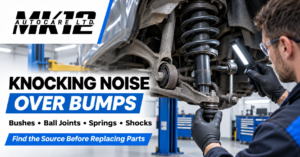

A knocking noise over bumps can make every pothole and speed hump feel like a warning. You may hear a dull clunk from the front, a light rattle near one wheel or a heavier thud through the floor. The sound might be obvious on a rough road and disappear completely on smooth tarmac. That pattern suggests movement, but it does not identify the failed part.
Several components can create similar noises. A worn control-arm bush, anti-roll bar link, ball joint, strut top mount or broken coil spring may all knock as the suspension moves. Loose exhaust hardware, brake components, wheel problems and even an unsecured item in the boot can sound surprisingly similar from the driver’s seat.
That is why a suspension knock is a symptom, not a diagnosis. Replacing the first part mentioned in an online forum can become expensive guesswork. A proper vehicle inspection aims to reproduce the noise, locate unwanted movement and check whether the fault also affects steering, stability or tyres.
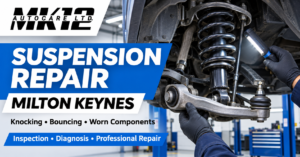
This guide explains the most likely sources, the clues that help narrow them down and the warning signs that should stop you from driving. If an inspection confirms worn parts, use MK12 Autocare’s dedicated suspension repair Milton Keynes page for local repair and booking information.
Why Does a Car Knock Over Bumps?
Suspension parts guide each wheel as it rises and falls. Springs carry the weight, dampers control movement, arms locate the wheel and rubber bushes allow limited flexibility. When a component develops excessive clearance or loses its cushioning, suspension travel can make two surfaces hit, shift or snap back into position.
The same road input can expose different faults. A small sharp bump may rattle a drop link, while a deep pothole may make a damaged top mount or spring seat clunk. Listening carefully helps, but the garage still needs physical evidence before recommending parts.
Movement Between Worn Components
Suspension joints and bushes are designed to move in controlled ways. A ball joint pivots, a rubber bush twists and a strut turns with the steering. Wear creates movement in directions the designer did not intend. When road force changes direction, that clearance can close suddenly and produce a knock.
The noise may appear only when one wheel crosses a bump because the component is loaded differently from the other side. It may also become louder with passengers or luggage. These clues help an auto mechanic, but they cannot replace checking the joint in the correct loaded or unloaded position.
Loose Mountings
A component can be healthy yet knock because its mounting is loose, corroded or damaged. Shock-absorber bolts, subframe fixings, anti-roll bar brackets and top-mount fasteners all rely on secure attachment. Even small relative movement can transmit a surprisingly heavy sound through the body.
Loose safety-critical fixings need prompt attention. Do not simply tighten an unknown bolt at home. Some fasteners are stretch bolts, require a specified torque or must be tightened at normal ride height. The mounting and surrounding metal must also be checked for damage.
Metal-to-Metal Contact
Rubber bushes, spring pads and mountings isolate vibration and stop hard surfaces striking each other. When rubber splits, separates or disappears, an arm, bar or spring may contact its bracket. The result can be a sharp clack or deeper thud depending on the size and position of the parts.
Metal-to-metal marks are useful evidence. A technician may find polished areas, chipped paint or rust dust where parts have been moving. The contact point is not always the original fault, so the inspection must determine what allowed the movement to happen.
Noise Caused by Suspension Travel
A bump compresses the spring and damper. As the wheel passes the bump, the system extends again. A fault can knock during compression, rebound or both. This is why the same car may sound different on a speed hump, pothole or driveway ramp.
Slow diagonal movement can twist the body and anti-roll bar more than a straight bump across both wheels. If a noise appears when one wheel rises but not when both rise together, anti-roll bar links or bushes become reasonable suspects. They still need testing before replacement.
Why Sound Can Travel Through the Body
The car’s structure carries vibration like the body of a guitar. A knock at the front subframe may seem to come from the footwell, dashboard or opposite side. Rear noises can travel through the boot floor and sound closer to the passenger compartment.
Road noise, trim panels and cabin insulation further distort direction. Opening a window or moving seats can change what the driver hears without changing the fault. Accurate diagnosis depends on reproducing the noise and observing components, not on perceived location alone.
Worn Bushes and Control Arms
Control arms hold the wheel hub in a defined relationship with the body or subframe. Flexible bushes connect the arms while filtering vibration and permitting the exact movement required by the suspension design. They work under acceleration, braking and cornering load on every journey.
Age, impact, road contamination and repeated load can deteriorate rubber or hydraulic bushes. The first sign may be a knocking noise over bumps, although steering changes and uneven tyre wear can develop as movement increases.
What Suspension Bushes Do
A suspension bush is not merely a soft spacer. Its shape, rubber hardness and internal voids control how an arm moves. Some bushes allow significant compliance in one direction while resisting movement in another, which improves comfort without losing wheel control.
Because movement is part of the design, a visible flex is not automatically a fault. The DVSA MOT manual notes that some rubber and synthetic bushes have comparatively high compliance. Serious deterioration, failed bonding or excessive movement matters more than minor surface ageing.
Cracked or Separated Rubber
Small surface cracks can appear as rubber ages. A technician looks deeper for separation from the metal sleeve, torn sections, distortion or fluid loss from a hydraulic bush. Once the rubber no longer restrains the arm correctly, load changes can produce a knock.
Oil and other chemicals can soften rubber and speed deterioration. If contamination is present, replacing the bush without addressing the leak can shorten the life of the new part. A useful diagnosis considers both the failed component and the reason it failed.
Control-Arm Movement
When a control-arm bush wears, the arm can shift as the wheel meets a bump. That movement may close a gap suddenly against the bracket, creating a dull clunk. A bent arm or loose fixing can create a similar effect and may follow a pothole or kerb impact.
The arm needs inspection for cracks, corrosion and distortion as well as bush condition. Some vehicles allow a separate bush to be pressed into the original arm. Others use an assembly containing bushes and a ball joint, so the correct repair depends on design and overall condition.
Knocking During Braking or Acceleration
Braking pushes suspension loads in one direction; acceleration can reverse them. A worn rear bush on a front control arm may let the wheel move backward during braking and return when the brake is released. The driver may feel a knock through the floor or steering.
Engine and gearbox mounts can also clunk when torque changes, so this pattern is not proof of a control-arm fault. Tell the garage whether the noise occurs with pedal input, steering or road bumps. Combining these details makes the investigation more efficient.
Effects on Wheel Geometry
Excessive bush movement can change toe, camber or caster while the vehicle is moving. The steering may wander, pull or feel inconsistent, and a tyre may wear on one edge. Static wheel alignment readings may also change as the joint moves under load.
An alignment adjustment cannot repair a damaged bush. Worn parts must be corrected first, followed by car wheel alignment where the manufacturer procedure or repair requires it. Otherwise, the wheel may not hold a stable setting.
Ball Joints and Anti-Roll Bar Links
Ball joints and anti-roll bar links are compact components that handle frequent movement. They contain articulated joints protected by rubber boots and lubricant. When wear develops, small clearances can become audible over broken road surfaces.
These parts sit close to the wheel, so drivers often describe the sound as coming from one corner. Yet a worn link can transfer noise through the bar, and a ball-joint sound can be confused with a wheel bearing, steering joint or control-arm bush.
Ball-Joint Movement
A ball joint allows the hub or control arm to pivot while maintaining wheel position. Wear between the ball and socket creates play. A bump can move the joint rapidly from one side of that clearance to the other, producing a knock or clunk.
Testing requires the correct jacking method. Spring force can load the joint and hide movement if the car is raised in the wrong place. DVSA guidance explains that different suspension types may need different support positions to remove force and assess play properly.
Drop-Link Knocking
Drop links connect the anti-roll bar to the suspension. Their small ball joints move whenever left and right wheel positions differ. Worn joints commonly create a repetitive light knock over small sharp bumps, cobbles or rough local roads.
A link can feel tight in one position and reveal play in another. The technician may need to load the suspension or use controlled movement to reproduce it. Replacing a link because it is a common cause can miss a top-mount or bush fault nearby.
Anti-Roll Bar Bush Wear
Anti-roll bar bushes hold the bar to the body or subframe while allowing rotation. When they wear, the bar may shift sideways or strike its bracket. The sound can be lower and more central than a drop-link rattle.
Bushes can look intact from below while being worn on the hidden surface. Polished areas on the bar or displaced bush edges may show movement. Correct part size and installation position matter because the bar diameter can vary between model versions.
Noise During Low-Speed Bumps
Small suspension knocks are often easiest to hear at low speed. Tyre and wind noise are quieter, and the wheel follows each surface change separately. Car parks, speed humps and uneven entrances can expose a link or bush that remains quiet on a smooth motorway.
Do not repeatedly drive over a harsh obstacle to test the noise. Note the type of surface, speed and steering position instead. A technician can choose a controlled route and inspect the car if the symptom suggests a safety concern.
Steering and Stability Symptoms
An anti-roll bar link mainly affects roll control, while a lower ball joint directly helps locate the wheel. Excessive ball-joint wear can therefore produce steering looseness, wandering or tyre wear alongside the knock. The seriousness depends on the joint and degree of deterioration.
If steering feels unpredictable, the wheel changes position or the joint may detach, stop driving and seek advice. DVSA defect categories treat excessive suspension-joint wear as major and a joint likely to detach as dangerous.
Shock Absorbers and Top Mounts
Shock absorbers, also called dampers, control the spring’s movement. In a strut system, the damper is part of a structural assembly that also guides the wheel. Top mounts connect that assembly to the body and may include bearings for steering rotation.
Wear can cause knocking, bouncing or both. However, weak damping does not always make a knock, and a noisy mount does not automatically mean the damper itself has failed. Each part needs separate assessment.
Internal Shock-Absorber Wear
Inside a damper, a piston forces oil through valves to control compression and rebound. Valve wear, internal damage or loss of pressure can reduce control. The car may bounce, float or take longer to settle after a bump.
Internal wear can exist without an obvious external leak. A knock may occur near the end of travel if the damper no longer controls the spring effectively, but bump stops, mounts and other parts must also be checked before blaming the shock absorber.
Loose or Damaged Damper Mountings
The upper and lower damper eyes or bolts must remain secure. Worn mounting bushes, loose fixings or elongated holes can let the damper shift each time the suspension changes direction. This can produce a clear clunk over bumps.
Inspection should cover the fixing, bush and surrounding metal. Tightening a bolt will not repair a torn bush or damaged bracket. Some fasteners must be renewed and tightened to a specified torque under defined suspension conditions.
Strut Top-Bearing Faults
Front strut top mounts often contain a bearing that lets the spring and strut rotate with the steering. A worn bearing can click, creak or knock while turning, especially at low speed. The spring may wind up and release if rotation is not smooth.
Some MacPherson strut top bushes show noticeable movement when the suspension hangs free. DVSA guidance warns that this can be part of the design. A technician must decide whether movement comes from wear or normal geometry.
Bouncing and Body Movement
If the body continues bouncing after a bump, damping may be weak. The Highway Code specifically warns that continued bouncing after pushing down on the front or rear can indicate worn shock absorbers that should be replaced.
A push test is only an initial clue. Modern suspension, vehicle weight and electronic dampers can change the response. A road test, leak inspection and component check provide a more reliable conclusion.
Leaking Dampers
Oil running down a damper body can indicate failed sealing and loss of fluid. Severe leakage, damage or negligible damping can be major MOT defects. A wet damper should be inspected alongside its partner on the same axle.
Not every mark is failure. The DVSA manual states that slight seepage creating a film is not in itself a reason for rejection. The amount, source and effect on damping must be evaluated rather than judging from a photo alone.
Broken Springs and Related Risks
Coil springs support vehicle weight and absorb vertical movement. They repeatedly compress and extend, often while exposed to water, grit and road salt. A fracture can occur at the end coil and remain partly hidden in the spring seat.
A broken spring may create a metallic clunk, uneven ride height or unstable handling. It can also become an immediate tyre risk. This is one suspension fault where continuing to drive can turn a component failure into a puncture or loss-of-control event.
How Coil Springs Break
The protective coating on a spring can chip or crack. Once metal is exposed, corrosion reduces its section until repeated loading causes fracture. Potholes, overloading, age and a damaged spring seat can add stress.
The break often occurs near the lower or upper end, where moisture and debris collect. The remaining spring may stay in place, so the driver hears an occasional knock without seeing anything obvious from outside the wheel arch.
Uneven Ride Height
One corner sitting lower than the opposite side can indicate a broken or weakened spring. Compare the car on level ground with normal load and correct tyre pressures. Road camber and luggage can otherwise create a misleading difference.
Ride-height change can also come from air-suspension faults, damaged mounts or previous incorrect parts. Measurement and inspection are safer than assuming the spring is the only cause.
Spring Contact With the Tyre
A broken spring end can move out of its seat and approach the inner tyre sidewall. Contact may cut the rubber or cause a sudden puncture. The AA advises that driving with a broken coil spring puts road users at risk because of this possibility.
If you see a spring fragment, fresh scrape marks or tyre contact, do not drive the car. Arrange recovery to a suitable repair centre. A tyre damaged on its inner side may not be visible without lifting the vehicle.
Noise During Steering
In a MacPherson strut assembly, the spring turns as the driver steers. A broken end, damaged seat or seized top bearing can make it jump, grind or knock. You may feel the sound through the steering wheel at parking speed.
Constant-velocity joints and steering components can also click while turning. Note whether the noise occurs when stationary, moving, on full lock or over a bump. These differences help the garage choose the correct checks.
When Not to Continue Driving
Stop if the car leans severely, the spring touches a tyre, steering becomes unstable or a component appears likely to detach. New scraping, a tyre bulge or a wheel sitting at an unusual angle also requires immediate attention.
Do not rely on an unexpired MOT certificate. The MOT reflects the vehicle at the time of inspection, not its condition today. Ask a professional whether recovery is required rather than taking a safety-critical car onto public roads.
Other Noises Mistaken for Suspension Knocks
Not every clunk over a bump comes from suspension. The same body movement that loads springs and bushes also shakes the exhaust, brakes, undertrays, spare wheel and items inside the cabin. A broad check prevents unnecessary suspension parts from being fitted.
This is also why phone recordings have limited diagnostic value. They can confirm the rhythm and severity, but cabin microphones distort direction and frequency. The source still needs to be located on the car.
Loose Exhaust Heat Shields
Thin metal heat shields protect the body from exhaust temperature. Corroded fixings can let a shield vibrate or tap against the exhaust when the vehicle moves over a bump. The noise is often lighter and more metallic than a heavy suspension clunk.
Exhaust hangers can also stretch or split, allowing the pipe or silencer to contact the body. A technician checks clearance and mounting condition rather than removing a heat shield that is required for protection.
Brake-Caliper Movement
Brake pads and floating calipers have controlled movement. Worn guide components, missing hardware or loose fixings may create a knock as the wheel rises or changes direction. The sound may change when light brake pressure is applied.
Do not use this as a DIY road test if braking feels abnormal. Loose brake hardware is safety-critical. A professional should inspect caliper security, pads, guides, discs and related suspension parts.
Wheel and Tyre Problems
Loose wheel fixings, a cracked wheel, tyre damage or a failing wheel bearing can create noise and movement. A stone trapped near a brake shield may also scrape or click. These faults require different repairs from a worn bush.
Check for a visibly soft tyre, bulge or wheel damage without crawling under the car. If the wheel feels loose, vibration is severe or a tyre is damaged, stop driving. A tyres and wheel alignment appointment should begin with safety checks, not automatic adjustment.
Steering-Rack or Track-Rod Faults
Inner and outer track rods connect the steering rack to the wheel hubs. Excessive play can knock over bumps and may be felt through the steering wheel. Steering-rack mountings or internal wear can create a more central clunk.
Because steering and suspension share wheel-control duties, the symptoms overlap. The technician should check both systems. Wheel alignment normally follows track-rod replacement, but alignment cannot repair looseness that remains.
Items Moving Inside the Boot
A loose spare wheel, jack, tool kit or bottle can mimic a rear suspension knock. The noise may happen only on corners or larger bumps. Folding seats and parcel shelves can rattle too.
Remove unsecured items and check that factory tools are clipped into place before booking. Do not remove essential safety equipment permanently. If the knock remains, a mechanical vehicle inspection is still needed.
How a Garage Finds the Source
Reliable diagnosis combines the driver’s observations with controlled testing. The technician tries to confirm when the sound occurs, then looks for physical movement, damage or contact that explains it. The process avoids replacing several possible parts one by one.
Some intermittent knocks take time. Temperature, load and suspension position can affect clearance. Clear information about the last journey on which the noise appeared can shorten the search.
Reproducing the Noise
The first step is defining the symptom. Is it one knock or a rapid rattle? Does it come from the front, rear or centre? Does it occur when one wheel crosses a bump, when both wheels rise together or when braking?
The technician may ride with the customer or use safe listening equipment. A known route can help reproduce the sound consistently. Random hard driving is neither safe nor useful.
Road Testing
A controlled road test reveals body control, steering feel, braking influence and the road input that triggers the noise. The technician listens for changes with speed, load transfer and steering angle while obeying normal road rules.
If a dangerous fault is suspected, inspection comes before a road test. A visibly broken spring, loose wheel or joint at risk of separation should not be driven merely to confirm that it knocks.
Lift Inspection
On a lift, the technician can see springs, dampers, arms, bushes, ball joints, anti-roll bar links, exhaust mountings and tyre inner faces. They look for fractures, severe corrosion, missing fixings, leakage and polished contact marks.
Suspension position changes when the wheels hang. Some faults become visible, while others unload and temporarily disappear. The vehicle may need to be supported in more than one position to assess the relevant joint correctly.
Controlled Component Movement
The technician may rock the wheel, support an arm or apply a lever carefully while watching joints and bushes. Play detectors can load components in ways that reveal movement. The objective is to reproduce the clearance without damaging the vehicle.
Normal rubber flex must not be mistaken for failure. The MOT tester guidance recognises that some bushes and strut top mounts naturally show movement. Experience and the correct loading method are essential.
Tyre and Wheel Checks
The tread pattern can reveal weak damping, geometry changes or pressure problems. The technician also checks for inner-side damage, bulges, uneven wear, loose fixings and wheel distortion. These checks may explain both the noise and a handling change.
If worn suspension has affected geometry, vehicle wheel alignment may be considered after repair. The tyres must first be safe and the mechanical parts stable enough to hold the setting.
Why Diagnosis From Sound Alone Is Unreliable
Many parts create similar frequencies, and the body carries sound away from its source. A drop-link rattle, exhaust tap and brake-caliper knock may all be described as “clunking over bumps.” The word is not specific enough to authorise a repair.
Diagnosis needs a matching physical fault. Ask the auto mechanic to explain the evidence, such as excessive joint play, failed bonding, a broken coil or contact marks. That explanation is more valuable than a list of parts that might be responsible.
When to Book a Suspension Inspection
Book an inspection when a new knock persists, becomes louder or appears with handling changes. A noise that disappears on smooth roads is still worth checking because suspension movement may be the only condition that exposes the clearance.
This article explains symptom causes, while MK12 Autocare’s commercial page covers local repair scope. Keeping those intentions separate helps you learn first and book the right service only when inspection is justified.
Knock Combined With Poor Steering
A knock plus looseness, wandering or delayed steering response raises the priority. Ball joints, control-arm bushes and steering links all help locate the wheel. Excessive movement can affect directional control.
Reduce speed and avoid unnecessary journeys. If the wheel position looks abnormal or steering feels unsafe, stop driving. Ask a garage Milton Keynes professional whether the vehicle needs recovery.
Uneven Tyre Wear
One-sided, feathered or cupped tread can accompany suspension or geometry faults. The Highway Code states that excessive or uneven tyre wear may be caused by braking or suspension faults or wheels that are out of alignment.
Replacing the tyre removes the worn rubber but not necessarily the cause. Arrange steering, suspension and pressure checks before final wheel alignment and tracking. The damaged tyre may still need immediate replacement for safety.
Vehicle Pulling or Instability
Pulling can result from tyre pressure, tyre construction, brake drag, road camber, alignment or suspension wear. Instability after a lane change or bump may also point to poor damping or joint movement. These symptoms require a broader assessment.
Tell the workshop whether the car pulls constantly, only during braking or after hitting a bump. If it cannot hold a predictable line, stop driving and obtain professional advice.
MK12 Autocare Suspension Inspection
MK12 Autocare provides suspension and car repair Milton Keynes support from its Stacey Bushes workshop. Drivers around MK12 Milton Keynes, Wolverton, Greenleys, Bradville and Neath Hill can describe the noise and arrange an appropriate inspection.
Provide the registration, mileage, recent MOT advisories and details of any pothole or kerb impact. If you also require car servicing or vehicle servicing, mention it during booking so the workshop can clarify the scope of each service.
Commercial Suspension Repair Page
If inspection confirms worn bushes, joints, springs, dampers or mounts, visit the Suspension Repair Milton Keynes: Knocking, Bouncing and Worn Components service page. It covers repair options, cost factors and local booking information without duplicating this symptom guide.
For a geometry concern after repairs, read the MK12 Autocare wheel alignment guide. Mechanical faults should be repaired before final alignment so the wheels can hold a reliable setting.
Inspect the Component Before Replacing Parts
A knocking noise over bumps can come from bushes, control arms, ball joints, anti-roll bar links, shock absorbers, top mounts or broken springs. It can also come from exhaust hardware, brakes, wheels, steering parts or loose items in the boot. Similar sounds do not mean identical repairs.
Pay attention to when the noise occurs and whether it comes with bouncing, pulling, uneven tyre wear or unstable steering. Those observations help a technician reproduce the symptom. They should guide an inspection, not become a do-it-yourself parts diagnosis.
Stop driving if a spring contacts the tyre, a joint may detach, steering becomes unpredictable or the vehicle sits at a dangerous angle. For a persistent but stable noise, arrange a professional inspection. Confirm the faulty component first, repair the cause and complete car wheel alignment only when the repair or geometry requires it.
Frequently Asked Questions
Q1: Is a Knocking Noise Over Bumps Dangerous?
It can be. A light knock may come from a worn drop link or loose heat shield, while a similar sound can result from a ball joint, broken spring or insecure suspension mounting. Sound volume does not reliably measure danger.
Check for additional warning signs: loose steering, severe pulling, a wheel at an unusual angle, a lowered corner, tyre contact or a component hanging down. If any appear, stop driving and ask a repair centre about recovery. If the car remains stable, book an inspection promptly rather than waiting for the next car MOT test.
Q2: Can Worn Bushes Cause a Knocking Sound?
Yes. When rubber separates or becomes excessively worn, a control arm or anti-roll bar can shift farther than intended. Load reversals over bumps, during braking or under acceleration can close that clearance suddenly and produce a dull knock.
Not every visible crack means a bush has failed. Many bushes are designed to flex. An experienced garage checks bonding, movement and effect on wheel control before recommending replacement.
Q3: What Does a Broken Spring Sound Like?
A broken coil spring may create a metallic clunk, twang or scraping noise. It can be most noticeable when steering, crossing a bump or carrying extra load. Some end-coil fractures remain almost silent and are discovered during inspection.
Look for uneven ride height or fresh marks near the inner tyre, but do not put yourself under the car. A broken spring can damage a tyre and is an MOT defect. Arrange professional assessment and avoid driving if contact or instability is possible.
Q4: Can a Top Mount Knock When Turning?
Yes. A worn top-mount bearing may bind while the strut turns, causing the spring to wind up and release with a knock or clunk. The mount itself may also develop excessive movement over bumps.
CV joints, steering links and spring-seat faults can sound similar. Tell the technician whether the noise occurs while stationary, at low speed, on full lock or only when the wheel also crosses a bump.
Q5: Why Does the Noise Disappear on Smooth Roads?
Smooth roads produce little suspension travel, so a worn joint may remain loaded against one side of its clearance. A bump changes the force quickly and allows the part to move or contact its mounting, which makes the noise.
The absence of noise on a motorway does not prove the car is safe. If the knock returns consistently on rough surfaces, arrange a vehicle inspection. Intermittent symptoms can still show measurable play or visible damage on a lift.
Q6: Can Wheel Alignment Stop Suspension Knocking?
Usually not. Wheel alignment changes available wheel angles; it does not repair a loose ball joint, torn bush, broken spring or worn top mount. A knock caused by physical clearance will remain after an alignment adjustment.
Repair worn parts first. Depending on the component and manufacturer procedure, the car may then need wheel alignment services. This order prevents spending money on settings that cannot remain stable.
Q7: How Does a Garage Locate an Intermittent Knock?
The technician asks when the noise appears, then may road-test the vehicle on a suitable route. On the lift, they inspect mountings and move relevant components under controlled load. Play detectors or chassis-listening tools may help with difficult cases.
Give specific details rather than saying only “it knocks.” Mention the road surface, speed, steering angle, braking, temperature, passengers and recent repairs. An intermittent noise can take longer to confirm, but evidence should still support any part replacement.
Q8: When Should I Stop Driving With a Suspension Noise?
Stop if steering or stability changes sharply, a wheel looks displaced, the car leans severely, a spring touches a tyre, a component is dragging or the noise follows a major impact with tyre damage. These conditions can create an immediate loss-of-control or puncture risk.
Do not assume a valid MOT makes the current fault safe. Contact MK12 Autocare or another qualified service centre and explain the symptoms. If they advise recovery, do not drive to a MOT testing station or workshop under your own power.