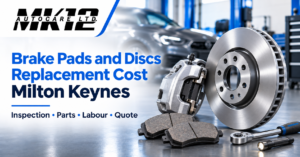

If you are trying to understand the brake pads and discs replacement cost Milton Keynes drivers may pay, the honest answer is that a reliable figure starts with the vehicle, not a generic price list. A small hatchback with standard front brakes will not use the same parts or require the same labour as a performance saloon, electric vehicle, large SUV or commercial van. Even two versions of the same model can have different disc diameters, calipers, wear sensors and braking specifications.
That is why a proper brake quote should be built from your registration number, the affected axle and an inspection of the components. The technician needs to confirm whether you require pads only, pads and discs, a wear sensor or additional work to a seized caliper, damaged carrier, brake hose or electronic parking-brake system. Quoting before checking these details is like pricing a new pair of shoes without knowing the size, style or condition of the old pair.
At MK12 Autocare, we believe the purpose of an inspection is to give you useful evidence. You should know what is worn, why it needs attention, which parts are included and how the final cost has been calculated. If the discs remain serviceable, you should be told. If they are below their safe working specification, heavily scored, heat-damaged or corroded, the recommendation should also be explained clearly.
Brake wear does not always arrive with a dramatic warning. Sometimes it begins with a faint squeal, a warning light or a slightly longer stopping response. In other cases, the first obvious symptom is grinding, vibration or one wheel becoming unusually hot. These signs deserve prompt attention because the braking system is central to vehicle control and road safety.
This guide explains when pads and discs normally need replacement, what changes the quote, why pads and discs may be replaced together and what a professional inspection should cover. If you need a local garage in Milton Keynes, you can use it to prepare the right questions before booking brake repair at our Stacey Bushes workshop.
When Do Brake Pads Need Replacement?
Brake pads are consumable friction components. When you press the brake pedal, the caliper pushes the pads against the rotating disc. The resulting friction converts the vehicle’s movement into heat and slows the wheels. Every braking event removes a tiny amount of pad material, so gradual wear is normal.
There is no single mileage at which every set of pads must be changed. Vehicle weight, driving style, traffic, road type, towing, brake design and the condition of the calipers all affect service life. A car used for repeated short urban journeys may brake far more often than one covering steady motorway miles. An electric or hybrid vehicle may also use regenerative braking, but its friction brakes still require physical inspection.
Low Friction Material
The most direct reason to replace pads is that the usable friction material has become too thin. A technician should assess the inner and outer pads because they do not always wear at the same rate. Looking through the wheel at one visible pad is not enough to establish the condition of the entire axle.
The DVSA MOT inspection manual treats a pad worn down to its wear indicator as a major defect. A brake lining or pad worn below 1.5 mm is categorised as dangerous. These MOT classifications are minimum test standards, not maintenance targets. Sensible maintenance aims to replace pads before they reach a dangerous state, particularly when the vehicle covers high mileage or has a long journey approaching.
Thin pads also have less material available to absorb and manage heat. That does not mean a pad becomes unsafe at one universal maintenance thickness, because specifications and recommendations vary, but it does explain why a technician considers remaining material, expected mileage and operating conditions together.
Brake Wear Warning Light
Some vehicles use an electrical wear sensor fitted to a pad. When the material wears to a defined point, the sensor circuit triggers a dashboard warning. Other pads use a mechanical indicator that produces a high-pitched sound when it contacts the disc.
An illuminated wear warning should prompt inspection, but it does not identify every detail of the required repair. The sensor may be fitted only to selected wheels, and the discs, opposite-side pads and caliper operation still need checking. The DVSA manual also makes an important distinction: an illuminated brake-wear indicator alone is not an MOT failure, while a pad physically worn to its wear indicator is a major defect.
Where the sensor is designed for single use, it may need replacement with the pads. That part and its installation can affect the quote. A damaged sensor wire or connector may require separate diagnosis rather than automatic replacement of otherwise serviceable brake parts.
Squealing or Scraping
A squeal can be caused by a wear indicator, vibration, contamination, surface glazing or a build-up of corrosion. It does not always mean the pad is completely worn out, but it should not be ignored. An inspection can separate a normal brief noise from persistent evidence of wear or poor component movement.
Scraping or grinding is more urgent. It can indicate that the friction material has worn away and metal is contacting the disc. Continuing to drive can damage the disc rapidly, increase stopping risk and turn a pad-only repair into a more extensive pads-and-discs job. If the braking response changes or the noise is severe, stop using the vehicle and arrange professional advice rather than trying to drive through the problem.
Reduced Braking Response
If the vehicle needs more pedal effort, takes longer to slow or feels different under braking, arrange an assessment promptly. Worn pads are one possible cause, but the fault could also involve contaminated friction surfaces, overheating, brake fluid, a hydraulic leak, a sticking caliper, vacuum assistance or another part of the system.
Do not rely on a dashboard warning to identify every brake problem. Many mechanical and hydraulic faults do not trigger a specific warning light. A hands-on inspection and, where appropriate, a controlled road test provide evidence that electronic vehicle diagnostics alone cannot supply.
Uneven Brake-Pad Wear
Pads on the same axle should be compared carefully. One pad being much thinner than its partner may point to a seized slider, sticking piston, damaged carrier or pad that cannot move freely. Simply fitting new pads without correcting the cause can make the new set wear unevenly again.
Uneven wear may also create heat, pulling or inconsistent braking. The quote should therefore identify whether normal pad replacement is sufficient or whether the caliper assembly requires cleaning, lubrication with suitable products, repair or replacement. This is one reason an accurate brake pad replacement cost in Milton Keynes cannot be confirmed from a generic vehicle category alone.
When Do Brake Discs Need Replacement?
Brake discs are designed to work with the pads as a friction pair. They usually last longer than one set of pads, but they still wear. Heat cycles, road salt, moisture, long periods of inactivity and caliper faults can all affect their condition. The fact that a disc still looks shiny in one area does not prove that it is within specification across its full working surface.
A technician should consider measurable thickness, the manufacturer’s minimum value, surface condition, corrosion, cracking, distortion and the way the vehicle behaves. Replacing discs unnecessarily adds cost, but keeping damaged or unsuitable discs can compromise the new pads and the quality of the repair.
Minimum Disc Thickness
As the pads clamp the disc, a small amount of disc material is also worn away. Manufacturers specify a minimum thickness for the disc. The technician measures it at suitable points with an appropriate tool, avoiding the unworn outer lip, and compares the readings with reliable vehicle data or the marking on the component where available.
The MOT and a workshop maintenance decision are not identical. DVSA guidance says that being below a manufacturer’s recommended disc limit is not, by itself, a reason for MOT rejection. For the MOT, a disc must be significantly and obviously worn to receive the relevant major defect. A responsible repair recommendation, however, also considers the manufacturer’s service limit, future wear and whether the disc can safely support another pad cycle.
Deep Scoring or Grooves
Light surface marks can occur during normal use, but deep scoring is different. It may develop when pads are worn excessively, debris becomes trapped, a pad is damaged or a caliper prevents even contact. Grooves reduce the quality of the mating surface and can stop new pads bedding evenly.
If a scored disc is retained, the new pad may initially touch only the high points. That can reduce effective contact, create noise and produce uneven temperature. The technician should assess the depth, pattern and overall condition rather than judging the disc from a photograph alone.
Heavy Corrosion
Surface rust can appear after rain or overnight parking and may clear during normal braking. Heavy corrosion, pitting or a large unswept area is more concerning. It is common on vehicles that cover low mileage, remain parked for long periods or use regenerative braking heavily, because the friction brakes may not clean the disc surfaces as often.
Corrosion can reduce consistent pad contact and create roughness, noise or imbalance. Rear discs are often affected because front brakes normally perform a larger share of the stopping work. An inspection should distinguish harmless temporary surface rust from deterioration that justifies replacement.
Heat Damage
Braking generates heat, and discs are designed to manage it. Excessive or uneven heat can create blue spots, hard patches, cracking or changes to the surface. Causes may include repeated heavy braking, a sticking caliper, incorrect bedding-in, overloading or continued braking on a long descent.
Replacing a heat-damaged disc without finding the cause may result in the same problem returning. The caliper, pads, sliders and driving symptoms should be assessed together. On a vehicle used for towing or commercial work, load and operating conditions are especially important to the diagnosis.
Brake Judder and Vibration
A steering-wheel vibration or pedal pulsation during braking is often described as a warped disc. In practice, the sensation may result from disc-thickness variation, uneven pad deposits, corrosion, hub runout, wheel-bearing movement, suspension wear or incorrect installation.
This is why parts should not be ordered solely from a symptom description. The technician may need to inspect the disc and hub mating surfaces, check wheel and suspension condition and measure the braking components. Correct diagnosis prevents a customer paying for discs when another fault is responsible.
Uneven Disc Surfaces
The inner face of a disc may be in worse condition than the outer face visible through the wheel. A partially seized caliper can also leave one face heavily worn while the other appears acceptable. Proper access and inspection are needed before deciding whether the discs can remain.
The assessment should cover both sides of the axle. If replacement is required, discs are normally replaced in axle pairs so that the left and right braking surfaces match. New pads are then installed with them, unless a manufacturer-approved procedure specifically states otherwise.
Brake Pad and Disc Cost Factors
The final brake pads and discs replacement cost Milton Keynes motorists receive is made up of parts, labour and any necessary supporting work. A useful quote should state the axle, component brand or quality level, VAT position where applicable, labour and additional items such as sensors or fluid. A single headline figure without this information is difficult to compare fairly.
Cheap parts are not automatically good value. Braking components need the correct dimensions, material specification, certification and compatibility with the vehicle. At the same time, an expensive quote should still be explained. Transparency matters more than a vague promise of either the cheapest or the most premium repair.
Vehicle Make and Model
The registration number helps the garage identify likely parts, but some vehicles have several brake options. Engine output, trim level, production date, axle load and factory package can change the fitted system. In some cases, the wheel or caliper must be checked before parts can be confirmed.
A common family car may use widely available components, while a performance model, electric vehicle or less common import may require larger or more specialised parts. Availability also affects how quickly the repair can be completed.
Front or Rear Axle
Front brakes usually do more work during deceleration because weight transfers forward. Their pads and discs may therefore be larger and may wear at a different rate from the rear set. However, rear brakes can suffer from corrosion, sticking mechanisms and electronic parking-brake complications.
Your quote should say clearly whether it covers the front axle, rear axle or both. “Brake replacement” is too vague because it does not tell you how many pads and discs are included.
Disc Size and Specification
Disc diameter, thickness, ventilation, coating and construction influence parts cost. Some vehicles use plain solid rear discs and vented front discs. Others use high-performance, two-piece or specially coated components. The matching pad compound also needs to suit the system.
The garage should select components that meet the required vehicle specification. Choosing only by approximate size risks incorrect fitment, poor performance or delays after the vehicle has already been dismantled.
Wear Sensors
Electrical wear sensors may be separate items or integrated with a pad. Some must be replaced after activation because the contact surface has been worn through. Others may be reusable if undamaged and permitted by the manufacturer.
The quote should identify whether a sensor is included. This avoids the frustrating situation in which the brake repair is completed but the warning remains because the sensor or reset procedure was not addressed.
Electronic Parking Brakes
Many modern rear braking systems use an electronic parking brake. The caliper may need to be placed into service mode with suitable equipment before the piston can be retracted safely. Forcing it mechanically can damage the actuator or caliper.
Service-mode procedures and calibration vary. The additional time and equipment can make a rear brake job different from a simple conventional system. Tell the garage about any parking-brake warning or previous repair before work begins.
Caliper Condition
Pads and discs cannot work correctly if the caliper is seized, leaking or unable to move. A sticking piston or slider can overheat one wheel and destroy new friction components quickly. The inspection must therefore take place before the final repair scope is agreed.
If the caliper requires replacement, the quote may also include a hose, brake fluid, bleeding and additional labour. These are not arbitrary extras when supported by clear evidence; they are part of correcting the underlying fault.
Should Pads and Discs Be Replaced Together?
Pads do not have to be replaced with discs every time. If the discs are within specification, have an acceptable surface and are likely to remain serviceable for the life of the new pads, a pad-only repair may be reasonable. The decision should be based on measurement and condition, not a blanket sales rule.
Equally, fitting new pads to badly worn discs can be false economy. You may return soon for another repair, pay overlapping labour and experience noise or poor bedding. The best decision is the one supported by inspection evidence and a realistic view of future use.
Matching New Pads to Existing Discs
New pads begin with a flat friction surface. An old disc may have a lip, grooves or uneven deposits. If the mismatch is excessive, the pad cannot make full contact immediately. That affects bedding and may create noise, localised heat or inconsistent feel.
This does not mean every minor mark requires new discs. A technician considers the whole surface and thickness. The goal is to determine whether the existing disc offers a suitable working face for the new pad.
Disc Measurement and Condition
Thickness measurement is essential, but it is not the only check. A disc can be above minimum thickness and still be unsuitable because of cracks, heavy corrosion, severe scoring or heat damage. It can also be below a manufacturer’s service limit without looking dramatic to the customer.
Ask for the reason behind the recommendation. Where practical, the garage should be able to show the worn part, measurement or visible defect. Clear evidence makes an itemised brake quote easier to trust and compare.
Replacing Brakes in Axle Pairs
Pads are supplied as axle sets, and discs are normally replaced in pairs. Replacing only the left or right pad or disc can create inconsistent friction and braking balance. The braking components on both wheels have worked under broadly similar conditions and should be assessed together.
A separate fault on one side, such as a seized caliper, still needs correction. Pair replacement does not remove the need to identify why one side wore faster.
When Discs Can Remain in Service
Discs may remain when they have adequate thickness, an acceptable surface, no significant damage and enough expected life for the new pads. The technician should also consider mileage and usage. A lightly used local car and a high-mileage work vehicle may justify different maintenance timing even with similar measurements.
If discs are retained, expect the garage to explain that a short bedding period is normal. You should also understand whether the existing surface may produce temporary noise or feel while the pads establish contact.
Why Inspection Evidence Matters
Evidence prevents two expensive mistakes: replacing serviceable parts and retaining parts that will compromise the repair. It also makes the quote specific. You can see whether the price covers pads only, pads and discs, sensors, caliper work or fluid.
At MK12 Autocare, the first step is to identify the vehicle and inspect the relevant system. You can then authorise the work with a clearer understanding of what is being repaired and why.
What a Professional Brake Inspection Includes
A brake inspection is more than glancing at the outer pad. The braking system combines friction parts, hydraulic components, mechanical movement, electronic controls and tyres. A professional assessment follows the symptom from the pedal to the wheel and looks for related damage.
The exact procedure depends on access, vehicle design and the reported problem. If a dangerous fault is suspected, the vehicle should not be road-tested until it is safe to do so.
Pad-Thickness Measurement
The technician checks the remaining friction material and compares inner and outer pads on both sides. Uneven readings may reveal a slider, piston or fitment problem. Cracks, contamination and damaged backing plates also matter.
The result helps determine urgency. A pad with limited material on a high-mileage vehicle may need earlier replacement than a casual visual description such as “a bit worn” suggests.
Disc-Thickness and Condition Checks
Disc thickness should be measured away from the outer wear lip and compared with the relevant specification. The surfaces are checked for scoring, corrosion, cracks, heat marks and inconsistent pad contact.
Where vibration is reported, further checks may be required. Disc replacement should not be treated as a guaranteed cure until hub condition, wheel fitment and related movement have been considered.
Calipers, Sliders and Carriers
The caliper piston must apply and release pressure correctly. Sliders should move as designed, and pads must be able to travel in the carrier without binding. Damaged boots can allow water and dirt to enter, leading to corrosion and seizure.
The technician also checks for leakage, damaged threads and insecure fixings. Any defect that changes the repair scope should be explained before additional work is carried out.
Brake Hoses and Pipes
Flexible hoses are inspected for cracking, chafing, swelling and leaks. Rigid pipes are checked for damage and excessive corrosion. These components carry hydraulic pressure; their condition is therefore as important as the visible friction parts.
DVSA guidance categorises a hydraulic brake-pipe leak as dangerous and an excessively corroded or damaged pipe as major. If a leak is present, do not continue driving in the hope that new pads will solve the problem.
Brake Fluid Condition
Brake fluid transfers force through the hydraulic system. Over time it can absorb moisture, and its condition or replacement interval should be considered according to manufacturer guidance. A low level may also signal wear or leakage and should not simply be topped up without investigation.
A fluid change is not automatically included with pads and discs. If it is recommended, the itemised quote should show it separately and explain the reason.
Road Test Where Safe
A controlled road test can help assess pedal feel, noise, pulling, vibration and braking response. It is performed only when the vehicle is safe and legal to drive. Severe grinding, a suspected hydraulic leak or an overheated wheel may make a road test inappropriate before inspection.
After repair, a final check may confirm that the system operates normally and that warning messages have been addressed. The customer should then receive bedding-in and aftercare guidance.
Seized Calipers and Additional Brake Repairs
A seized or sticking caliper is one of the most common reasons a straightforward pad quote changes after inspection. The caliper may fail to apply fully, fail to release or move unevenly on its sliders. Each fault affects wear and heat differently.
Ignoring the caliper and replacing only the friction parts is rarely sensible. The new pads and discs can be damaged quickly, leaving you to pay for the same axle again.
Signs of a Sticking Caliper
Possible signs include a burning smell, reduced performance, one wheel collecting much more brake dust, poor fuel economy or a car that feels reluctant to roll. The symptom can be intermittent, especially as temperature changes.
These signs are not exclusive to calipers, so diagnosis matters. A parking-brake mechanism, hose restriction, bearing or other fault may produce similar effects.
Uneven Pad Wear
If one pad is nearly worn out while its partner has substantial material, the caliper or pad movement needs investigation. Replacing the set without cleaning or repairing the mechanism leaves the cause in place.
The carrier may be corroded, the slider may be seized or the piston may not retract. Each solution has a different labour and parts requirement.
Vehicle Pulling During Braking
A car that pulls during braking may have unequal braking force. A sticking caliper is one possibility, but tyre condition, alignment, suspension, contamination and hydraulic faults can also contribute.
Tell the garage when the pulling occurs and whether it began suddenly. If it is severe or accompanied by reduced braking, arrange recovery rather than driving to the workshop.
Excessive Heat From One Wheel
A wheel that becomes much hotter than the others after a normal journey may have a dragging brake. Do not touch the disc or caliper because braking components can cause burns. Park safely and seek advice.
Continued driving can overheat the pad, disc, fluid, wheel bearing and tyre area. What began as caliper movement can therefore become a much larger repair.
How Caliper Faults Affect the Quote
The cost depends on whether the caliper can be serviced safely, needs replacement or has damaged other parts. A replacement may require bleeding, fluid, an electronic parking-brake procedure and extra time. Parts availability may also affect same-day completion.
The garage should contact you with the evidence and revised total before proceeding beyond the authorised scope. Ask whether the quote includes the caliper, pads, discs, sensor, brake fluid, labour and VAT where applicable.
Brake Bedding-In and Aftercare
New pads and discs do not reach their final working relationship the instant the vehicle leaves the lift. Bedding-in allows the surfaces to establish even contact and a stable friction layer. The process supports consistent performance and helps reduce uneven deposits.
There is no universal routine for every pad and disc combination. Follow the instructions supplied by the technician and component manufacturer, particularly if the vehicle uses performance brakes or has a demanding duty cycle.
Why New Surfaces Need Time to Bed In
Microscopically, new surfaces are not perfectly matched. Early controlled braking gradually increases the contact area and transfers material evenly. Repeated extreme braking from the first mile can create excessive local heat before that relationship is established.
You may notice a slightly different pedal feel or smell during the initial period, but the brakes should still operate safely. If stopping ability feels poor, do not assume bedding-in will fix it.
Following Technician Instructions
Your technician may advise moderate braking, allowing cooling time and avoiding unnecessary emergency-style stops for an initial distance. The correct advice depends on the fitted parts and vehicle.
Keep the invoice and note which components were fitted. If you return with a concern, that information helps the garage assess the repair and any warranty conditions.
Avoiding Harsh Unnecessary Braking
Plan ahead, maintain a safe following distance and use progressive braking where traffic allows. Do not perform aggressive bedding procedures on public roads unless a qualified professional and the component instructions specifically require a safe, legal method.
Also avoid holding very hot brakes stationary with heavy pedal pressure for longer than necessary, because this may encourage uneven material transfer. Normal safe driving always takes priority over any bedding routine.
Normal vs Abnormal Post-Repair Symptoms
A mild temporary smell, light surface noise after rain or a slightly changing feel may occur. Persistent grinding, strong pulling, severe vibration, smoke, fluid leakage, a very hot wheel or a warning message is not something to monitor casually.
If in doubt, contact the garage and describe when the symptom occurs. A quick reinspection can separate a normal settling characteristic from a fault that needs immediate correction.
When to Return for Inspection
Return promptly if braking response worsens, the pedal feels unusually soft or hard, a warning light stays on, or new noise becomes severe. Stop using the vehicle if it may be unsafe.
You should also follow any scheduled recheck recommended for associated components. For example, a borderline hose, corroded pipe or tyre problem remains important even after the pads and discs have been replaced.
Book Brake Repair in Milton Keynes
If you need car repair in Milton Keynes, MK12 Autocare can inspect your braking concern and prepare a vehicle-specific quote. Our workshop is located at 27 Heathfield, Stacey Bushes, Milton Keynes, MK12 6HR, serving drivers across the MK12 Milton Keynes area and nearby communities.
When contacting us, describe the symptom rather than diagnosing the part yourself. Tell us about grinding, squealing, vibration, pulling, warning lights, heat or any recent MOT advisory. This helps us reserve suitable inspection time and understand whether the vehicle may be unsafe to drive.
Itemised Brake Quote
An itemised quote helps you see the difference between pad-only replacement, pads and discs, sensor work and caliper repairs. It should identify the axle, parts, labour and additional authorised work.
If inspection reveals a different problem, we can explain the evidence and revised scope before repair. You remain better informed than you would with a vague one-price estimate.
Registration and Axle Information
Provide the registration number, make, model and current mileage. Tell us whether the concern appears to come from the front or rear, although final diagnosis will depend on inspection.
If the car has modified, upgraded or optional brakes, mention that when booking. Photos or previous invoices may help, but they do not replace checking the fitted components.
Same-Day Availability Where Possible
We will discuss current availability when you contact the workshop. Same-day inspection or repair may be possible where diary space, diagnosis and correct parts allow, but it should not be promised before the vehicle and parts requirement are confirmed.
If the vehicle is unsafe, ask about recovery or the safest next step. An appointment does not make a dangerous vehicle roadworthy.
Stacey Bushes, MK12 and Nearby Locations
Our Stacey Bushes location provides convenient access for drivers from Wolverton, Bradwell, New Bradwell and surrounding Milton Keynes areas. Contact the team if you need current opening times, directions or accessibility information.
You can review the wider services offered by MK12 Auto Care before booking. These include MOT testing, car servicing, diagnostics, alignment and mechanical repair support.
Connecting Brake Repairs With MOT or Servicing
Brake wear is often identified during servicing or an MOT. If your annual test is approaching, ask whether a combined MOT and service appointment is suitable. The MOT remains a regulated inspection, while servicing covers maintenance in a different way.
Drivers looking for a full car service in Milton Keynes can mention brake symptoms when booking so the workshop can plan enough time. If you operate an eligible commercial van and are also searching for a Class 7 MOT near me, provide the vehicle class and brake concern together.
To request an appointment, use the online vehicle service booking page or call MK12 Autocare on +44 1908 22 77 94. Do not wait for the next routine visit if the brakes are grinding, pulling, overheating or losing effectiveness.
Book an Inspection Before Brake Wear Becomes Dangerous
The most useful answer to brake pads and discs replacement cost Milton Keynes is a quote supported by inspection. Vehicle specification, axle, disc size, sensors, electronic parking brakes and caliper condition can all change the total. A low headline price is not helpful if it excludes necessary parts or fails to correct the reason for uneven wear.
Act early when you notice squealing, scraping, vibration, pulling, a warning light or reduced response. Early inspection may protect serviceable discs and prevent heat from damaging a wider group of components. More importantly, it gives you evidence before normal wear develops into an unsafe condition.
MK12 Autocare can check the pad thickness, disc condition, caliper movement, hoses, pipes and fluid-related concerns, then provide an itemised recommendation. Contact our Stacey Bushes workshop with your registration, mileage and symptoms to arrange brake repair in Milton Keynes. If you believe the vehicle may be dangerous, stop driving and ask for advice about recovery.
Frequently Asked Questions
Q1: How Much Does Brake-Pad Replacement Cost in Milton Keynes?
There is no responsible single price for every car. The total depends on the registration, front or rear axle, pad specification, wear sensors, caliper design and labour required. A small car with conventional front brakes may need a simpler job than a large SUV, performance model, electric vehicle or van.
For an accurate brake pad replacement cost in Milton Keynes, provide your registration and arrange an inspection. Ask whether the quote includes an axle set of pads, sensors, fitting, VAT and any brake-fluid or caliper work. If a price is supplied without identifying the vehicle or axle, treat it as an initial estimate rather than a confirmed total.
Q2: Do Brake Discs Need Replacing With Every Set of Pads?
No. Discs can remain if their thickness, surface and overall condition are suitable and they are expected to last through the new pad cycle. A technician should check both faces for scoring, corrosion, cracking, heat damage and uneven contact.
Discs should be replaced when wear or damage makes them unsuitable for the new pads. Fitting pads to a heavily grooved or badly corroded surface may cause poor bedding, noise and uneven wear. The decision should come from measurement and inspection rather than an automatic rule.
Q3: Should Pads Be Replaced on Both Sides of an Axle?
Yes. Brake pads are replaced as an axle set so the left and right wheels receive matching friction material. Discs are also normally replaced in axle pairs. Replacing only one side can create inconsistent braking characteristics.
If one side is much more worn, the garage must investigate the cause. A seized slider, sticking piston or contaminated surface could damage the new set unless it is corrected at the same time.
Q4: Why Are My Brakes Making a Grinding Noise?
Grinding can mean the pad friction material has worn away and metal is contacting the disc. It may also involve debris, a damaged backing plate, severe corrosion or another mechanical fault. Because metal-to-metal contact can damage the disc quickly, continued driving may increase both risk and repair cost.
Stop and seek professional advice if grinding is accompanied by reduced braking, pulling, smoke, a burning smell or a warning light. Do not wait for a future vehicle MOT test to identify the problem. A vehicle must remain roadworthy between tests.
Q5: Can a Seized Caliper Increase Repair Costs?
Yes. A seized caliper can wear one pad rapidly, overheat the disc and damage new components. Repair may require a replacement caliper, additional labour, brake fluid, bleeding or an electronic parking-brake procedure.
The garage should explain how it confirmed the fault and whether other parts have been affected. Correcting the caliper is often necessary to protect the new pads and discs, not an unrelated addition to the quote.
Q6: How Long Do New Pads and Discs Take to Bed In?
The exact period depends on the components and manufacturer instructions. Many systems settle progressively over the first several journeys or few hundred miles, but there is no single distance that applies to every vehicle. Follow the technician’s guidance.
Use smooth, progressive braking where safe and avoid unnecessary repeated harsh stops during the initial period. However, the brakes must still function safely from the time the vehicle is returned. Severe vibration, grinding, pulling, smoke or weak braking needs immediate inspection.
Q7: Will Worn Brake Pads Fail an MOT?
They can. DVSA guidance states that a lining or pad worn down to the wear indicator is a major defect, while a lining or pad worn below 1.5 mm is dangerous. An illuminated wear indicator alone is not a reason for failure, but the actual pad condition may still result in a major or dangerous defect.
The MOT is a minimum-standard inspection on one day. Do not use the test threshold as a target for normal maintenance. If you receive a brake advisory, read our guide to MOT advisories explained and arrange a condition check before the wear becomes serious. Official brake defect criteria are available in the DVSA MOT inspection manual.
Q8: What Details Are Required for a Brake Quote?
Start with the registration number, make, model, mileage and a clear description of the symptoms. Tell the garage whether the noise or vibration occurs during light braking, heavy braking, at a particular speed or after the vehicle becomes warm. Mention any dashboard message or recent MOT advisory.
Also explain whether the vehicle has modified brakes, an electronic parking brake or a previous caliper repair. The registration identifies likely parts, but inspection confirms the fitted system and its condition. This information allows MK12 Autocare to prepare a more accurate brake pads and discs replacement cost Milton Keynes quote and discuss realistic appointment timing.