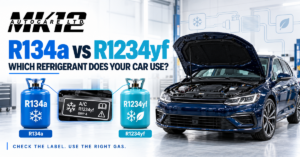

Modern cars do not all use the same air-con gas for car cooling. A system may contain R134a Refrigerant, R1234yf or another approved gas. They perform a similar job but are not interchangeable; each system is designed and serviced around one specification.
Vehicle age is only a starting point. Many older cars use R134a gas, while R1234yf became common in lower-GWP systems. A model can change gas during production, and imports or repaired vehicles may not match an age-based assumption.
Find the refrigerant label under the bonnet, check manufacturer data or ask a suitably equipped garage. This guide explains R134a vs R1234yf, identification, mixing risks and what to expect from an air-con regas, including compatibility checks at MK12 Autocare.
How a Car Air-Conditioning System Works
A car’s air conditioning is a sealed heat-transfer system. Refrigerant collects cabin heat at the evaporator, carries it through the refrigerant circuit, then releases it at the condenser.
Correct refrigerant, pressure, lubricant and components must work together. A low charge, contamination or unsuitable gas can weaken cooling and strain components.
Refrigerant Circulation
Refrigerant circulates through pipes, hoses and components as both a liquid and a vapour. It changes state as system pressure and temperature change. In the cabin-side evaporator, low-pressure refrigerant absorbs heat and boils into vapour. It then returns to the compressor to begin the cycle again.
Refrigerant is not fuel a car routinely consumes. Rapid or repeated loss suggests a leak or component fault, so adding gas without investigation may only hide the problem.
Compressor, Condenser and Evaporator
The air-conditioning compressor is the pump at the heart of the system. Driven mechanically or electrically, it compresses low-pressure refrigerant vapour into a hot, high-pressure vapour. The refrigerant then enters the condenser, normally positioned near the front of the vehicle, where passing air removes heat and changes the vapour into a high-pressure liquid.
After a metering device lowers its pressure, refrigerant reaches the dashboard evaporator and absorbs cabin heat. Moisture condenses there, helping demist windows and causing harmless water drips beneath a parked car.
Pressure Changes and Cabin Cooling
Pressure changes control where the refrigerant absorbs and releases heat. The compressor raises pressure and temperature; the expansion device sharply reduces pressure before the evaporator. This controlled difference allows the refrigerant to boil at a suitably low temperature inside the cabin and condense at a higher temperature outside it.
The system needs the labelled refrigerant mass. Too little can reduce cooling and oil circulation; too much can raise pressure. Professional machines charge by weight, not guesswork.
Why the Refrigerant Specification Is System-Specific
Manufacturers design seals, hoses, service ports, lubricant, control software and safety measures for a defined refrigerant. R134a and R1234yf have different chemical and safety characteristics, so a system approved for one should not be casually filled with the other. The correct specification is part of the vehicle’s engineering, not a preference selected during a service.
Similar-looking systems can require different charges and procedures. Checking the label or manufacturer database before connecting recharge equipment prevents refrigerant contamination.
What Is R134a Refrigerant?
R134a Refrigerant, also called HFC-134a or 134a refrigerant, replaced ozone-depleting R12 in most cars during the 1990s. It cools effectively and has zero ozone-depletion potential, but a much higher global warming potential than R1234yf.
The US EPA lists a 100-year GWP of 1,430 for HFC-134a and 4 for HFO-1234yf. That explains the move towards lower-GWP alternatives, but existing R134a vehicles must still receive their approved gas.
Vehicles Commonly Associated with R134a
R134a is commonly found in cars built from the 1990s through the earlier part of the 2010s. It also remains present in many vehicles still driven and serviced across the UK. A pre-2015 registration may make R134a more likely, but it is a clue, not proof.
Transition timing varied by model, category and market, while late registration can mislead. Use the label, vehicle data or professional confirmation before booking.
Pressure and Equipment Requirements
An R134a service machine recovers the existing charge, measures what was removed, creates a vacuum and installs the specified quantity. Its hoses, couplers and storage cylinder are intended for R134a. The machine must be maintained correctly so recovered refrigerant does not contaminate other vehicles or the workshop’s supply.
Pressure varies with temperature, airflow and system operation, so one gauge cannot establish charge quantity. Accurate servicing uses stated system capacity, suitable equipment and operational testing.
Environmental and Handling Considerations
R134a is an F-Gas, so release to the atmosphere must be avoided. UK government guidance says F-gases must be recovered by appropriately qualified technicians and that unnecessary intentional release can lead to enforcement action. Professional recovery allows the gas to be recycled, reclaimed or handled as controlled waste.
Liquid refrigerant can cause cold burns, while vapour can displace oxygen. Approved connections, protection and controlled recovery make professional service safer than a DIY can.
Why R134a Is Still Used in Many Older Cars
R134a remains relevant because millions of compatible vehicles are still on the road. The later restriction focused on the design and approval of new vehicles using high-GWP refrigerant; it did not make R134a illegal in every existing car. Correctly maintaining an original R134a system is normally safer than improvising an unapproved refrigerant change.
For R134a refrigerant UK service, confirm both gas and charge quantity. Correct recovery keeps compatible older systems efficient and limits emissions.
What Is R1234yf Refrigerant?
R1234yf, or HFO-1234yf, performs the same heat-transfer role as R134a with far lower GWP. European limits on refrigerants above GWP 150 accelerated its adoption in new passenger vehicles.
R1234yf is A2L, commonly described as mildly flammable, while R134a is A1. Correctly designed vehicles remain safe, but servicing requires appropriate controls, labels and equipment.
Why Manufacturers Moved to R1234yf
The EU Mobile Air-Conditioning Directive drove the move to refrigerants below GWP 150. The European Commission says R134a was prohibited in new passenger cars from 2017, with R1234yf the main substitute.
Manufacturers validated materials, heat exchangers, charge quantities, software and safety provisions for R1234yf. The gas is therefore a fixed vehicle specification.
Vehicles Commonly Using R1234yf
R1234yf is common in many newer petrol, diesel, hybrid and electric cars. It can also appear in vehicles registered before 2017 because the transition began by model and type approval rather than with a single UK registration plate change. Conversely, age alone cannot prove that every later vehicle uses it.
EV climate systems may cool the cabin, battery and electronics. Many use R1234yf, some use R744, so manufacturer data remains decisive.
Service Equipment and Safety Procedures
R1234yf requires compatible recovery, recycling and charging equipment. Machines may include refrigerant identification, leak checks and ventilation-related safety features. The service connections are deliberately different from R134a fittings to reduce the chance of an accidental mix.
Technicians must follow A2L procedures, control ignition sources and use approved equipment. Incompatible couplers must never be defeated with adaptors.
Cost and Availability Differences
R1234yf usually costs more because the gas, dedicated machines and handling requirements cost more. Charge quantity and diagnostic work also affect the bill.
Request a quote for the confirmed refrigerant. It should state the included charge, checks and extra costs if a leak or fault appears.
R134a vs R1234yf Comparison
R134a is an established HFC used in many older cars; R1234yf is a lower-GWP HFO common in newer designs. Both cool effectively only in their intended system.
For owners, the differences affect identification, equipment, procedure and price. Label and manufacturer data tell the technician which service process to follow.
Chemical and Environmental Differences
R134a and R1234yf are different molecules with substantially different atmospheric effects. R134a has a GWP of about 1,430, while R1234yf has a GWP around 4 under the comparison published by the US EPA. Neither depletes stratospheric ozone, but R1234yf breaks down much faster in the atmosphere.
Their flammability classifications also differ. R134a is classed A1, while R1234yf is A2L and mildly flammable. The distinction shapes system and service requirements, yet both refrigerants can be used safely when the vehicle design and approved procedures are followed.
System Design and Service Connections
Service ports are intentionally designed to discourage connecting the wrong equipment. R134a and R1234yf couplers are not supposed to be interchangeable. SAE safety guidance explains that unique fittings and service equipment help prevent cross-contamination during automotive air-conditioning work.
Port shape is useful to a technician, but an owner should not identify the gas by cap colour alone. Caps can be replaced, faded or fitted incorrectly. The printed refrigerant specification and charge weight are better evidence, supported by the vehicle manufacturer’s technical data.
Equipment and Technician Requirements
An R134a machine needs dedicated or correctly segregated recovery paths, cylinders and couplers. An R1234yf machine must accommodate that refrigerant’s safety and purity requirements. Refrigerant analysers may be used when the contents are uncertain, particularly on imported, previously repaired or incorrectly serviced vehicles.
In Great Britain, government guidance on F-Gas qualifications requires a relevant qualification to recover refrigerant from qualifying mobile air-conditioning systems. Competence matters because the work involves pressure, controlled gases, electrical components and valuable equipment.
Typical Regas Cost Differences
R134a is often the less expensive service because its refrigerant and established equipment base generally cost less. MK12 Autocare currently advertises an R134 air-con DeGas/ReGas service for pre-2015 vehicles at £79.99, but compatibility must still be confirmed before connection.
R1234yf prices vary and should be checked directly with the garage. Do not compare quotes until you know they cover the same refrigerant quantity and process. Leak diagnosis, replacement seals, condenser damage or compressor faults are separate from a routine regas and can change the cost substantially.
Compatibility and Contamination Risk
Mixing R134a and R1234yf can create an off-spec charge that cannot be processed as clean recovered refrigerant. It may contaminate a recovery cylinder or machine, leading to isolation, disposal and cleaning costs. The vehicle will still need the mixed contents removed before the correct refrigerant is installed.
Contamination can also make pressure and performance readings difficult to interpret. A garage may use an identifier before recovery if the history is suspicious. That extra step is sensible protection, not an unnecessary add-on, because one contaminated vehicle can affect equipment used on many others.
How to Check Which Refrigerant Your Car Uses
Do not guess from a forum or registration year. Start with the engine-bay label showing the refrigerant, charge quantity and sometimes lubricant or safety information.
If the label is unreadable, use the manual, VIN-linked manufacturer data or professional confirmation before booking, even when a service uses a broad age cut-off.
Find the Label Under the Bonnet
Open the bonnet safely with the vehicle parked, switched off and cool. Look for a printed or engraved label containing “R-134a”, “HFC-134a”, “R-1234yf” or another refrigerant code. The label may also show a snowflake symbol, oil information and a quantity such as 500 g plus or minus a stated tolerance.
Do not loosen a cap, press a valve or connect a DIY hose while checking. The under-bonnet label is designed to provide the information without opening the pressurised circuit. Photograph it clearly so the garage can review the details when you enquire.
Near the Front Panel, Compressor or Bonnet Area
Common label locations include the slam panel above the radiator, the underside of the bonnet, a strut tower, the bulkhead or a plastic engine-bay cover. On some vehicles it sits near the air-conditioning pipework or air-conditioning compressor, although access and visibility vary.
Use a torch and check both sides of the engine bay. Do not reach near belts, fans or hot components. If the label is hidden, damaged or absent, stop there rather than removing parts. A workshop can access manufacturer data without creating a safety risk.
Read the Refrigerant Type and Charge Quantity
The refrigerant code answers “which gas?”, while the mass answers “how much?” A label may state R134a 525 g, for example, but the actual value is vehicle-specific. A dual-zone model, hybrid variant or different engine can carry a different charge from an otherwise similar car.
Give both pieces of information to the garage. The system capacity helps it confirm the correct database entry and quote. Never assume that a half-full system needs half of the label quantity; the remaining amount must be recovered and measured before an accurate charge is installed.
Check the Owner’s Manual or Manufacturer Data
The handbook may list the refrigerant in the technical data or climate-control section. Digital manuals and manufacturer service portals can also help. Make sure the document matches the exact model, production period, engine and market, not merely the same badge on the boot.
A VIN-based lookup is stronger evidence because it can identify build specification and relevant updates. If handbook and under-bonnet information conflict, do not choose between them yourself. Ask a garage or manufacturer representative to investigate, particularly if previous accident repair may have replaced a panel carrying the original label.
Ask a Garage to Identify the System
When contacting a car air conditioning repair specialist, provide the registration, VIN if requested, label photo and any service history. The technician can compare these details with vehicle data and inspect the connections. If contamination is suspected, refrigerant identification may be necessary before recovery.
This check should happen before the garage promises a refrigerant-specific service. At MK12 Autocare, you can ask for compatibility confirmation when booking an aircon regas in MK12 Milton Keynes. It is a small step that prevents the wrong machine or gas being used.
Can Vehicle Age Confirm the Refrigerant Type?
Vehicle age narrows the possibilities but cannot identify refrigerant conclusively. The transition varied by type approval, production date, model and market.
Use age as a prompt to check, not permission to connect equipment. The label and manufacturer specification remain decisive.
Why Registration Year Is Only a General Guide
Number plates and registration records are convenient, so many service menus use year ranges. In broad terms, earlier vehicles are more likely to use R134a and later vehicles more likely to use R1234yf. The overlap between them makes a year-only decision unreliable.
A car can sit in storage before registration, be imported later or belong to an early-adopting model line. Two cars carrying the same registration-year letter may therefore use different refrigerants. A thirty-second label check is more valuable than a confident assumption.
Model-Year and Production-Date Differences
Manufacturers often introduce technical changes at a model-year update rather than on 1 January. The switch may occur at a particular factory, VIN break or production month. Visually identical vehicles can have different condensers, pipes, ports and refrigerant labels.
Parts catalogues recognise these cut-off points, and air-conditioning servicing should too. Exact build data lets a technician select the right recharge equipment, charge quantity and replacement components. It also avoids ordering a condenser or compressor that fits physically but has the wrong specification.
Converted, Repaired or Imported Vehicles
Older systems can sometimes be converted under an approved engineering procedure, but a conversion should include suitable components, lubricant, fittings and updated labelling. A collision repair may also replace the front panel or condenser. Imports can carry specifications different from UK-market examples.
These cases deserve closer inspection. Service-port adaptors of uncertain origin, handwritten labels or inconsistent records are warning signs. The garage may need to identify the refrigerant and inspect the system before carrying out a standard service.
Missing or Damaged Labels
Heat, cleaning chemicals, age and accident repairs can make a label unreadable or remove it completely. Do not substitute cap colour, hose size or an online guess. Those details may support an experienced technician’s inspection but are not reliable confirmation on their own.
Use the VIN, manufacturer technical information and previous invoices. If doubt remains, a refrigerant identifier can analyse the contents without contaminating the main recovery machine. The cost of careful identification is usually far lower than correcting a mixed charge.
Why R134a and R1234yf Must Not Be Mixed
Mixing creates an off-spec blend that no longer behaves as a known product. Recovered material may also become unsuitable for normal recycling.
Unique fittings, labels and separate equipment help prevent this. Tell the garage about any questionable top-up before it connects a machine.
Different System Requirements
R134a and R1234yf systems are validated with different refrigerants, lubricants, seals, components and safety controls. Their pressure-temperature behaviour is similar enough to invite dangerous assumptions, but not identical enough to justify substitution. Cooling alone cannot prove that the charge is correct.
The manufacturer’s approval covers the complete refrigerant circuit. Changing one chemical can affect material compatibility, oil return, control behaviour and compliance. Unless an approved conversion procedure exists for that exact vehicle, use only the labelled refrigerant.
Cross-Contamination of Recovery Equipment
A recovery machine transfers refrigerant from the vehicle into an internal or external cylinder. If an unknown blend enters equipment intended for pure R134a or R1234yf, it can contaminate the stored supply and potentially affect subsequent services.
The workshop may have to quarantine the gas, arrange specialist disposal and clean affected equipment. The EPA’s technical guidance notes that automotive refrigerant can become contaminated by other refrigerants through improper servicing. Identification and separate contaminated-refrigerant recovery protect both the garage and its customers.
Cooling-Performance and Component Risks
An incorrect blend can produce unexpected pressures, temperatures and mass-flow behaviour. The system may cool poorly, cycle incorrectly or place unusual load on the compressor. Adding gas by pressure alone can compound the problem because the gauge is being interpreted against the wrong refrigerant.
Long-term damage is not guaranteed in every case, but the risk is unnecessary and the system remains non-compliant with its design. Correcting it early reduces the chance of lubricant or compressor trouble and restores a known baseline for diagnosis.
Safe Recovery and Correction Procedures
The technician should identify or treat the charge as contaminated, recover it into appropriate equipment and prevent release to atmosphere. The system may then require evacuation, checks and charging with the specified refrigerant by weight. The contaminated mixture must be stored and disposed of or reclaimed through the proper route.
Correction is more involved than an ordinary regas, so explain any DIY products or previous work when booking. Do not vent the system to “start again”. UK guidance makes clear that unnecessary intentional release of F-Gas is against the law, and escaping liquid or vapour can injure you.
What an R134a DeGas and ReGas Includes
A proper R134a gas service is controlled recovery and recharge, not a top-up. The machine records what it removes, draws a vacuum and installs the specified charge.
First, the technician confirms compatibility and checks for obvious damage. An empty, leaking or faulty system may need diagnosis instead.
Recovering Existing Refrigerant
The service machine connects to the correct high- and low-side service ports and recovers the refrigerant into an approved cylinder. This prevents venting and allows the machine to measure what was present. A low recovered amount supports the possibility of loss, although it does not reveal the leak location by itself.
Recovered R134a may be filtered and recycled within compliant equipment when its purity is suitable. Suspected mixed or contaminated gas needs separate handling. The technician should not knowingly pull it into a clean machine merely to save time.
Vacuum and Pressure Checks
After recovery, the machine creates a vacuum to remove air and moisture from the circuit. It can monitor whether that vacuum holds for a set period. A failed vacuum test suggests a significant leak or another problem requiring investigation before charging.
A vacuum hold is useful but does not prove that every small leak is absent. Systems operate under positive pressure and may behave differently when hot, vibrating or running. Depending on the symptoms, further leak detection with approved methods may be needed.
Adding the Correct Refrigerant Quantity
The machine adds R134a by weight according to the label or manufacturer specification. It may also add the correct quantity and type of oil when the service procedure calls for it. More refrigerant is not better; accuracy matters on systems with relatively small charges.
This is where professional equipment has a major advantage over DIY cans. The garage knows how much it recovered and how much it installed. That record provides a useful baseline if cooling later fades or another repair is required.
Cooling-Performance Testing
Once charged, the technician runs the system and checks operation. Tests may include centre-vent temperature, compressor engagement or command, pressure readings, cooling fan operation and obvious noises. Ambient temperature and vehicle design are considered when interpreting the result.
A successful regas should produce cooling appropriate to the conditions, but it cannot make a failed component healthy. If performance remains weak with the correct charge, the garage can investigate airflow, sensors, valves, the compressor, condenser efficiency or electrical controls.
What a Standard Regas Does Not Include
A routine regas does not normally include dismantling the dashboard, replacing a condenser, repairing a compressor or tracing a tiny intermittent leak. It is also not a substitute for full vehicle diagnostics when warning codes or control-system faults are present. Ask what the quoted service specifically covers.
It should not be sold as a permanent fix for repeated refrigerant loss. If the air conditioning becomes warm again soon after charging, book diagnosis. Paying for gas repeatedly while the system leaks is like inflating a punctured tyre every morning: it treats the consequence, not the cause.
Signs the Air-Con Needs Testing
Air conditioning can deteriorate gradually. Compare performance on similar warm days and note how quickly the cabin cools. Weak airflow and warm air are different symptoms.
Test the system when cooling changes, noises appear or regassing becomes frequent. Early diagnosis can protect the compressor and separate low charge from other faults.
Warm or Weak Cooling
Air from the vents that stays warm may indicate low refrigerant, compressor control trouble or another fault. Cooling that is merely less cold than before can have several causes, including a blocked condenser, weak fan, blend-door problem or incorrect charge.
Do not diagnose refrigerant level from vent temperature alone. A technician can compare pressures, commands and temperatures under known conditions. If airflow itself is weak at every temperature, the cabin filter, blower or ducting may need attention rather than an AC recharge.
Cooling That Fades Quickly
The system may begin cold and then turn warm as pressures change or a component stops operating. Icing, sensor faults, fan problems, compressor control issues and an incorrect charge can all create intermittent behaviour. Note whether it happens at idle, on the motorway or after a specific time.
If cooling was restored by a recent regas but faded over days or weeks, leakage is likely enough to justify investigation. Tell the garage the timeline and whether dye or a component was previously added. That history can shorten diagnosis.
Compressor Noise or Failure to Engage
Clicking, grinding, rattling or a sudden change in engine load can point to compressor, clutch, belt or pulley trouble. Many modern variable-displacement or electric compressors do not produce the familiar engagement click, so silence alone is not proof of failure.
Avoid repeatedly forcing a noisy system to run. Low charge can reduce oil circulation, while internal compressor damage can spread debris through the circuit. A car diagnostic check plus mechanical inspection is safer than assuming another can of refrigerant will help.
Repeated Refrigerant Loss
If an air conditioning regas is needed unusually often, the system should be leak-tested. Common leak areas include condenser damage, hose joints, seals, service valves and the compressor. Evaporator leaks are less visible because the component sits behind the dashboard.
A garage may use electronic detection, approved trace gas, ultraviolet dye already present in the system or another manufacturer-approved method. Repairing the leak before recharging protects the environment and prevents repeated spending on lost refrigerant.
R134a Air-Con Service in Milton Keynes
Drivers searching for car air conditioning repair Milton Keynes near me should first confirm that the garage can identify and service their refrigerant correctly.
MK12 Autocare serves Stacey Bushes and Milton Keynes. Its advertised R134 service is for compatible pre-2015 vehicles, but the actual specification takes priority over age.
Compatibility Confirmation
Provide the exact refrigerant code and charge quantity from the under-bonnet label. If the label is missing, send the registration or VIN so the team can check manufacturer data. Mention imported status, previous conversion work or a recent failed regas.
This pre-check helps MK12 Autocare select the correct equipment and appointment type. It also prevents wasted journeys when the vehicle uses R1234yf or needs diagnosis rather than a routine R134a service.
MK12 Autocare Service Scope
The services offered by MK12 Auto Care include air-conditioning support alongside servicing, MOT testing, tyres, mechanical repairs and diagnostics. That wider workshop capability is useful when poor cooling turns out to involve a fan, sensor, belt or damaged condenser rather than refrigerant alone.
For related maintenance, you can review MK12 Autocare’s services, including full car service Milton Keynes options and car repair Milton Keynes support. Keep internal links relevant: an air-con reader needs service and diagnostic information, not unrelated keyword lists.
Booking at Stacey Bushes
MK12 Autocare is at 27 Heathfield, Stacey Bushes, Milton Keynes, MK12 6HP. Call +44 1908 22 77 94 or use the website to enquire. Share the label photo, vehicle registration, symptoms and date of any previous car air con regas.
Ask the team to confirm compatibility, the current price and what happens if a leak or contamination is found. A good booking sets expectations before work begins, so you know whether the visit is for standard regassing, inspection or more detailed car air conditioning repairs.
Confirm the Gas Before Booking
The answer to R134a vs R1234yf is written into your car’s design. Older age may point towards R134a Refrigerant, and newer age may suggest R1234yf, but neither proves compatibility. Read the refrigerant label, note the charge quantity and use manufacturer or VIN data when anything is unclear.
Never mix the two gases or rely on port-cap colour. Correct refrigerant, dedicated equipment and qualified handling protect cooling performance, the compressor and the workshop’s recovery system. They also reduce avoidable emissions and make future fault-finding far easier.
If your compatible vehicle needs an R134a air-con regas in Milton Keynes, contact MK12 Autocare with the registration and a label photo. The team can confirm whether its R134 service fits your vehicle and explain whether routine regassing or diagnosis is the right next step.
Frequently Asked Questions
Q1: Can I identify the refrigerant from the service-port cap colour?
No. Caps can fade, break or be replaced, so colour cannot confirm car refrigerant type.
Read the refrigerant label and manufacturer data. If unavailable, ask a garage to identify the gas before recovery.
Q2: Can an older car be converted to a different refrigerant?
An approved conversion may require new fittings, labels, lubricant, seals or components. Replacing only the gas is not a conversion.
Ask a specialist about approval, parts and cost. Maintaining a working R134a system is usually simpler than improvising a change.
Q3: Is R134a refrigerant illegal in existing cars?
No. R134a was restricted in new passenger-car systems but remains serviceable in compatible existing vehicles.
R134a is an F-Gas, so qualified recovery matters. Never vent it deliberately.
Q4: Why does R1234yf usually cost more?
R1234yf itself is typically more expensive than R134a, and workshops need compatible recovery, charging and safety equipment. Refrigerant identification and contamination protection may also form part of the process.
Prices vary by charge quantity and garage. Compare like for like, including recovery, vacuum checks, the amount of refrigerant and post-charge testing. Diagnosis and leak repair are normally additional services.
Q5: Can I top up the refrigerant myself?
DIY top-up kits cannot recover and weigh the existing charge, confirm purity or properly diagnose a leak. Adding by gauge pressure can undercharge or overcharge the system, introduce contamination and expose you to cold-burn or pressure hazards.
Government guidance requires relevant qualifications for refrigerant recovery from qualifying mobile systems. A professional auto aircon regas provides controlled recovery and a measured charge, making it a safer and more informative option.
Q6: What happens if the refrigerant label is missing?
The garage can use the VIN, registration-linked technical data, exact model and production date to identify the specification. Previous invoices or manufacturer records may also help, particularly if the vehicle has been imported or repaired.
If evidence conflicts or contamination is possible, the technician can use suitable identification equipment. Do not accept an age-based guess when a machine and refrigerant supply could be contaminated by the wrong contents.
Q7: Does an electric vehicle use a different air-con system?
An electric vehicle uses the same broad vapour-compression principles, but its compressor is usually electrically driven. Climate systems may also cool the traction battery and electronics or work as a heat pump, making correct lubricant and electrical-safety procedures especially important.
Many EVs use R1234yf, but some designs use another refrigerant such as R744. The high-voltage system and exact manufacturer instructions mean EV air conditioning should be handled by a technician with appropriate training and equipment.
Q8: Can the wrong refrigerant damage the compressor?
Yes, it can contribute to poor lubrication, abnormal pressures, weak performance and compressor stress. The exact outcome depends on the contaminant, amount and system, but any mixed or incorrect charge falls outside the manufacturer’s approved specification.
Stop using the air conditioning if it behaves abnormally after a questionable refill. Tell a car air conditioning repair specialist what was added, then arrange identification, safe recovery and correction rather than adding more gas.