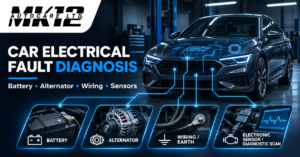

A warning light tells you that a system has noticed something unusual. It does not tell you which part to buy. The same is true when a car will not start, the headlights flicker or the battery keeps going flat. Several components share the same power supply, earth connections and communication network, so one weak connection can create symptoms that seem unrelated.
That is why car electrical fault diagnosis should follow evidence rather than guesswork. Replacing a battery because the engine cranks slowly may appear sensible, but the real cause could be poor alternator output, excessive resistance in a cable or an electrical drain while the car is parked. A fault code naming a sensor may actually be the result of low voltage, a broken wire or a lost earth.
Modern vehicles contain control modules, sensors, actuators and data networks alongside familiar parts such as the battery, alternator and starter motor. The systems work together like a team. If one member sends incomplete information, several others may react. A technician therefore has to confirm the symptom, test the circuit under the right conditions and prove the cause before recommending a repair.
This guide explains the signs of common electrical problems, how a professional investigation works and what affects the price. It also shows when to arrange an automotive diagnostic test with MK12 Autocare’s vehicle diagnostics service in Stacey Bushes. The focus is electrical fault isolation, not a generic code scan.
How Modern Vehicle Electrical Systems Work
A modern car does more than send power from a battery to a collection of switches. Control units continually exchange information and decide when components should operate. Understanding the main parts helps explain why similar symptoms can have very different causes.
Battery Power Supply
The 12-volt battery provides the energy needed to wake the vehicle’s control units and operate the starter motor. It also helps stabilise system voltage. Even on a hybrid or electric vehicle, a separate low-voltage battery commonly supports locks, lighting, computers and the process that activates the high-voltage system.
A battery can show an acceptable open-circuit voltage yet fail when asked to deliver high current. Temperature, age, state of charge and internal condition all matter. That is why a proper assessment may include state-of-charge and conductance or load testing, not just placing a meter across the terminals.
Alternator Charging
On a conventional engine, the alternator supplies electrical power while the engine runs and replenishes the battery. Many newer vehicles use smart charging. The engine control unit may vary alternator output according to battery condition, temperature, braking and electrical demand.
This variable behaviour means one voltage reading does not always prove that an alternator is good or bad. A technician may compare requested and actual output, apply electrical loads and inspect the drive belt, power cable, earth path and communication line. A charging fault can sit outside the alternator itself.
Starter Motor Operation
The starter motor turns the engine fast enough for combustion to begin. When you turn the key or press the start button, the vehicle may check the immobiliser, clutch or brake switch, selector position and battery condition before energising the starter relay and solenoid.
A single click can suggest a starter or high-resistance circuit, while rapid clicking often accompanies low available voltage. Silence may involve a battery connection, fuse, relay, switch, immobiliser or control signal. The sound is a clue, not a complete diagnosis.
Control Modules
Electronic control units manage the engine, gearbox, brakes, airbags, body functions, climate system and many other features. Each module receives inputs, makes decisions and operates outputs. Some vehicles have dozens of modules, and they depend on stable voltage and reliable communication.
When system voltage falls, modules may reset or store several trouble codes at once. A module can also stop responding because its power supply, earth or network wire has failed. Replacing the module without testing those external circuits can turn an expensive guess into an even more expensive problem.
Sensors and Actuators
Sensors measure conditions such as temperature, pressure, wheel speed and pedal position. Actuators carry out commands by moving a valve, switching a relay or operating a motor. A control module compares sensor inputs with expected values and may record a diagnostic trouble code when a signal is missing or implausible.
The component named in a code is often where the abnormal signal was detected, not necessarily where the fault began. A sensor may be healthy but receive a poor reference voltage. An actuator may not move because its power feed is missing. Circuit testing separates the part from its supporting wiring.
CAN Bus Communication
The Controller Area Network, usually called the CAN bus, lets modules share data over a small number of wires. Other networks, including LIN, are often used for simpler local devices. These networks reduce wiring but make electrical diagnosis more connected.
A short circuit, open wire, corroded connector or non-responsive module can disrupt communication. The result may be several warning lights, missing dashboard information or accessories that fail together. Network codes help identify the affected area, but the technician still needs the correct wiring information and electrical measurements.
Common Signs of an Electrical Fault
Electrical problems can be constant or intermittent. Some appear only after rain, during cold starts or when the engine bay becomes hot. Recording exactly when the symptom occurs gives the garage a better chance of reproducing it.
Vehicle Not Starting
First notice what happens when you try to start the car. Slow cranking, rapid clicks, one heavy click and normal cranking with no start point towards different test routes. Lights working does not prove the battery can supply the much higher current required by the starter.
If the engine cranks normally but does not fire, the cause may involve fuel, ignition, immobiliser or engine-management inputs rather than the starting circuit. MK12 Autocare’s guide to a car that will not start explains why the observed behaviour matters before parts are replaced.
Intermittent Warning Lights
A warning light that appears and disappears can indicate a loose connection, unstable voltage or a signal that moves outside its expected range under certain conditions. It may leave a stored or historic code even when the light is no longer on.
Write down the dashboard message, outside temperature, road conditions and what the car was doing. A photo can help. Clearing the code before an inspection may erase useful freeze-frame data and make the original fault harder to trace.
Flickering or Dim Lights
Headlights that dim at idle, interior lights that pulse or dashboard illumination that changes with engine speed can point towards a charging or connection issue. A poor earth can affect several lights, while a fault limited to one lamp may be local to its connector, wiring or driver module.
Some brightness changes are normal on vehicles with energy-management strategies, so context matters. Testing voltage and voltage drop while the circuit is loaded is more meaningful than judging by appearance alone.
Electrical Accessories Failing
Windows, central locking, mirrors, wipers, infotainment and climate controls may share fuses, earth points or body-control functions. Several accessories failing at once can therefore reveal a common supply or communication fault.
One feature failing may still have several possible causes: the switch, motor, module, wiring or mechanical linkage. A technician can check whether the module sees the command and whether the output reaches the component before recommending replacement.
Battery Repeatedly Going Flat
A battery that repeatedly loses charge may be worn out, undercharged or drained while the car is switched off. Interior lights, aftermarket equipment, a module that does not enter sleep mode or a wiring fault can create an excessive parasitic draw.
Repeated jump-starting does not solve the cause and can place further strain on the system. The battery should be charged and tested, the charging system checked and the key-off current measured using a method appropriate for the vehicle’s sleep cycle.
Burning Smell or Blown Fuse
A burning-plastic smell, smoke, hot cable or repeatedly blown fuse needs prompt attention. A fuse protects wiring against excessive current. Fitting a larger fuse removes that protection and can allow the harness to overheat.
Stop safely and switch the vehicle off if there is smoke or an obvious overheating electrical component. Do not keep replacing the fuse. The short circuit or overloaded component must be found and corrected using the specified fuse rating.
Battery, Alternator or Starter Motor?
These three components work closely together, so one fault can make another look guilty. Good diagnosis checks the whole starting and charging system, including the cables and control strategy.
Signs of a Weak Battery
A weak battery often causes slow cranking, rapid clicking, dim lights during starting or electronic resets. Cold weather may expose a battery that seemed acceptable in warmer conditions because the engine needs more starting effort while battery performance falls.
Those symptoms can also come from loose terminals or a poor earth. A battery test should therefore follow a visual inspection and state-of-charge check. On some vehicles, a replacement battery must also be registered or coded so energy management uses the correct charging strategy.
Signs of Poor Alternator Output
The battery warning lamp while driving, dimming electrical equipment or a car that stops after a short journey can indicate a charging problem. The source may be the alternator, its drive belt, a main cable, a fuse, an earth or the control signal used by a smart charging system.
A red battery warning light while driving deserves urgent attention because the vehicle may be running only on stored battery energy. Move to a safe place and seek assistance rather than assuming the battery itself is the failed part.
Signs of a Starter-Motor Fault
A single click with no cranking, intermittent operation or a starter that turns unusually slowly despite a healthy battery may lead the investigation towards the starter motor or solenoid. Worn internal contacts can behave differently when hot and work again after cooling.
However, the motor cannot perform correctly if voltage is lost through cables, terminals or earth connections. Testing voltage at the starter while it is commanded to operate helps distinguish an internal starter fault from a supply problem.
Voltage-Drop Symptoms
Resistance in a high-current connection consumes voltage when current flows. The circuit may look normal with no load but fail during cranking. Symptoms include slow starting, hot terminals, dim lamps and inconsistent charging.
A voltage-drop test measures the loss across the positive or earth side while the circuit works. This can expose corrosion hidden inside a cable, loose crimps and poor engine-to-body earth straps that a simple continuity beep may miss.
Why Testing Is Required Before Replacing Parts
Changing the battery first may hide the symptom temporarily because the new unit arrives fully charged. If the alternator is not replenishing it, or a parked-current drain remains, the new battery will go flat too.
The sensible sequence is to verify the complaint, assess the battery, measure cranking and charging performance, then test the relevant cables and controls. This approach protects the customer from paying for components that were never faulty.
Wiring, Fuses and Earth Connections
Wiring is the road network of the electrical system. A clean diagram may show a simple line, but the real harness travels through heat, vibration, moisture and moving body panels. Finding a fault often requires both electrical data and careful physical inspection.
Damaged Wiring
Insulation can rub through where a loom touches a bracket, engine or sharp edge. Wires can also break internally near hinges, connectors or areas that flex. The damage may cause an open circuit, short to earth or short between circuits.
A visual check is useful but does not reveal every break. The technician may isolate sections, measure voltage under load, test continuity with the circuit safely disconnected or gently manipulate the harness while monitoring the signal.
Corroded Connectors
Moisture and road salt can reach connectors in exposed areas. Corrosion increases resistance, weakens terminals and can spread into the wire beneath the insulation. A connector may look attached while one pin no longer makes reliable contact.
Repair requires more than spraying the outside. The affected pins, terminal tension, seals and surrounding cable should be assessed. Severe damage may require approved terminal or connector replacement rather than a temporary twist-and-tape repair.
Poor Earth Connections
Current must return to the battery, usually through body and engine earth paths. Dirt, paint, oxidation or a loose fixing can create resistance. Because many circuits share an earth point, one poor connection can produce multiple strange symptoms.
Earth faults may affect the starter, alternator, lighting, ABS, injection and other electronics. Cleaning and securing the correct point can solve the issue, but the connection should first be measured under load so the diagnosis is proven.
Repeatedly Blown Fuses
A fuse that blows again is reporting excessive current. Possible causes include a shorted wire, water-damaged connector, seized motor or internally failed component. The circuit diagram shows which branches and loads share that fuse.
Installing a higher-rated fuse is unsafe. A professional may isolate branches and use controlled test methods to locate the short without repeatedly consuming fuses or overheating the harness.
Water Ingress
Blocked drains, damaged seals, windscreen leaks and poorly closed electrical boxes can allow water to reach wiring or modules. Problems may begin after heavy rain or a car wash, then disappear as the area dries.
The repair must address both the electrical damage and the entry path. Replacing a corroded module without stopping the leak invites the same failure to return. Damp carpets, condensation and green deposits around terminals are useful clues.
Previous Accessory Installations
Dash cameras, trackers, alarms, stereos and tow-bar wiring can be reliable when installed correctly. Poor connections, incorrect fuse taps or circuits chosen without understanding vehicle sleep behaviour can create drains, communication faults or blown fuses.
Tell the technician about any recent accessory work, even if it seems unrelated. The timing can shorten the investigation, particularly when a problem began immediately after installation or body repair.
Sensors, Control Modules and Warning Lights
A scan tool is important, but it is one instrument in a larger diagnostic process. The technician has to translate stored information into tests that confirm what actually failed.
Diagnostic Trouble Codes
When a control unit detects an electrical or performance condition outside its rules, it may store a diagnostic trouble code, or DTC. The code can identify the system, circuit and type of irregularity. Freeze-frame data may record operating conditions when the fault appeared.
Codes can be current, pending, stored or historic. Their wording must be interpreted with manufacturer information. Clearing codes before recording them removes evidence and does not repair the underlying condition.
Live Sensor Data
Live data shows values reported by sensors and calculated by modules. A technician may compare battery voltage, switch state, temperatures or requested and actual actuator positions while reproducing the complaint.
The display still needs interpretation. A believable number can be wrong if the sensor is biased, and a strange value may be a default substituted after communication is lost. Comparing related signals and using an independent measurement builds confidence.
Plausibility Testing
Plausibility means asking whether a value makes sense in context. A coolant-temperature reading should broadly agree with ambient temperature after the car has stood overnight. A brake-switch state should change when the pedal moves.
If the value is implausible, the next task is to decide whether the sensor, wiring, reference supply, earth or module interpretation is responsible. This prevents a data anomaly from becoming an automatic parts order.
Communication Faults
U-codes and “no communication” messages indicate that expected data did not arrive or a module could not be reached. Low voltage during starting can create a cluster of such codes without a permanent network failure.
Diagnosis may include checking module power and earth, network resistance, signal integrity and whether a device is pulling the bus down. Manufacturer-specific topology helps the technician understand which module or section connects to the affected branch.
Why a Fault Code Is Not Always a Diagnosis
Consider a code for a sensor circuit with low voltage. The sensor could be faulty, but so could its power supply, earth, signal wire or connector. A module may even log the code because another system provided bad data over the network.
Professional car diagnostics use the code to choose a test plan. The result of that plan, not the code title alone, supports the repair recommendation. This distinction is central to accurate electrical fault isolation.
Professional Electrical Diagnostic Process
The exact sequence varies by vehicle and symptom, but a structured process reduces guesswork. Each stage gathers evidence and narrows the possible causes.
Confirming the Customer Complaint
The technician begins by asking what happens, when it happens and what changed beforehand. They may inspect the vehicle, operate the affected feature or road-test it when safe. A fault that cannot be reproduced may require monitoring or conditions similar to those described by the driver.
Provide the registration, warning messages, recent repairs, accessory installations and any jump-start history. Video or photos of an intermittent dashboard symptom can be valuable.
Battery and Charging-System Test
Stable power is the foundation of reliable diagnosis. The battery terminals and condition are checked, followed by suitable state-of-charge, capacity, cranking and charging tests. Results are assessed against the vehicle and battery type.
On smart systems, alternator command, actual output and battery-sensor data may be relevant. A charging voltage that varies is not automatically wrong; the technician needs to understand how that vehicle controls it.
Diagnostic Scan
A full-system scan can reveal current and historic DTCs, modules that do not respond and patterns shared by several systems. Freeze-frame and live data help connect the electronic record to the customer’s symptom.
The scan report provides direction, not a guaranteed parts list. Relevant codes are prioritised, especially those involving supply voltage or communication, because they may influence many secondary faults.
Wiring and Connector Inspection
The technician uses the wiring diagram and component locations to inspect likely sections. They look for chafing, heat damage, water, corrosion, loose pins, poor previous repairs and signs that the loom has been disturbed.
Access can be a major part of the work. A connector behind trim or beneath another assembly may take time to reach without causing damage. Inspection is targeted by evidence rather than dismantling the entire vehicle.
Multimeter and Voltage-Drop Tests
A digital multimeter can measure voltage, resistance and current when used with the correct procedure. Loaded voltage-drop testing is particularly useful because it reveals resistance while the circuit is doing real work.
Depending on the fault, further equipment may include a current clamp, battery tester, test light or oscilloscope. The tool is chosen for the signal and circuit. Safety procedures are essential around airbags, hybrid systems and sensitive electronics.
When Manufacturer-Specific Test Data Matters
Expected values, connector pinouts and network layouts can differ between models and production dates. Vehicle-specific diagrams and test instructions help the technician choose the correct terminals, operating conditions and limits instead of relying on a generic rule.
That detail becomes especially important with smart alternators, coded batteries, protected gateways and control modules that require adaptation. The correct technical information reduces the risk of misleading measurements or damage to sensitive circuits.
Confirming the Repair
After the cause is repaired, the original test is repeated. Codes may be cleared, live values checked and the relevant function operated under the conditions that previously caused failure.
A repair is not confirmed simply because the warning lamp has gone out. The circuit must perform correctly, the symptom should be absent and no relevant DTC should return during an appropriate verification check.
Electrical Diagnostic Cost Factors
The initial diagnostic appointment and the complete investigation are not always the same thing. A permanent fault in an accessible circuit may be found quickly, while an intermittent network issue can require staged testing.
Intermittent vs Permanent Faults
A permanent fault is usually easier to measure because it is present during the appointment. An intermittent issue may require repeated tests, a longer road test, temperature change or monitoring until the condition returns.
Accurate notes can reduce this time. Saying “the light came on” is less useful than explaining that it appears after twenty minutes in rain while the heater fan is on.
Testing Time
Diagnostic charges reflect skilled time as well as equipment. Reading a code may take minutes, but proving whether a wire, component or module caused it can take longer. The garage should explain what the first booking includes and seek authorisation before significant additional testing.
MK12 Autocare’s live diagnostics pages currently show a 45-minute service with a written report and display inconsistent price references. Check the live booking price and scope before attending rather than relying on an old figure.
Initial Assessment vs Further Fault-Finding
An initial appointment can establish the symptoms, record codes and identify the next test route. It cannot guarantee that every intermittent or hidden wiring fault will be located within the same fixed period.
Ask the garage to pause and obtain approval if more time is needed. This keeps diagnostic spending transparent while allowing the investigation to follow the evidence.
Wiring Access
A visible broken wire near a connector may be straightforward. A fault inside a loom routed behind the dashboard, under carpet or through a door can require careful removal and refitting of trim.
The repair method also affects cost. A lasting repair may need correct terminals, sealing, cable support and protection against the original cause, not merely access to the damaged point.
Module Programming
Some replacement modules require coding, calibration, security access or software programming. Others may be tied to the immobiliser or vehicle configuration. A used module is not always a plug-in substitute.
The technician should confirm that the external power, earth and network circuits are correct before condemning a module. Programming requirements and manufacturer access can then be included in the quote.
Replacement Components
Battery specification, alternator design, sensor quality and module availability all influence the repair price. Some components are available separately, while others form part of a larger assembly.
Ask for an itemised quote that separates diagnosis, parts, labour and any programming. The cheapest component is not good value if it is incorrect for the vehicle or does not resolve the verified cause.
Previous Unsuccessful Repairs
Earlier parts replacement can complicate the picture if incorrect components, disturbed wiring or erased fault data are involved. Bring previous invoices and say exactly what was changed.
That history is not an inconvenience. It helps the technician avoid repeating work and assess whether the present symptom began before or after the attempted repair.
Electrical Diagnostics in Milton Keynes
If you need car electrical fault diagnosis in MK12 Milton Keynes, the aim should be a clear path from symptom to evidence, then from evidence to an authorised repair. A local appointment can cover the first assessment, but complex or intermittent problems may need further time.
MK12 Autocare Diagnostic Support
MK12 Autocare offers diagnostic and repair support for drivers in Stacey Bushes, Wolverton and surrounding Milton Keynes areas. Its site describes an electronic health check with written findings, alongside wider car repair Milton Keynes and servicing work.
When booking, state that you need electrical fault isolation rather than only a warning-light scan. This keeps the article’s purpose distinct from the garage’s broader vehicle diagnostics Milton Keynes service page.
Information to Provide When Booking
Share the registration, make, model and approximate mileage. Describe whether the car starts, whether it is safe to drive and exactly which functions fail. Include any sounds, smells and dashboard messages.
Also give the timing: cold or hot, dry or wet, driving or parked. Mention battery replacement, jump-starting, bodywork, accessory installation and previous diagnostic work.
Warning Lights and Recent Repairs
Do not erase codes immediately before the visit unless safety or a repair procedure requires it. Photograph the warning and note whether other systems stopped working at the same time.
Bring reports or invoices from recent work. A fault that began after a windscreen replacement, stereo installation or engine repair may direct inspection towards disturbed connectors, water entry or shared wiring.
Stacey Bushes Location
MK12 Autocare lists its workshop at 27 Heathfield, Stacey Bushes, Milton Keynes. The live site currently shows both MK12 6HR and MK12 6HP in different sections, so check the postcode in your booking confirmation before travelling.
If the car will not start or repeatedly loses power, ask how it should reach the garage. Continuing to drive a vehicle with a charging fault may result in a breakdown when the stored battery energy is exhausted.
Diagnostic Inspection Before Parts Replacement
The most useful outcome is not a long list of possibilities. It is a report that distinguishes observed symptoms, stored information, completed tests and confirmed findings.
You can start through the MK12 Autocare services page or call the workshop on +44 1908 22 77 94. Confirm the current price, appointment length and how any further investigation will be approved.
Test the Circuit Before Replacing Components
An electrical symptom rarely points to one part with certainty. A flat battery can be the result of poor charging or a parked-current drain. A sensor code can begin with damaged wiring. Several warning lights can trace back to low voltage or one shared earth connection. The visible symptom is the start of the investigation, not the final answer.
Good car electrical fault diagnosis follows a simple principle: confirm, measure, isolate and verify. The technician listens to the customer’s description, checks the power supply, scans the relevant modules and tests the circuit under realistic conditions. Only then should a battery, alternator, starter, sensor or module be recommended.
If your car will not start, repeatedly loses charge or shows intermittent electrical warnings, record what happens and arrange an assessment before more parts are fitted. MK12 Autocare can provide a local starting point for electrical diagnostics in Stacey Bushes. Give the team complete information, agree the scope of the initial check and ask for the evidence behind the recommended repair.
Frequently Asked Questions
Q1: What Is Included in an Electrical Diagnostic Test?
The scope depends on the symptom and the garage’s booking terms. An initial test may include confirming the complaint, inspecting the battery and connections, checking charging performance, carrying out a full-system scan and reviewing relevant codes or live data. If the evidence points towards a particular circuit, the technician may inspect its wiring and connectors.
More complex work may require voltage-drop testing, current measurement, oscilloscope analysis, access to wiring diagrams or extended monitoring. Ask what is included in the quoted time and whether you will receive written findings. A basic auto diagnostic check is useful, but it should not be described as a complete repair diagnosis when further circuit testing is still required.
Q2: Can Diagnostics Identify a Broken Wire?
Yes, but a scan tool alone may not locate the physical break. It can show that a signal is missing, a circuit is open or a module is not communicating. The technician then uses the diagram, visual inspection and electrical measurements to narrow down the affected section.
Some broken wires work intermittently as the harness moves. Others corrode beneath intact insulation. Testing the circuit under load, checking voltage at different points and moving a suspected loom while monitoring data can reveal faults that a simple continuity check misses.
Q3: Does a Fault Code Show Exactly Which Part Has Failed?
Usually not. A DTC reports the condition detected by a control unit. For example, “sensor circuit low” can be caused by the sensor, a shorted signal wire, missing reference voltage, poor earth, connector corrosion or a control-unit issue.
Codes are valuable because they direct testing towards the right system. The technician should compare live data, check supplies and test the relevant circuit before naming the failed part. Treating the code description as a shopping list is a common cause of unnecessary replacement.
Q4: How Can I Tell If the Battery or Alternator Is Faulty?
Slow cranking after the car has stood may suggest a weak or discharged battery. A battery warning light while driving, electrical systems fading or a new battery going flat can suggest a charging problem. These are clues, and wiring or earth faults can produce the same symptoms.
A proper check assesses battery state and capacity, cranking voltage, alternator performance under load and cable voltage drop. Smart charging systems may intentionally vary output, so vehicle-specific data is more reliable than a single universal voltage rule.
Q5: Why Does an Electrical Fault Happen Intermittently?
Vibration, temperature and moisture can change a weak connection. A cracked wire may touch when the loom rests in one position and separate when the engine moves. A worn relay or module may fail when hot, while corrosion can conduct differently when wet.
Intermittent diagnosis often takes longer because the fault must be reproduced or captured. Note the conditions and avoid clearing codes. Photos, video and the precise sequence of events can turn an occasional symptom into a testable pattern.
Q6: Can a Poor Earth Connection Cause Warning Lights?
Yes. Modules and components need a dependable return path to the battery. Resistance at a shared earth can lower available voltage, distort sensor signals and cause several systems to report faults together.
The connection may look secure but fail under load. A voltage-drop test between the component, body, engine and battery can reveal the loss. Cleaning or repairing the correct earth should then be followed by repeating the original test.
Q7: How Long Does Electrical Fault Diagnosis Take?
There is no fixed time for every problem. A permanent fault with an accessible damaged connector may be confirmed within an initial appointment. A fault behind the dashboard or one that appears only after a long drive can require additional authorised testing.
Ask the garage Milton Keynes team to define the first stage, its price and the point at which they will contact you. Good diagnosis can be staged. You should know what has been tested, what remains uncertain and what the next step will cost.
Q8: Can MK12 Autocare Diagnose Electrical Faults in Milton Keynes?
MK12 Autocare advertises vehicle diagnostics, written reports and repair support from its Stacey Bushes workshop. Contact the team with your registration and symptom to confirm whether the available appointment is suitable for the specific electrical problem.
The workshop is listed at 27 Heathfield, Stacey Bushes, Milton Keynes. Call +44 1908 22 77 94 or use the website to enquire. Confirm the live price, postcode and scope when booking, particularly if the vehicle is non-running, the fault is intermittent or you need more than a standard code scan.