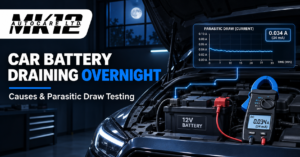

You turn the key in the morning and hear a slow crank, a rapid click or nothing at all. The battery was charged yesterday, so it must be faulty, right? Not necessarily. A flat battery is the result you can see, but it does not automatically reveal the cause.
A battery can discharge overnight because it has lost capacity, the alternator did not recharge it, a light remained on or an electrical component continued drawing current after the vehicle was locked. Short journeys can leave a healthy battery undercharged, while cold weather can expose a battery that was already close to the end of its useful life. Replacing the battery without checking these possibilities may only reset the clock until the next flat morning.
Modern cars also remain partly active after the ignition is switched off. Alarm systems, keyless entry, clocks and control modules use a small amount of power. That normal background demand becomes a problem when a module does not enter sleep mode, an accessory is wired incorrectly or a component develops a fault. The difference between acceptable standby current and excessive drain has to be measured under the correct conditions.
This guide explains why a car battery draining overnight needs systematic testing. You will learn how a garage separates battery failure from a parasitic electrical draw, how the alternator can contribute and what information to provide when booking diagnosis with MK12 Autocare in Stacey Bushes.
Why a Car Battery Goes Flat Overnight
An overnight failure can have one cause or several contributing factors. A partly charged battery, a small abnormal draw and a cold night may combine to create a no-start condition even though none of them seemed serious on its own.
Old or Weak Battery
A lead-acid battery gradually loses its ability to store and deliver energy. Age is a useful clue, but it is not a diagnosis. Heat, vibration, repeated deep discharge, long periods without use and charging problems can shorten service life. Two batteries of the same age may therefore perform very differently.
A weak battery may start the engine after a long drive but fail after sitting overnight. It can show reasonable voltage with no load, then collapse when the starter demands high current. A proper battery assessment considers its state of charge and available starting capacity before deciding whether replacement is justified.
Lights Left On
Headlights, interior lamps, a glovebox light or a boot light can consume enough energy to flatten a battery. Modern cars often switch some lights off automatically, but a faulty switch, damaged latch or altered wiring may prevent that protection from working.
A boot lamp is especially easy to miss because you cannot see it once the lid is closed. The technician may check the switch status through live data, observe the lamp during latch operation or measure the circuit after the vehicle settles. The aim is to prove that the lamp is staying on, not simply assume it is.
Charging-System Fault
The alternator should replenish the energy used during starting and supply the vehicle while the engine runs. Low output, poor cable connections, a slipping drive belt or a control problem can leave the battery only partly charged at the end of a journey.
The car may still restart immediately because some charge remains, then fail the following morning. That pattern can look like an overnight drain even when the primary problem occurred while driving. Battery and charging tests should therefore come before a lengthy parked-current investigation.
Parasitic Electrical Draw
A parasitic draw is current used while the vehicle is parked and should be in its settled state. Some draw is normal because the alarm, clock, memory and remote-locking functions remain active. The concern is an abnormal amount or a circuit that stays awake for too long.
Possible causes include a relay that remains energised, an infotainment unit that does not shut down, an aftermarket tracker or a control module repeatedly waking the network. Current measurement can confirm that a draw exists, but isolating its source may require patience and vehicle-specific information.
Short Journeys and Low Charge
Starting an engine removes a meaningful amount of energy from the battery. A short journey with lights, heated screens, blower fans and other consumers operating may not put all of that energy back. Repeating the pattern can gradually lower the state of charge.
This is common for cars used mainly for school runs, local errands or irregular trips. An occasional suitable longer drive may help a healthy system, but it will not repair a worn battery or electrical drain. MK12 Autocare’s short-trip maintenance guide explains the wider effects of repeated low-mileage use.
Cold-Weather Effects
Cold conditions reduce battery performance while the engine can require more effort to turn. A battery that managed in mild weather may therefore struggle on the first cold morning. This does not mean the temperature created the entire fault; it may simply have revealed reduced capacity or low charge.
Winter also increases electrical demand through lights, demisters, heated seats and blower motors. Testing before the colder season is sensible when cranking has slowed, the battery has repeatedly needed help or the vehicle mainly makes short trips.
Battery Fault vs Parasitic Drain
The central question is whether the battery cannot hold enough energy or whether the vehicle is consuming too much while parked. Testing one without the other can produce the wrong answer.
Battery Age and Condition
The installation date, service history and number of deep discharges help build the picture. Visible swelling, leakage, damaged terminals or severe corrosion needs attention. However, a clean-looking battery can still have poor internal capacity.
Conversely, an older battery is not automatically responsible for every flat start. If it passes appropriate testing after being fully charged, the investigation should continue towards charging performance, connections and parked-current consumption.
Capacity Testing
A battery tester can assess how well the battery can provide starting power. The exact method depends on battery type and equipment. A discharged battery may first need controlled charging because testing it in a low state of charge can make a serviceable unit appear defective.
The result should be interpreted alongside vehicle specification, temperature and symptoms. A battery may have enough capacity for a warm start but very little reserve for a cold morning or several days parked.
Voltage After Resting
Resting voltage can help indicate state of charge after surface charge has dissipated and loads have settled. It is one data point, not a complete health certificate. A battery can display plausible voltage yet fail under starter demand.
Measurements taken immediately after charging or driving may be misleading. A technician may also monitor the voltage during cranking and compare it with battery-test results. The combination tells more than one static number.
Overnight Current Consumption
If the battery and charging system are capable, current consumption with the car off becomes the next focus. The test must account for the vehicle’s normal shutdown sequence. Opening a door, unlocking the car or connecting equipment carelessly can wake modules and change the result.
There is no single acceptable value for every car. Specification, fitted equipment and sleep strategy vary. The technician assesses the stable reading against manufacturer information and considers how the measured current relates to the battery’s available capacity.
Why Repeated Jump-Starting Is Not a Repair
A jump-start supplies enough external energy to crank the engine. It does not prove the battery is faulty, recharge it fully or remove the drain. If the original cause remains, the vehicle may fail again at the next stop.
Repeated deep discharge can also harm a battery that was initially serviceable. After emergency starting, arrange proper charging and diagnosis. MK12 Autocare’s guide to a car that will not start helps distinguish slow cranking, clicking and normal cranking with no start.
Common Causes of Parasitic Draw
The circuit causing the drain may be simple, such as a lamp, or connected to several modules. Recent changes are valuable clues, so tell the garage about accessories, bodywork, water leaks and electrical repairs.
Interior or Boot Lights
Door, glovebox, vanity-mirror and luggage-compartment lamps depend on switches or latch information. A misaligned or failed switch can keep a lamp energised even though the panel appears closed.
The lamp itself may be hidden, but its consumption appears in the current measurement. A technician can test the switch or monitor its status without repeatedly opening the vehicle and resetting the sleep timer.
Audio and Infotainment Systems
Factory infotainment systems may remain active briefly to save data and complete shutdown. A software fault, internal failure or communication problem can stop that process. An amplifier may also remain powered when it should switch off.
Aftermarket stereos can cause drain when permanent and ignition-switched feeds are connected incorrectly. The unit may appear off while still consuming current. Correct diagnosis checks the supply, wake signal and shutdown behaviour instead of blaming the head unit by reputation.
Dash Cameras
A dash camera wired for parking mode intentionally uses power after the ignition is off. A suitable installation should include voltage protection or a timed cutoff, but settings, wiring and battery condition all affect how long it can operate safely.
A camera powered from an always-live socket may continue recording indefinitely. If the battery trouble began after installation, disclose that timing. The technician can compare the draw with the camera connected and isolated, then assess whether the installation matches its intended use.
Aftermarket Alarms and Trackers
Alarms, immobilisers, trackers and remote-start equipment often need a permanent supply. A healthy, correctly installed device should use a controlled amount, but internal faults or poor wiring can create excessive drain.
Do not remove security equipment at random. It may interact with the immobiliser, central locking or insurance requirements. Testing should identify whether the device or its installation is responsible before a safe repair is planned.
Control Module Remaining Awake
Control modules communicate over networks and normally enter low-power states after the car is locked. A faulty door latch, keyless-entry activity, software issue or another module sending repeated messages can keep the network awake.
The current may fall normally on some occasions and remain high on others. Diagnosis can involve monitoring the sleep pattern, checking network activity, reviewing DTCs and identifying which input or module triggers the wake-up.
Faulty Relay
A relay uses a small control signal to switch a larger electrical load. Contacts can stick, or the relay may remain commanded on because of another fault. Pumps, fans, heaters or modules can then continue operating after shutdown.
Heat, noise or repeated clicking may provide a clue, but not every failed relay is obvious. Circuit diagrams and current measurements help show whether the relay, its control side or the connected component caused the problem.
Could the Alternator Cause the Battery to Drain?
Yes. The alternator can contribute in two different ways: it may fail to recharge the battery while driving, or a fault inside it may allow current to flow when the engine is off.
Low Alternator Output
Low output leaves the battery progressively undercharged. Electrical demand may exceed the energy produced at idle or under load, especially when a connection or control fault is present. Eventually the battery lacks the reserve needed for the next start.
Testing should include the charging circuit, not only the alternator body. Loose, damaged or oxidised connections and a poor earth can limit current. On a smart system, requested output and actual response may also need comparison.
Charging Voltage
Charging voltage is useful, but modern systems do not always hold one fixed number. The vehicle may vary alternator output according to battery state, temperature, engine load and energy-recovery strategy.
A quick meter reading can therefore be incomplete. A technician may apply electrical loads, review battery-sensor data and check whether the system responds as designed. Vehicle-specific specifications matter more than a universal internet value.
Alternator Diode Leakage
The alternator uses rectifier diodes to convert generated current for the vehicle’s DC system. A damaged diode can reduce charging quality and, in some cases, create a path that discharges the battery with the engine off.
This fault may produce starting trouble, a battery warning, fluctuating lights or an abnormal quiescent current. Testing can include charging performance, ripple analysis and controlled isolation of the alternator circuit by a qualified technician.
Drive-Belt Condition
The belt transfers engine rotation to the alternator on many vehicles. A loose, worn or contaminated belt can slip and limit output. A tensioner problem can have a similar effect.
Squealing, visible damage or inconsistent charging deserves inspection. Keep hands, clothing and tools away from moving belts. Belt condition should be checked with the engine safely stopped unless a trained technician is carrying out a specified test.
Warning-Light Behaviour
The battery symbol is primarily a charging-system warning, not a simple “replace battery” instruction. If it stays on while the engine runs, output, belt condition, wiring or control may be at fault.
Continuing to drive can exhaust the remaining battery energy and cause the vehicle to stop. Move to a safe place and obtain assistance if a red charging warning remains illuminated or electrical functions begin failing.
How Parasitic Draw Testing Works
Reliable testing is more involved than disconnecting a battery cable and looking for a spark. Modern electronics can wake when power is interrupted, and careless meter connection can damage the meter or lose vehicle settings.
Confirming Battery Condition First
The battery is inspected, charged when necessary and tested for condition. Terminals and earth connections are checked because resistance can cause starting symptoms that resemble low charge.
The charging system is assessed as well. There is little value spending hours locating a small parked load if the battery cannot store energy or the alternator never replenishes it properly.
Allowing Control Modules to Enter Sleep Mode
After the ignition is switched off and the car is locked, modules may remain active for minutes while completing normal tasks. Some vehicles take longer than others. The technician prepares access points so doors or the boot can appear closed without disturbing the test.
Unlocking the car, approaching with a keyless fob or opening a door can restart the timer. A stable reading is meaningful only after the normal shutdown sequence has completed.
Measuring Current Draw
Current can be measured with suitable equipment and a procedure that avoids interrupting the system unnecessarily. The exact method depends on the vehicle, expected current and diagnostic tools available.
The reading is observed over time rather than treated as one instant result. Periodic wake-ups may be normal, while sustained or repeated high consumption can explain the discharge pattern. Battery capacity and parking duration provide context.
Why a Universal Milliamp Limit Can Mislead
Older advice often quotes one standby-current limit for every car. Modern vehicles differ in module count, security equipment, telematics and sleep strategy, so manufacturer information should guide the judgement.
The key questions are whether the vehicle reaches its designed sleep state and whether stable consumption is consistent with its specification. A reading is evidence only when the test conditions are controlled.
Isolating Circuits
Once excessive draw is confirmed, the next step is to identify the circuit. Wiring diagrams show which fuses, relays, modules and components share each supply. The investigation follows the evidence rather than disconnecting random items.
Removing a component may wake the network and change the reading, so the technician interprets changes carefully. Voltage-drop measurement across fuses or non-invasive current tools may be useful in some diagnostic strategies.
Fuse-by-Fuse Investigation
Fuses divide the electrical system into protected branches. Observing how current changes when a circuit is isolated can narrow the problem to a smaller group of components.
However, removing a fuse can reset a module or alter network behaviour. The method, order and waiting time matter. A fuse label also describes the circuit broadly; it may feed several devices through additional junctions.
Testing Suspected Components
After the affected circuit is identified, the technician checks its components, power supplies, control signals and wiring. A relay may be stuck, but it may also be responding to a module that incorrectly commands it on.
The final diagnosis should explain what caused the draw and reproduce the improvement after repair. The vehicle is allowed to sleep again and current is rechecked under the same conditions.
What to Do When the Battery Is Flat
The immediate priority is safety and getting appropriate assistance. The correct method depends on the vehicle, battery location and manufacturer instructions.
Safe Jump-Starting Procedure
Read the owner’s manual before connecting any leads. Use the designated jump points, keep both vehicles secure and switch off unnecessary electrical loads. The manual will state the correct connection sequence and any model-specific restrictions.
Poor connections, reversed polarity and sparks near a battery can cause serious damage or injury. If you are uncertain, use a professional breakdown service. A successful start should be followed by proper charging and diagnosis, not treated as proof of repair.
Using the Correct Vehicle Guidance
Some batteries are located away from the engine bay, while remote positive and earth points are provided under the bonnet. Hybrids, electric vehicles and cars with sensitive energy-management systems can have specific procedures.
Do not guess based on another model. Follow the manual for the exact vehicle and use equipment suitable for its voltage and battery type. If instructions are missing or unclear, seek qualified help.
When Not to Jump-Start
Do not attempt to jump-start a visibly damaged, leaking, swollen or potentially frozen battery. Stop if there is smoke, a strong unusual smell, overheated wiring or evidence that polarity may have been reversed.
A vehicle involved in a collision or showing high-voltage warnings needs specialist assessment. A no-start condition can also have a mechanical or security cause that extra battery power will not solve.
Charging the Battery Properly
A dedicated charger can restore a discharged battery more fully than a short drive. The charger must be compatible with the battery technology, such as conventional flooded, EFB or AGM, and used according to both charger and vehicle instructions.
If the battery will not accept or retain charge, it may be damaged. If it charges successfully but becomes flat again, investigate the charging system and parked draw. Disconnecting or charging in place may have manufacturer-specific requirements.
Avoiding Repeated Unnecessary Battery Replacement
A new battery may mask the issue because it has more reserve capacity. If an alternator fault or parasitic load remains, that new unit can also discharge and suffer premature damage.
Ask for test results before authorising another replacement. Battery condition, charging response and sleep-current findings should form a connected diagnosis. For wider circuit concerns, see the guide to car electrical fault diagnosis.
Preventing Repeated Battery Drain
Prevention begins with understanding how the vehicle is used. A car parked for long periods needs a different plan from one covering regular motorway miles.
Regular Longer Journeys
Where appropriate, a longer journey gives the charging system more time to replace starting energy than repeated short trips. Actual recovery depends on battery condition, electrical demand and vehicle strategy.
Do not rely on driving alone to recover a deeply discharged unit. If the battery keeps going flat, testing is needed. A longer journey cannot repair a failing cell, slipping belt or abnormal draw.
Battery Maintenance Charging
A compatible smart maintenance charger can help a vehicle that is stored or used infrequently. It monitors the battery rather than supplying uncontrolled current continuously.
Follow the vehicle and charger instructions, provide suitable ventilation and route cables safely. Choose the correct mode for AGM, EFB or other specified battery technology. Seek advice if the car has unusual connection or energy-management requirements.
Checking Aftermarket Accessories
Review dash-camera parking settings, USB devices, coolers, trackers, alarms and audio equipment. Confirm whether the socket they use remains live after the car is locked.
Professional installation should include correct fusing, connection points and low-voltage protection where required. If drain began after an accessory was fitted, test that circuit early rather than replacing unrelated factory components.
Software and Module Issues
Some sleep problems arise from module software or an input that incorrectly reports a door, boot or ignition state. A diagnostic scan may reveal communication errors or a module that remains active.
Software updates and programming should follow manufacturer procedures. Updating a module is not a substitute for proving the fault, and a physical wiring or switch problem may create similar symptoms.
Rechecking the Charging System
After repairing a drain, confirm that the alternator can recharge the battery and that cables, terminals and earths are sound. A battery repeatedly left discharged may also need retesting after a full charge.
The final verification should reproduce the original conditions where practical. If the car previously failed after one night, an appropriate monitoring period may be more convincing than one immediate restart.
Battery Drain Diagnosis at MK12 Autocare
Drivers looking for battery-drain help in MK12 Milton Keynes can contact MK12 Autocare in Stacey Bushes. Describe the pattern before travelling because a non-starting vehicle may need recovery rather than a normal workshop drop-off.
Battery and Alternator Testing
Battery diagnosis should distinguish state of charge from actual capacity. Charging-system checks then assess whether the alternator, belt, cables and control strategy are supporting the battery correctly.
MK12 Autocare advertises diagnostics and mechanical repair support. Confirm what the initial appointment covers, especially if you need specific battery, alternator or starting-circuit measurements rather than only an electronic code scan.
Parasitic-Current Testing
Parked-current diagnosis may require the car to remain undisturbed while its modules enter sleep mode. An intermittent drain can need monitoring or additional authorised test time.
Ask how the work will be staged and when the garage will contact you. A useful report should distinguish battery condition, charging performance, confirmed current draw and the circuit or component requiring further attention.
Details Required for Diagnosis
Provide the registration, battery age if known and how long the car can stand before failing. Say whether it starts after a jump, whether the red battery light appears and whether the problem follows rain, cold weather or a recent repair.
List dash cameras, trackers, alarms, audio equipment and anything plugged into a power socket. Mention recent battery replacement, jump-starting, software work and body repairs. These details can shorten the investigation.
Stacey Bushes and Milton Keynes Service Area
MK12 Autocare lists its workshop at 27 Heathfield, Stacey Bushes, Milton Keynes and serves drivers from Wolverton and surrounding areas. The website currently shows both MK12 6HR and MK12 6HP in different sections, so verify the postcode in your booking confirmation.
Call +44 1908 22 77 94 or use the online booking page to enquire. Confirm the current diagnostic price, appointment duration and arrangements if the vehicle cannot be driven.
Electrical Fault Diagnosis Internal Link
A parasitic drain is one form of electrical fault. If the vehicle also has warning lights, flickering lamps, failed accessories or communication errors, wider circuit testing may be needed.
Read MK12 Autocare’s guide to car electrical fault diagnosis for battery, alternator, starter, wiring, earth, sensor and control-module testing. For a general diagnostic appointment, review the vehicle diagnostics service.
Find the Cause Before Buying Another Battery
A flat battery is evidence that available energy has become too low, but it does not identify why. The battery may be worn, undercharged by short journeys, starved by an alternator problem or discharged by a circuit that stays active after shutdown. Cold weather often exposes the weakness rather than creating the entire problem.
Good diagnosis follows a clear order. Charge and test the battery, verify the charging system, allow the car to enter sleep mode, measure parked current and isolate the affected circuit. Once the suspected component or control is repaired, repeat the test to prove that consumption has returned to an appropriate level.
If your car battery is draining overnight, record how quickly it fails and what changed before the problem began. Avoid repeated jump-starting and unnecessary replacement. Contact MK12 Autocare with the vehicle details, accessory list and symptoms so the workshop can advise on the right initial assessment in Stacey Bushes.
Frequently Asked Questions
Q1: How Quickly Can a Parasitic Draw Flatten a Battery?
The time depends on the size of the draw, battery capacity, state of charge, temperature and battery condition. A large load such as a lamp can cause trouble in hours, while a smaller abnormal load may take several days. A weak or partly discharged battery has less reserve and may fail much sooner.
Current measurement helps estimate whether the observed drain can explain the pattern, but the garage should also test battery condition. If a car fails after one night, tell the technician exactly when it was last driven and whether it had recently been charged.
Q2: Can a New Battery Drain Overnight?
Yes. A new battery can be discharged by a lamp, aftermarket accessory, control module, alternator diode fault or damaged wiring. It may also have been installed without being fully charged or without required registration on a vehicle with battery management.
Replacing it again will not correct an external cause. Check the installation, battery specification, charging system and parked-current draw. A new battery that has suffered a deep discharge should be recharged correctly and retested.
Q3: Can an Alternator Drain the Battery When the Car Is Off?
Yes. A fault in the rectifier diodes can create unwanted current flow when the engine is stopped. The alternator may also undercharge the battery while driving, leaving it unable to start after the car sits.
Diagnosis may include output under load, cable and earth checks, ripple analysis and parked-current testing. Do not disconnect the alternator or battery while the engine is running as a DIY test; voltage spikes and unsafe conditions can result.
Q4: How Is Parasitic Current Measured?
The vehicle is prepared so its doors, boot and bonnet status can be controlled, then it is allowed to complete its normal shutdown. Suitable equipment measures current without unnecessarily waking modules or interrupting the system.
If the draw is excessive, circuits are isolated using diagrams, fuse information and targeted testing. The process may take time because removing a fuse or opening a door can wake the network and require another sleep period.
Q5: Can a Dash Camera Cause Battery Drain?
Yes, particularly when parking mode operates from a permanent supply without suitable voltage protection. Incorrect hardwiring, an always-live power socket or an unsuitable cutoff setting can allow the camera to use too much energy.
That does not mean every parking-mode camera is faulty. The installation, settings, vehicle use and battery condition all matter. Compare the vehicle’s current behaviour with the camera connected and correctly isolated.
Q6: Why Does the Battery Drain Only Occasionally?
An intermittent drain may occur when a relay sticks, a module fails to sleep, a latch reports the wrong state or moisture affects a connector. Keyless activity and accessory behaviour can also vary from one parking event to another.
Occasional faults are harder to capture. Note weather, parking duration, key location and which accessories were used. Longer monitoring may be necessary if the current is normal during the initial appointment.
Q7: Will Driving Recharge a Completely Flat Battery?
A jump-start followed by driving may restore some energy, but it may not recharge a deeply discharged battery fully. The alternator is designed to support the vehicle and maintain charge, not always to recover a severely depleted battery efficiently.
Use a compatible charger and have the battery tested after charging. If it repeatedly goes flat, arrange an automotive diagnostic test rather than relying on longer drives. The underlying battery, charging or drain problem still needs an answer.
Q8: When Should I Book a Battery-Drain Test?
Book testing when a charged or recently replaced battery becomes flat again, the car fails after being parked, accessories behave strangely or the battery warning appears. Investigation is also sensible if you have needed more than one jump-start without a clear explanation.
For local help, contact a garage Milton Keynes service with the exact failure pattern. MK12 Autocare can advise whether the first booking should cover battery and alternator testing, broader vehicle diagnostics or specific parasitic-current investigation.