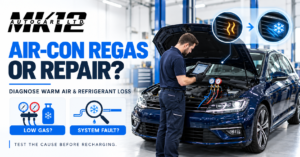

You switch on the air conditioning, but the vents stay warm. Does the car need a car aircon regas, or is something else wrong?
Low refrigerant is one cause. Leaks, condenser damage, fan failure, a faulty compressor, restricted airflow or electrical trouble can also reduce cooling performance. Refilling without diagnosis is like inflating a punctured tyre.
A routine air con regas recovers the old charge, checks the system and installs the correct quantity. Repair may require leak detection, electrical diagnosis or new parts.
This guide separates regas symptoms from repair faults and explains workshop testing. For car air-con repair Milton Keynes, identify the cause before paying for work.
How Car Air Conditioning Produces Cold Air
The air-conditioning system moves cabin heat outside through a sealed refrigerant circuit. Changes in pressure and state let the refrigerant absorb heat inside and release it outside.
The compressor, condenser, evaporator, sensors and controls must work together. One weak link can leave the vents warm even with the correct refrigerant quantity.
Compressor and Refrigerant Circulation
The compressor is the pump at the centre of the circuit. Depending on the vehicle, it may be driven by an engine belt or an electric motor. It draws in low-pressure refrigerant vapour and compresses it into a hotter, high-pressure vapour before sending it towards the condenser.
If the compressor does not operate, refrigerant cannot circulate effectively. Low refrigerant pressure, an electrical fault or a failed control signal may prevent engagement to protect the system. This is why “the compressor is not clicking” does not automatically prove the compressor itself has failed.
Condenser and Heat Release
The condenser usually sits near the front of the vehicle, close to the radiator. Air passing through its fins removes heat from the hot refrigerant. As heat leaves, the refrigerant changes from vapour into a high-pressure liquid.
The condenser depends on clean airflow. Bent fins, dirt, road debris or impact damage can reduce its ability to release heat. At low road speed, electric cooling fans become especially important. A system that cools while driving but turns warm in traffic may have a fan or condenser-airflow problem rather than simply needing gas.
Expansion and Evaporator Cooling
The liquid refrigerant passes through an expansion valve or another metering device, where its pressure falls sharply. It then enters the evaporator, usually located behind the dashboard. At low pressure, the refrigerant absorbs heat from air passing across the evaporator and changes back into vapour.
The blower sends this cooled, dehumidified air into the cabin. Moisture collects on the evaporator and drains beneath the car, so a small pool of clear water after using the air conditioning is usually normal. Restricted airflow from a dirty cabin filter can still make cooling feel weak even when the refrigerant circuit is working.
Sensors, Fans and Electronic Controls
Modern systems rely on a pressure sensor, temperature sensors, cooling fans, relays and an air-conditioning control module. The module may stop compressor operation when pressure is too low or too high, the engine is overheating, or another condition could damage the system.
This electronic layer makes diagnosis important. Warm air can result from a broken wire, blown fuse, faulty sensor or missing control command. A regas cannot repair any of those faults. A technician may need live data, fault-code scanning and circuit tests to find the real cause.
Signs Your Car May Need an Air-Con Regas
Gradually weaker cooling can suggest an air conditioning regas is due, especially without obvious noise, damage or electrical trouble.
Symptoms do not measure refrigerant quantity. Treat these signs as reasons to test the system, not proof that gas will solve it.
Air Is Cool but Not Cold
If the vents produce cool air but not a properly cold stream, the system may contain less refrigerant than specified. A low charge can reduce the evaporator’s ability to absorb cabin heat, especially after the vehicle has been parked in the sun.
Weak cooling can also result from poor condenser airflow, a blend-door problem or restricted cabin airflow. Before booking a regas car air conditioning service, note whether the airflow volume is strong and whether changing the temperature setting affects the air normally.
Cooling Takes Longer Than Before
A healthy system should begin making a noticeable difference within a reasonable period, although outside temperature, cabin size and direct sunlight all matter. If the car now takes much longer than it did last summer, refrigerant loss is one possible explanation.
Compare like with like. A dark car left in direct sun on a 30°C day will naturally take longer to cool than the same car on a mild morning. Persistent deterioration across similar conditions is more useful diagnostic information than one difficult journey.
Performance Changes in Hot Weather
A partly effective system may appear acceptable in spring but struggle during a heatwave. Higher ambient temperature raises the heat load and makes condenser performance more demanding. A marginal refrigerant charge or weak cooling fan often becomes easier to notice in these conditions.
Tell the garage whether the fault appears only in hot weather, at idle or during slow traffic. That detail helps separate a possible low charge from airflow or fan trouble. It can prevent an unnecessary aircon regas when the refrigerant is already correct.
Refrigerant Has Not Been Serviced for a Long Time
Refrigerant is not engine oil and does not have a universal replacement interval. A sealed system can remain effective for years, although a small amount may escape gradually through hoses and seals. If cooling has slowly declined and there is no recent service record, testing the charge is reasonable.
Avoid choosing a regas only because a fixed number of years has passed. Condition matters more than the calendar. If the system cools well, operates quietly and shows no sign of leakage, ask the garage whether a performance check is more appropriate than automatic recharging.
Signs the System May Need Repair Instead
Some symptoms point beyond a recharge. A regas cannot seal a pipe, power a failed fan or repair compressor damage.
Describe whether cooling failed suddenly, weakened slowly or stopped after a recharge. Also distinguish lost airflow from strong but warm airflow.
Cooling Stops Soon After a Regas
If cold air returns after a regas but disappears again within days or weeks, a leak is likely. The exact leak rate can vary with temperature, pressure and vibration, so a small fault may not be obvious during a quick visual check.
Do not keep paying for repeated refills without investigation. The garage may need to inspect joints, service ports, hoses, the condenser, compressor seals or the evaporator. Repairing the leak protects the system and prevents refrigerant from repeatedly escaping.
No Compressor Operation
When the compressor does not run, the cause could be low pressure, a fuse, relay, wiring fault, sensor issue, control-module command or mechanical failure. Some modern compressors do not use a traditional clutch, so the familiar click may not occur even when the system is functioning.
A technician should check system pressure and control signals before condemning the compressor. Replacing an expensive part without confirming power, ground and command is poor diagnosis. Likewise, adding gas cannot fix a compressor that lacks electrical control.
Unusual Grinding, Clicking or Rattling
Compressor noise deserves prompt attention. Grinding may suggest bearing or internal damage, while rattling or repeated clicking could involve the clutch, pulley, belt tensioner or another nearby component. Noise that changes when the air conditioning is selected is especially useful information.
Turn the system off if the sound is severe or new. Continuing to run a failing compressor can spread metal debris through the refrigerant circuit, increasing the repair scope. Arrange professional inspection before trying another recharge.
No Cabin Airflow
If no air comes through the vents, refrigerant is unlikely to be the first problem. The blower motor, resistor or control module, fuse, wiring, cabin filter or air-distribution flap may have failed. A fully charged system cannot cool the cabin if the blower does not move air.
Test several fan-speed settings and different vent positions. If only one speed fails, an electrical control issue may be involved. If airflow is weak on every setting, a blocked filter or blower problem deserves inspection before any car air con regas.
Visible Condenser or Pipe Damage
The condenser is exposed behind the front grille, where stones, corrosion and collision damage can puncture it. Oily residue around a damaged area may indicate refrigerant oil escaping with the gas. Crushed pipes or rubbing hoses can also create leakage.
Visible damage changes the job from routine recharge to repair. The damaged component should be assessed and replaced or repaired using the correct procedure. Charging a system with a known leak wastes refrigerant and may provide only a few hours of cooling.
Electrical or Control-Panel Faults
Flashing climate-control displays, unresponsive temperature buttons or inconsistent fan commands point towards an electrical or control fault. The air-conditioning control module may store diagnostic trouble codes that help locate sensor, actuator or communication problems.
These issues need vehicle diagnostics, wiring checks or actuator testing. A standard regas machine does not perform all of that work. Ask whether diagnostic labour is included before assuming a recharge price covers electronic investigation.
Common Causes of Warm Air from the Vents
Warm air is a symptom, not a diagnosis. Refrigerant, airflow and electronic faults can feel identical from the driver’s seat.
A structured test checks temperature, pressure, airflow, compressor operation and fault data before parts are replaced.
Low Refrigerant Level
A low refrigerant charge reduces the amount of heat the system can transfer. It may also lower pressure enough for the control system to prevent compressor operation. Cooling often becomes weak or inconsistent before stopping completely.
Low level describes the condition, not the reason. Refrigerant has escaped somewhere, even if only slowly over a long period. The garage should consider the history and check for evidence of leakage rather than treating every low charge as normal.
Refrigerant Leak
Leaks can develop at seals, hose crimps, pipe joints, service ports, the condenser, compressor or evaporator. Some are visible through oil staining or physical damage, while others are too small or hidden to find without dedicated equipment.
A rapid leak can empty the system soon after charging. A very small leak may take months to become noticeable. The correct leak detection method depends on the system, refrigerant and suspected location.
Faulty Compressor or Clutch
A worn clutch may fail to engage even when the control system requests cooling. Internally damaged compressors may turn but fail to build the required pressure difference. Variable-displacement and electric compressors require their own diagnostic approach.
Before replacement, the technician should confirm refrigerant charge, electrical supply, control command and pressure response. Internal failure may contaminate the circuit with debris, requiring flushing or additional component replacement rather than a simple compressor swap.
Blocked or Damaged Condenser
The condenser must transfer heat to outside air. Dirt, leaves, bent fins and condenser damage can restrict this process. High-side pressure may rise, and the control system may reduce or stop compressor operation to protect the circuit.
Cleaning can help when external blockage is the only issue, but damaged or leaking condensers usually need replacement. The technician should also examine why the component failed and make sure the cooling fan works correctly.
Cooling-Fan Failure
Electric fans pull air through the condenser when road speed is low. If a fan, relay, fuse, resistor, control module or wiring circuit fails, cooling may be reasonable on the motorway and poor while stationary.
This pattern is a strong diagnostic clue. A regas may not change it at all. Fan testing should include command, power supply and actual operation, not just a visual glance while the system is switched off.
Pressure-Sensor or Electrical Fault
The pressure sensor tells the vehicle how the refrigerant circuit is behaving. An inaccurate sensor or broken wire may report unsafe pressure even when the mechanical system is sound. The module may then disable the compressor.
Live diagnostic data can reveal implausible readings, but the result should be compared with physical pressure measurements. Replacing a sensor from a fault code alone can miss wiring damage or a genuine pressure problem.
Cabin Filter or Blower Problem
A heavily restricted cabin filter reduces the amount of air reaching the vents. The evaporator may be cold, yet the cabin still feels uncomfortable because too little air passes across it. A weak blower motor or damaged fan wheel can create a similar result.
Airflow diagnosis is separate from refrigerant charging. A technician can inspect the filter, listen to the blower and check each speed. Replacing a dirty filter may improve airflow, but it does not repair a refrigerant or compressor fault.
Why Refrigerant Loss Needs Investigation
The circuit is intended to remain sealed. Slow long-term loss and rapid leakage require different responses.
Repeated refilling increases cost and environmental impact. Early investigation may also protect the compressor and oil circulation.
Normal Long-Term Loss vs Rapid Leakage
Slow performance decline over several years may be consistent with gradual permeation through hoses and seals. A sudden change, or loss of cooling soon after a recharge, is not the same pattern and should raise suspicion of a leak.
There is no reliable dashboard measurement of refrigerant mass. Pressure changes with temperature and operating conditions, so the garage may need to recover and weigh the charge. Service history helps interpret whether the loss appears gradual or abnormal.
Seals, Hoses and Service Ports
Rubber seals age, hose crimps move and valve cores can leak. Protective caps on service ports provide a secondary seal and should be refitted correctly. Oily dirt around a joint can be a clue because refrigerant oil may escape with the gas.
Not every stain proves active leakage. The area may need cleaning and retesting. Replacing accessible seals can be straightforward, while hidden joints or evaporator connections may require more labour.
Condenser Damage from Road Debris
The condenser’s location gives it excellent airflow but exposes it to stones, salt and impact. A small puncture can release refrigerant, while corrosion can weaken thin tubes and fins over time.
Inspecting through the grille may reveal damage, although bumpers and covers can restrict the view. If a condenser is replaced, the system must be recovered safely, opened under clean conditions, evacuated and recharged to the correct specification.
Environmental and System-Protection Concerns
R134a is a fluorinated greenhouse gas. UK guidance requires qualified people to recover refrigerant from relevant mobile air-conditioning systems, while intentional release should be avoided. A professional service captures the existing charge rather than venting it.
Running with a very low charge may also reduce oil circulation and cause the control system to cycle or disable the compressor. Investigating loss protects both the environment and expensive components. It is better than treating refrigerant as a disposable consumable.
How a Garage Tests the Air-Con System
Diagnosis begins with the symptoms, timing and recent repair history. This helps the technician reproduce the complaint.
Testing then moves from simple checks to detailed work, preventing an unnecessary aircon recharge.
Customer Symptom Review
Useful details include whether the air is always warm, cools only while driving, fades after a few minutes or stopped after a previous regas. Mention smells, noises, warning messages and changes in airflow.
Also provide the registration, exact model and any air-conditioning invoices. A repair after front-end accident damage or a previous DIY refill can change the diagnostic approach, especially if contamination is possible.
Temperature and Pressure Measurements
The technician may measure ambient temperature, centre-vent temperature and high- and low-side pressure while the system operates. The readings are interpreted together because one pressure value cannot confirm the refrigerant charge.
Pressure behaviour can indicate poor compression, inadequate condenser airflow, restriction or an abnormal charge. Manufacturer data and workshop conditions matter. Internet pressure charts are not a safe substitute for vehicle-specific diagnosis.
Visual Inspection
A visual check covers the condenser, pipes, hoses, compressor area, drive belt, connectors and service-port caps where accessible. The technician looks for impact damage, oil staining, corrosion, loose connections and rubbing pipes.
The inspection can reveal obvious faults quickly, but hidden evaporator leaks or tiny porous areas may leave no visible evidence. A clean-looking engine bay does not guarantee a leak-free system.
Refrigerant Recovery and Vacuum Test
Approved equipment recovers the existing refrigerant and measures how much was removed. The machine then creates a vacuum to remove air and moisture before monitoring whether the system holds that vacuum.
A failed vacuum test indicates a significant leak or connection problem, but passing it does not prove that every small pressure-side leak is absent. Components can behave differently under positive pressure, heat and vibration. Further testing may still be necessary.
Leak-Detection Methods
Depending on the system and workshop, leak testing may involve an electronic detector, ultraviolet dye already present, approved trace gas or another manufacturer-supported method. Soap solution can help confirm leakage at an accessible suspected joint.
The chosen method should suit the refrigerant and fault. A technician may need to remove covers or inspect the evaporator drain. Diagnosis takes longer when leakage is intermittent or hidden behind the dashboard.
Electrical and Diagnostic Testing
A scan tool can read fault codes, sensor values and compressor commands from the vehicle’s modules. The technician may then test fuses, relays, power supplies, grounds, wiring continuity and fan operation.
Codes are clues rather than final answers. A pressure-sensor code might result from low refrigerant, wiring trouble or the sensor itself. Combining electronic data with physical measurements gives a stronger diagnosis.
What Happens During a Car Air-Con Regas?
A professional car aircon regas confirms the specification, recovers the old charge, evacuates the circuit and refills by weight.
Included checks vary. A standard service does not automatically cover detailed leak tracing or component repair.
Identifying the Correct Refrigerant
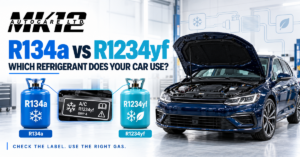
The under-bonnet label normally identifies the refrigerant and charge quantity. Many older vehicles use R134a, while newer models may use R1234yf or another approved gas. Registration year is only a guide.
The garage should check the label or manufacturer data before connecting equipment. Mixing refrigerants can contaminate the vehicle and recovery machine. Correct identification is more important than choosing the lowest advertised recharge price.
Recovering Existing Refrigerant
The service machine removes refrigerant from the circuit and records the recovered mass. Qualified recovery prevents controlled gas from being released into the atmosphere and provides useful information about how much was present.
If the contents appear contaminated or the service history is suspicious, the garage may need refrigerant identification and separate recovery equipment. Pulling an unknown mixture into a clean machine can affect other vehicles.
Vacuum and System Checks
Once recovery is complete, the machine draws the system into vacuum. This helps remove air and moisture, both of which interfere with cooling and can contribute to corrosion or abnormal pressure.
The machine usually monitors vacuum stability for a defined period. If it cannot hold, the technician should pause and investigate rather than charging a clearly leaking circuit.
Recharging to the Correct Quantity
The specified refrigerant mass is added using calibrated equipment. More is not better. Overcharging can raise pressure and reduce performance, while undercharging limits cooling and may affect oil circulation.
Where required, the correct lubricant type and measured quantity are used. Different refrigerants and compressor technologies can need different oils. Universal guesswork has no place in a modern air-conditioning system.
Final Cooling-Performance Test
After charging, the technician runs the system and checks vent temperature, pressure behaviour, compressor control and fan operation. The result is considered against ambient conditions and vehicle design.
If cooling remains poor with the correct charge, further diagnosis is required. The regas has established a known baseline, but it has not proved that the compressor, valve, condenser or electronic controls are healthy.
What a Standard Regas Does Not Include
A regas is a defined service, not a cure for every fault. Repairs, parts and extended diagnosis cost separately.
Ask what happens if the system is empty, leaking or still warm after charging.
Leak Repair
A regas may reveal that refrigerant was low, but it does not repair the escape route. Replacing a seal, pipe, condenser or evaporator requires parts and additional labour. The system must then be evacuated and recharged again.
Some advertised services include a basic check, but detailed leak detection may cost extra. Confirm the method and whether any diagnostic charge is credited towards authorised repair.
Compressor or Condenser Replacement
Replacing a compressor or condenser involves refrigerant recovery, component access, new seals and often additional system work. Internal compressor failure may require debris removal, a receiver-drier or other parts.
These repairs cannot be included in a basic cheap air con regas price. The garage should provide an itemised quote once it has confirmed the failed component and contamination risk.
Blower-Motor and Cabin-Airflow Repair
The regas machine works on the refrigerant circuit, not the cabin blower. A failed blower motor, resistor, control unit or air-distribution flap needs electrical or dashboard-area repair.
Cabin-filter replacement may be offered separately or included in a broader service package. Ask rather than assume. A new filter can improve airflow and smell, but it will not correct low refrigerant.
Electrical Fault Diagnosis Beyond the Service Scope
Basic operational checks may be included, while in-depth diagnosis usually is not. Tracing an intermittent wire, testing a module or checking network communication can take significant technician time.
If the system has warning messages or no compressor command, request car diagnostics as well as an air-conditioning check. The quote should separate diagnostic labour from any approved repair.
Regas Cost vs Repair Cost
A recharge is predictable. Repair cost depends on refrigerant, fault location, parts and access, so diagnosis may be needed before quoting.
When comparing car air conditioning repair Milton Keynes cost, check scope as well as price. Good diagnosis can prevent unnecessary work.
Refrigerant Type and Quantity
R134a and R1234yf have different costs and require compatible equipment. Vehicles also use different charge quantities. A large system may therefore cost more to recharge than a smaller one using the same gas.
Ask the garage to confirm the refrigerant from the vehicle label. A generic headline price may apply only to R134a or include refrigerant up to a specified amount.
Diagnostic Labor
Straightforward testing can identify an obvious fault quickly. Intermittent electrical problems or hidden leaks may require several stages of diagnosis, road testing, or partial access to components.
Paying for diagnosis is not paying for “nothing.” It funds the technician’s time and equipment to reach an evidence-based conclusion. A clear report should explain what was tested and what needs to happen next.
Parts, Access and System Contamination
A front-mounted condenser may be easier to replace on one car than another. An evaporator hidden behind the dashboard can involve extensive dismantling. Parts quality, seals, lubricant and recharge work also affect the total.
If a compressor has broken internally, metal contamination can spread through the circuit. Replacing only the compressor may lead to another failure. The quote should cover the full corrective procedure recommended for that vehicle.
Why the Cheapest Recharge May Not Be the Best Value
The cheapest service may omit recovery, correct weighing, meaningful checks or post-charge testing. It may also cover a different refrigerant from the one your car uses. Price matters, but service scope matters more.
Look for clear compatibility checks, qualified handling and an honest policy when faults appear. Paying once for the correct diagnosis is usually cheaper than repeating low-cost refills on a leaking system.
Air-Con Service at MK12 Autocare
Drivers searching for aircon regassing near me can contact MK12 Autocare in Stacey Bushes for published R134a support and diagnostics.
Provide the registration, refrigerant label, symptoms and service history so the team can identify the right appointment.
R134a Service Scope
MK12 Autocare lists R134a regas support for compatible vehicles. A typical service may involve refrigerant recovery, evacuation, recharge to specification and a final performance check, subject to the garage’s current terms.
Confirm the current price and exact inclusions when booking. If the system has a known leak, compressor noise or no airflow, say so in advance. That allows the garage to allocate the right appointment type.
Compatibility and Exclusions
Not every vehicle uses R134a. Check the under-bonnet label because age alone cannot confirm compatibility. R1234yf systems require the correct dedicated equipment and should never be filled with R134a.
Leak repair, electrical diagnosis and component replacement may fall outside a standard regas. Ask for an itemised quote before authorising extra work. This keeps the difference between recharge and repair clear.
Booking at Stacey Bushes, Milton Keynes
MK12 Autocare is located at 27 Heathfield, Stacey Bushes, Milton Keynes, MK12 6HP. You can call +44 1908 22 77 94 or visit MK12 Autocare to request an appointment.
When booking, mention whether cooling is weak, absent, noisy or short-lived after a previous regas. You can also review the garage’s vehicle diagnostics service if the fault appears electrical or requires broader testing.
Test the Cause Before Recharging Again
A car aircon regas can restore cooling when the refrigerant charge is low and the system is otherwise healthy. It cannot repair a leak, failed compressor, damaged condenser, broken fan, restricted blower or electrical fault. The same warm-air symptom can come from very different causes.
Pay attention to the pattern. Gradual weakening may justify a refrigerant and performance check. Cooling that disappears soon after a recharge, severe noise, no airflow or visible damage points towards repair diagnosis. Tell the garage exactly what you have noticed and avoid repeated DIY top-ups.
For air-conditioning help in MK12 Milton Keynes, contact MK12 Autocare with your vehicle details and refrigerant label. Confirm compatibility, service scope and current pricing before the visit. Testing the cause first gives you a better chance of paying for the right solution once.
Frequently Asked Questions
Q1: Can a car pass its MOT with faulty air conditioning?
Air conditioning is not tested as a separate MOT item, so a car can generally pass with an A/C system that does not produce cold air. The MOT still checks relevant safety and visibility items under its official inspection criteria.
A fault that affects windscreen visibility or another tested component can still matter. Do not treat an MOT pass as confirmation that the climate-control system is working correctly.
Q2: Why is there a bad smell when the air-con starts?
Moisture on the evaporator can support bacteria or mould, producing a damp smell when the blower starts. A dirty cabin filter, blocked drain or debris in the ventilation system can add to the problem.
Filter replacement and appropriate evaporator cleaning may help. A burning or electrical smell needs prompt investigation rather than deodorising because it may indicate an overheating motor or wiring fault.
Q3: Does a regas include cabin-filter replacement?
Usually not. A standard air con regas deals with the refrigerant circuit, while the cabin filter belongs to the airflow and routine maintenance system. Some garages offer a combined package, but you should confirm the scope.
If airflow is weak, ask the technician to inspect the filter. Replacing it can improve ventilation, although it will not fix a leak, compressor fault or incorrect refrigerant charge.
Q4: Can air conditioning affect fuel consumption?
Yes. The compressor needs energy, so using air conditioning can increase fuel or electrical consumption. The effect varies with vehicle, temperature, speed, system design and how hard the compressor must work.
That does not mean you should avoid it completely. Air conditioning supports comfort and demisting. Using recirculation after the hot cabin air has escaped can reduce the load during very warm weather.
Q5: Why does the air-con work only while driving?
Road speed pushes more air through the condenser. If cooling is good while moving but poor in traffic, a failed cooling fan, blocked condenser or high-pressure issue may be involved.
Low refrigerant can create inconsistent cooling too, so the pattern is not proof of one fault. Ask for fan operation, pressure and condenser airflow to be tested before approving a regas.
Q6: Can the air-con system lose gas during winter?
Yes. A leak does not stop because the weather is cold. Seals, hoses, service valves and damaged components can release refrigerant at any time, even if you do not notice until summer.
Run the system periodically when the manufacturer permits. This helps circulate lubricant and keeps you aware of changes, but it cannot prevent every leak or repair damaged seals.
Q7: Is it safe to keep using the system if the compressor is noisy?
It is safer to switch the air conditioning off and arrange inspection. Grinding, harsh rattling or new clicking may indicate compressor, clutch, pulley or bearing trouble.
Continued operation can worsen damage and spread debris through the system. A car air conditioning repair specialist should identify the source before the system is used again.
Q8: How can I maintain the air-con between services?
Use the system regularly, keep the condenser area free from obvious debris and replace the cabin filter according to the vehicle’s maintenance schedule. Notice changes in cooling, noise, smell and airflow early.
Book a professional check if performance declines or refrigerant loss repeats. If you are searching for mobile aircon regas Milton Keynes or garage-based support, confirm the refrigerant type, technician capability and included tests before choosing on price alone.