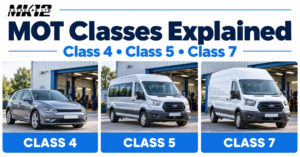

You know your vehicle needs an MOT. But when the booking form asks for a class, what do you choose? A family car is straightforward. A van, minibus, converted camper or heavy electric goods vehicle can make the choice less obvious. Booking the wrong test may mean your MOT test centre cannot examine the vehicle on the day.
The short answer is that MOT classes depend on the vehicle’s type and use, its number of passenger seats and, for many goods vehicles, its design gross weight. Most ordinary cars are Class 4. Certain private passenger vehicles with 13 or more passenger seats are Class 5. Conventional goods vehicles over 3,000kg and up to 3,500kg design gross weight are normally Class 7. A 2026 rule also brings qualifying zero-emission goods vehicles from 3,501kg to 4,250kg into Class 7. DVSA MOT testing guide
This is a guide to the class, not a substitute for checking the registration and vehicle documentation. Some taxis, pickups, motor caravans, passenger vehicles and seatbelt arrangements need a closer look. If anything is unclear, send the details to the test centre before selecting an appointment. It is easier to sort out the category in a conversation than in the MOT bay while another booking is waiting.
What Is an MOT Vehicle Class?
An MOT class determines the test, station approval and equipment a vehicle needs. This guide focuses on the Class 4, 5 and 7 tests advertised by MK12 Autocare, not motorcycles or public service vehicle tests.
How the DVSA Groups Vehicles
For Class 4, the guidance includes ordinary cars, some passenger vehicles, motor caravans and goods vehicles not exceeding 3,000kg design gross weight. Class 5 concerns qualifying private passenger vehicles, ambulances and motor caravans with 13 or more passenger seats. Class 7 principally concerns goods vehicles in the specified heavier weight range. DVSA class definitions
Notice that “van” or “minibus” is not a complete class description. A van can fall either side of the 3,000kg goods-vehicle threshold. A minibus with 9 to 12 passenger seats can be Class 4, while one with 13 to 16 may be Class 5 if its use and seatbelt arrangements fit that class.
Why MOT Classes Affect Test Equipment and Fees
An approved MOT test station must be authorised and equipped for the class it tests. A bay suitable for an ordinary car does not automatically have the lifting, clearance or brake-testing capacity for a larger passenger vehicle or a heavier van. Some specialist seatbelt installation checks have further station requirements.
The maximum test fee also varies. GOV.UK currently lists £54.85 as the maximum for an ordinary Class 4 car and £58.60 for Class 7. Class 5 has different maximums according to passenger capacity and whether a Class 5a seatbelt installation check is required. A garage may charge below the maximum, but the correct category must come first. GOV.UK MOT fee table
MOT Class vs Driving-Licence Category
Your driving licence category answers a different question: what you are entitled to drive. The MOT class determines how that particular vehicle is tested. A category B licence is not another name for a Class 4 MOT, and an entitlement to drive a van does not tell you whether its MOT is Class 4 or Class 7.
The distinction matters for heavier electric vehicles. Government guidance permits certain zero-emission vehicles up to 4,250kg maximum authorised mass to be driven on a category B licence, subject to its rules. A qualifying zero-emission goods vehicle in the 3,501kg-to-4,250kg range needs a Class 7 MOT under the separate testing rule. Check both obligations independently. Driving a zero-emission vehicle | DVSA MOT class update
What Is a Class 4 MOT?
A Class 4 MOT covers ordinary cars and several other vehicle types, including qualifying 9-to-12-passenger-seat vehicles and goods vehicles not exceeding 3,000kg DGW. Check the specific subtype because fees and first-test timing can differ. DVSA Class 4 guidance | GOV.UK fee categories
Cars and Taxis
Your typical hatchback, saloon, SUV or family estate with up to eight passenger seats will normally need a Class 4 MOT. The first test for an ordinary new car is generally due by the third anniversary of registration, followed by annual testing. Check the actual due date for the registration before you book.
Taxis may also be in Class 4, but they can have different first-test timing and additional local licensing requirements. Do not assume a taxi follows every rule that applies to a private family car. Ask the operator or local licensing authority about any separate vehicle checks.
Passenger Vehicles with Up to 12 Passenger Seats
Seat counts in the MOT guidance mean passenger seats, excluding the driver’s seat. An ordinary car with eight passenger seats and one driver remains within the basic Class 4 description. Certain private passenger vehicles, ambulances and motor caravans with 9 to 12 passenger seats are also Class 4, subject to the relevant seatbelt conditions.
This is the source of a common booking mistake. Someone sees more than eight passenger seats and selects Class 5 MOT, although the particular 9-to-12-passenger-seat vehicle may still require Class 4 or Class 4a. GOV.UK lists a different maximum fee for that Class 4 passenger-vehicle group, so confirm the precise test with the garage. DVSA vehicle classes
Goods Vehicles Not Exceeding 3,000kg DGW
A goods vehicle with a design gross weight, or DGW, of no more than 3,000kg is generally Class 4. This can include a small panel van or car-derived goods vehicle. The threshold is the manufacturer’s rated maximum operating weight, not what the van happens to weigh empty on test day.
If your work van is plated at exactly 3,000kg DGW, it sits on the Class 4 side of the ordinary goods-vehicle dividing line. If it is plated above 3,000kg, check whether the conventional Class 7 range applies. Do not infer the number from the size of the cargo space.
Motor Caravans and Dual-Purpose Vehicles
Motor caravans and qualifying dual-purpose vehicles can also be Class 4. A camper conversion does not automatically become a Class 7 goods vehicle simply because it is built on a large van body. Its classification and recorded use need to be checked.
Pickups are another area where a neat one-line rule can mislead. DVSA guidance contains specific provisions for certain 4×4 pickups, crew cabs and American pickups. If you drive a converted or imported vehicle, provide the documents and plate details to a competent MOT station rather than selecting the class from its appearance. DVSA MOT testing guide
When a Seatbelt Installation Check May Affect the Class
Class 4a is a Class 4 test with an additional check of certain seatbelt installations. It can apply to vehicles with 9 to 12 passenger seats when the fitted belt arrangement meets the specific DVSA conditions, including cases where more belts than the minimum were installed without the relevant type approval or previous qualifying check.
Do not assume every vehicle with extra seats needs Class 4a. The history and approval of the installation matter. DVSA says a Class 4a test may only be carried out at a Class 5 test station. Explain any seat conversion or added belt to the centre before booking. DVSA Class 4a rules
What Is a Class 5 MOT?
A Class 5 MOT applies to qualifying private passenger vehicles, ambulances and motor caravans with 13 or more passenger seats. Use, seatbelts and possible public service vehicle rules can change the route. DVSA Class 5 definition
Private Passenger Vehicles and Ambulances
DVSA’s Class 5 description includes private passenger vehicles, ambulances and motor caravans with at least 13 passenger seats that meet its belt-installation conditions. These are passenger-carrying categories. A heavy goods van cannot become Class 5 because it has a high roof or a second row of seats.
Some vehicle types have their first test after one year rather than the three-year rule many car owners know. Check the government’s fee and first-test table against your registration, especially when a vehicle has changed use or entered a passenger fleet. GOV.UK MOT costs and first-test timing
Vehicles with 13 to 16 Passenger Seats
A private minibus with 13 to 16 passenger seats may be Class 5, assuming it meets the conditions for that class and is not subject to a different public service vehicle testing route. Count the seats designed for passengers, not the driver. An advertised “16-seater” can be ambiguous, so confirm what the label includes.
The official maximum standard Class 5 fee for the 13-to-16-passenger-seat group is currently £59.55. This is not necessarily the test centre’s actual price. It is also different from the Class 5a maximum if an additional seatbelt installation check is required. GOV.UK fee table
Vehicles with More Than 16 Passenger Seats and Playbuses
The Class 5 category also includes qualifying private passenger vehicles and ambulances with more than 16 passenger seats. GOV.UK lists playbuses in the corresponding fee group. Do not assume an ordinary Class 5 price for a 14-passenger-seat vehicle automatically applies to a larger one.
For more than 16 passenger seats, the current maximum standard Class 5 MOT fee is £80.65. The type of operation remains important: some public service vehicles are tested by DVSA under Class 6 or 6a, outside the normal Class 5 route discussed here. GOV.UK fees | DVSA Class 6 distinction
Class 5a Seatbelt Installation Checks
Class 5a adds a check on the installation of certain seatbelts to the normal Class 5 test. It can apply where more belts than the construction minimum are fitted and the vehicle lacks the specified original type-approval or previous qualifying belt-installation test record.
This is an installation question, not a request for a more thorough general MOT. The official maximum fee is currently £80.50 for the 13-to-16-passenger-seat Class 5a category and £124.50 for the more-than-16 category. Tell the booking team about added seats or belts and provide supporting documents. DVSA Class 5a conditions | GOV.UK fees
When a Vehicle May Need a Different Testing Route
Not every minibus or bus belongs in Class 5. A 9-to-12-passenger-seat private vehicle can be Class 4 or 4a. A vehicle operated as a public service vehicle can require Class 6 or 6a testing by a different route. Seat count alone does not settle every case.
If you manage a community transport or passenger fleet, confirm the operating use, vehicle registration details and seatbelt history with the relevant testing authority. Do this before paying for a Class 5 appointment, particularly when the vehicle has been converted or its use has changed.
What Is a Class 7 MOT?
A Class 7 MOT generally applies to conventional goods vehicles over 3,000kg and up to 3,500kg DGW, plus qualifying zero-emission goods vehicles over 3,500kg and up to 4,250kg DGW from June 2026. DVSA Class 7 rules
Goods Vehicles Over 3,000kg and Up to 3,500kg DGW
The ordinary goods-vehicle dividing line is precise. At 3,000kg DGW, the vehicle is within the general Class 4 goods category. At more than 3,000kg and up to 3,500kg, a conventional goods vehicle usually needs Class 7. The relevant maximum is based on the vehicle’s design, not today’s load.
Suppose two similar-looking vans arrive at the same workshop. One is rated at 2,800kg and the other at 3,500kg. Their empty weights might seem close, but the first would normally book Class 4 and the second Class 7. The manufacturer’s plate is more reliable than a glance at the bodywork.
Vans, Pickups and Commercial Vehicles
Many larger panel vans and light commercial vehicles fall in Class 7. A pickup used for work may as well, but certain dual-purpose and imported pickups have special classification provisions. “Commercial” in an advertisement is not enough to determine the MOT test class.
Check the registration, recorded body type, plate and use. A specialist conversion can change what information a tester needs to see. If you are searching Class 7 MOT near me, send those details before reserving a bay and avoid losing a workday to a wrong-class booking.
Finding the Design Gross Weight
Design gross weight is the maximum gross weight the manufacturer designed the vehicle to operate at. It normally appears on a manufacturer plate attached to the vehicle. On some older or heavier vehicles there may be a ministry plate; the figures and their hierarchy should be assessed using the official rules. DVSA inspection manual definitions
Do not substitute kerb weight, payload, towing capacity or an empty weighbridge reading. Those numbers answer different questions. Check the handbook and vehicle documents as supporting evidence, then ask the MOT test centre to confirm which plated figure it needs.
Zero-Emission Goods Vehicles Between 3,501kg and 4,250kg
A qualifying zero-emission goods vehicle in this higher DGW range is now Class 7. Its maximum MOT fee is currently £58.60 and the first Class 7 test is required three years after registration. The rule applies to zero-emission goods vehicles, not automatically to a hybrid fitted with a combustion engine. DVSA 2026 notice | GOV.UK fee table
Give the station both DGW and current loaded condition when making an appointment. The DVSA says a test may be declined if the vehicle is presented in a condition or at a weight that prevents safe testing. You may need to unload it before a test can take place.
The Rule Effective from 1 June 2026
The change took effect on 1 June 2026 in England, Scotland and Wales. Previously, a vehicle above the conventional 3,500kg Class 7 ceiling could be routed differently. The revised definition brings qualifying zero-emission goods vehicles up to 4,250kg DGW into the Class 7 system. DVSA special notice 01-26
The word “zero-emission” is doing important work here. DVSA specifically excludes hybrids and range extenders that use an internal-combustion engine for propulsion or to charge the battery. If the drivetrain is unusual, ask the station to check the official classification before booking.
Class 4 vs Class 5 vs Class 7 Comparison
To compare MOT test classes, check vehicle use first, then passenger seats or DGW. Conversions and special cases need confirmation from an authorised tester. DVSA MOT testing guide
| Question | Class 4 | Class 5 | Class 7 |
| Typical use | Cars, smaller goods vehicles, some passenger vehicles and motor caravans | Qualifying private passenger vehicles, ambulances and motor caravans | Goods vehicles in the specified higher DGW bands |
| Passenger seats | Ordinary cars up to 8; qualifying passenger vehicles up to 12 | Generally 13 or more | Not defined by a passenger-seat threshold; goods-vehicle classification is key |
| Conventional goods-vehicle DGW | Not exceeding 3,000kg | Not a general goods-van class | Over 3,000kg up to 3,500kg |
| Qualifying zero-emission goods vehicle | Depends on its class and weight | Not a general goods-van class | Over 3,500kg up to 4,250kg DGW |
| Special seatbelt check | Class 4a in qualifying cases | Class 5a in qualifying cases | Not the Class 4a/5a passenger-vehicle route |
Comparison by Vehicle Use
A family car and a smaller delivery van may both need Class 4 for different reasons. The car belongs to the normal passenger-car group; the goods van’s relevant DGW does not exceed 3,000kg. A larger qualifying goods van moves to Class 7.
Class 5 is for specified private passenger-carrying vehicles and ambulances with 13 or more passenger seats. That is why the common shortcut “Class 5 is the test for big vans” is wrong. Passenger use cannot be replaced by a weight-only guess.
Comparison by Passenger Capacity
For ordinary cars, up to eight passenger seats fits Class 4. Certain passenger vehicles with 9 to 12 passenger seats also fall within Class 4, or Class 4a when the particular seatbelt installation rules apply. Qualifying passenger vehicles with 13 or more passenger seats move into Class 5 or 5a.
Remember that the driver seat is not included in the passenger-seat count. A vehicle advertised as a “nine-seater” may mean eight passengers plus the driver. Confirm the actual configuration and legal category before booking a Class 5 MOT near me appointment.
Comparison by Design Gross Weight
For conventional goods vehicles, 3,000kg DGW is the Class 4 upper limit and 3,500kg DGW is the Class 7 upper limit. A vehicle’s current cargo does not move it between classes. A 3,500kg-rated van remains rated at 3,500kg even with an empty load compartment.
Weight is not a universal single answer for every vehicle. A motor caravan, a dual-purpose pickup or a qualifying passenger vehicle may follow rules beyond the simple goods-van thresholds. The 2026 zero-emission goods-vehicle extension is another specific exception.
Comparison by Test Bay Requirements
The test station must hold approval for the appropriate class and have equipment that can examine the vehicle safely. Check the station’s test classes rather than assuming that every MOT garage with a car bay can take a heavier van or a 16-seat passenger vehicle.
Vehicle height, length and presented weight can also matter in practice. A qualifying electric goods vehicle should be discussed with the station in advance so it can confirm safe access and equipment capacity. Class 4a requires a Class 5 test station under DVSA rules. DVSA MOT station guidance
Examples of Vehicles in Each MOT Class
Similar-looking models can have different rated weights or seating. Check the particular registration; conversions and public service use may change the simple examples below.
Family Car and Small Car-Derived Van
A five-seat family hatchback will ordinarily be Class 4. So can a car-derived goods van with a DGW below 3,000kg. The car and van take the same broad MOT class for different reasons: the passenger-car definition for one and goods-vehicle weight for the other.
Neither needs a Class 7 test merely because it is used for business. Business use can bring other maintenance or insurance considerations, but it does not automatically change a 2,800kg-rated goods van into a Class 7 vehicle.
Private Minibus and Passenger Transport Vehicle
A private minibus designed to carry 10 passengers plus a driver may be Class 4, subject to its seatbelt arrangements. A similar private vehicle with 15 passenger seats is generally Class 5 if it meets the Class 5 conditions. The difference is the passenger count and legal type, not which vehicle looks larger in a car park.
If a minibus is operated as a public service vehicle, stop at this point and check whether the Class 6 or 6a route applies. The booking form for an ordinary Class 5 MOT should not be used as a substitute for classifying the operation properly.
Commercial Van and Heavy Pickup
Imagine a goods van plated at 3,200kg DGW. It falls above the 3,000kg Class 4 limit and within the conventional Class 7 range. Another van of the same model plated at 2,900kg will generally be Class 4. Compare the plates, not the paintwork.
A heavy pickup can be less straightforward because some 4×4, crew-cab and imported pickups can be treated as dual-purpose vehicles under special DVSA provisions. Send the registration, plate photograph and body description to the test centre if the classification is uncertain.
Electric Commercial Van Above 3,500kg
Consider a zero-emission goods van with a DGW of 4,000kg. It is within the special Class 7 range introduced from 1 June 2026. Its additional battery weight may explain why it is above the conventional 3,500kg ceiling while having a similar commercial role.
Now change the example to a hybrid van with a combustion-engine range extender and the same DGW. It does not qualify for the zero-emission Class 7 extension just because it can run electrically. The station must check the appropriate testing route under the vehicle’s actual specifications. DVSA 2026 notice
How to Check Your Vehicle’s MOT Class
Use the registration, documents, manufacturer plate, seats and actual use. If they conflict, ask the test centre before booking. DVSA MOT testing guide
Check the V5C Registration Document.
Review the V5C for registration, recorded body type and other vehicle particulars. It is a useful starting document, especially if you bought the vehicle used and do not know its conversion history.
Do not treat a generic description such as “van” as the sole answer. You may need to compare it with the plated DGW, passenger-seat count and vehicle use. Where the record does not match the actual vehicle, ask the relevant authority or test station how to resolve it.
Locate the Manufacturer Weight Plate
The manufacturer plate is commonly fixed in a door aperture, engine compartment or another location specified in the handbook. It shows identification and rated weights. Find the maximum designed gross weight, not the axle limit or the combined train weight for towing.
DGW is the manufacturer’s maximum operating weight and normally appears on that plate. Some vehicles have a ministry plate whose figures may supersede the manufacturer plate for relevant purposes. Photograph the whole plate so the test centre can interpret the numbers in context. DVSA definitions
Count Passenger Seats Correctly
Count the seats intended for passengers and leave out the driver’s seat. Check the installed and approved seating arrangement, including any conversion history. A folded or removable seat should not be casually ignored when determining what the vehicle is designed to carry.
For bench seating, official guidance has a method for assessing passenger capacity. If the configuration is unusual, send clear interior photos and documents rather than estimating how many people would fit. Seatbelt installation history may affect whether Class 4a or 5a is needed. DVSA seating guidance
Ask the Test Centre Before Booking
Provide the registration, make and model, use, number of passenger seats, DGW and details of any conversion. For an electric goods vehicle, specify whether it is fully zero-emission and whether the rated weight exceeds 3,500kg.
Ask the MOT test station to confirm the class and that its bay can safely accept your vehicle. If you need a Class 4a or 5a seatbelt installation check, say so explicitly. A clear answer now protects your appointment time later.
What Happens If You Book the Wrong MOT Class?
A wrong-class booking can delay the test. Online forms may miss conversions, heavy electric vehicles and unusual pickups; confirm these manually before paying.
Test Centre Authorisation and Equipment
An MOT test centre needs approval to test the relevant class. Its bay also needs to be appropriate for the vehicle presented. A garage equipped for Class 4 cars should not be assumed to handle a Class 7 van or Class 5 passenger vehicle.
DVSA publishes a list of active stations with the classes they test. It is updated periodically, so confirm the current position and your particular vehicle with the station directly. DVSA active station list
Rebooking and Vehicle Downtime
If the station cannot perform the intended test, you may need to rebook an approved bay elsewhere. That can be disruptive when the MOT is close to expiry or a van is needed for work.
Allow time to correct a classification question well before the due date. A work vehicle with an incorrect booking can create avoidable downtime even when it needs no repairs. Fleet managers should record each vehicle’s class alongside its registration and expiry date.
Avoiding Incorrect Online Selection
Read the class label and vehicle description, not just the booking price. When the form offers separate Class 4 MOT, Class 5 MOT and Class 7 MOT products, select only after checking the plate and seat count.
If the booking choices do not cover Class 4a, 5a or an unusual electric van clearly, call first. Ask whether the workshop can carry out the required test and whether it needs photographs or documents before accepting the appointment.
MOT Testing for Different Vehicle Classes at MK12 Autocare
MK12 Autocare advertises Class 4, Class 5 and Class 7 tests in Stacey Bushes. Confirm unusual vehicles and any 4a or 5a requirement directly. MK12 Autocare services
Class 4 Testing
For most ordinary cars in MK12 Milton Keynes, Class 4 is the familiar annual test. Certain lighter goods vehicles and smaller private passenger vehicles also fall within this category, subject to their particular class rules.
When booking through MK12 Autocare, share the registration and mention any conversion or extra passenger seating. That helps distinguish a standard car from a 9-to-12-passenger-seat vehicle whose fees and belt requirements may differ.
Class 5 Testing
The workshop advertises Class 5 testing for relevant larger private passenger vehicles. Before reserving a slot, confirm the passenger count, operating use, belt-installation history and whether an ordinary Class 5 or Class 5a check is required.
One price detail needs clarification: the MK12 website currently displays £59.99 as a flat Class 5 product price, while GOV.UK lists a £59.55 maximum for an ordinary 13-to-16-passenger-seat Class 5 MOT. Ask the garage to confirm the lawful, vehicle-specific fee before payment; a larger Class 5 vehicle or Class 5a test has a different ceiling. MK12 Class 5 | GOV.UK MOT fees
Class 7 Testing
MK12 Autocare advertises Class 7 MOT testing for qualifying goods vehicles. If you use a 3,500kg-rated work van, share the manufacturer plate details when booking. If it is a zero-emission goods vehicle rated above 3,500kg, describe the vehicle and load so the station can confirm safe testing arrangements.
The Class 7 MOT currently lists £58.60, matching the government maximum. Prices should still be checked at booking. Any servicing or repairs are separate from the regulated test unless a clear package says otherwise.
Booking from Stacey Bushes and Wolverton
Drivers in Stacey Bushes, Wolverton, Neath Hill and nearby Milton Keynes areas can contact the workshop at 01908 227794 or use its online booking options. Send the registration and class information before selecting a time if the vehicle is not an ordinary car.
If you want to arrange an MOT and service during one visit, say so separately. The MOT class determines the inspection booked; the servicing package covers maintenance. Keeping them distinct makes the work and total price easier to understand.
Conclusion
Most ordinary cars need Class 4. Qualifying private passenger vehicles with 13 or more passenger seats generally need Class 5, while a conventional goods vehicle over 3,000kg and up to 3,500kg DGW generally needs Class 7. A private passenger vehicle with 9 to 12 passenger seats can still be Class 4. Since 1 June 2026, qualifying zero-emission goods vehicles over 3,500kg and up to 4,250kg DGW also use Class 7.
These rules are a useful map, not a reason to guess. Check the V5C, manufacturer plate, seat count, seatbelt history and how the vehicle is used. Then ask an approved MOT station to confirm the test it can carry out. If you are booking in MK12, provide those details to MK12 Autocare before choosing a Class 4, 5 or 7 appointment.
Frequently Asked Questions
Q1: Is every van a Class 7 vehicle?
No. A conventional goods van not exceeding 3,000kg design gross weight is generally Class 4. A conventional goods van above 3,000kg and up to 3,500kg is generally Class 7. A van’s body size or work use does not settle the question; check the plated DGW. Other special vehicle classifications can need further assessment. DVSA class definitions
Q2: Is a minibus always Class 5?
No. A qualifying private passenger vehicle with 9 to 12 passenger seats may be Class 4 or 4a. Class 5 or 5a generally applies from 13 passenger seats under the relevant conditions. A public service vehicle may need Class 6 or 6a instead. Count passenger seats excluding the driver and check the vehicle’s operating use.
Q3: Does vehicle weight determine the MOT class for every vehicle?
No. Rated weight is central to the Class 4 and 7 distinction for many goods vehicles, but passenger capacity and use matter for Class 4 and 5 passenger vehicles. Motor caravans, dual-purpose vehicles and certain pickups have more specific rules. Do not apply the 3,000kg goods-van threshold to every vehicle body type.
Q4: Where can I find my van’s design gross weight?
Look for the manufacturer weight plate, often in a door opening or under the bonnet. Your handbook and registration documents can help identify the vehicle, but make sure you read the maximum vehicle weight rather than the axle or train weight. Ask the test centre to interpret the plate if it is unclear.
Q5: What is the difference between Class 5 and Class 5a?
Class 5a is the standard Class 5 test plus an installation check for certain seatbelts. It applies when the vehicle meets specific DVSA conditions concerning additional belts and their approval or prior testing. Not every minibus with belts requires Class 5a. Share its seating and conversion history when booking. DVSA guidance
Q6: Can a Class 4 MOT station test a Class 7 vehicle?
Only if it is also authorised and equipped for Class 7. Approval for Class 4 alone is not enough. Check the station’s listed classes and confirm the particular vehicle’s dimensions and presented weight directly with the garage. DVSA active station list
Q7: Are electric vans tested under different MOT rules?
The important 2026 classification change concerns zero-emission goods vehicles over 3,500kg and up to 4,250kg DGW. They became Class 7 on 1 June 2026. A smaller electric van still needs classification according to its actual vehicle details. Hybrids are excluded from that specific higher-weight zero-emission extension. DVSA notice
Q8: Can MK12 Autocare confirm my vehicle class before booking?
Contact MK12 Autocare with the registration, passenger-seat count, vehicle use, DGW and any conversion details and ask its booking team to confirm the correct available test. You can call 01908 227794 or review the workshop’s services. For a 4a, 5a or unusual electric vehicle, ask directly whether the required test can be conducted.